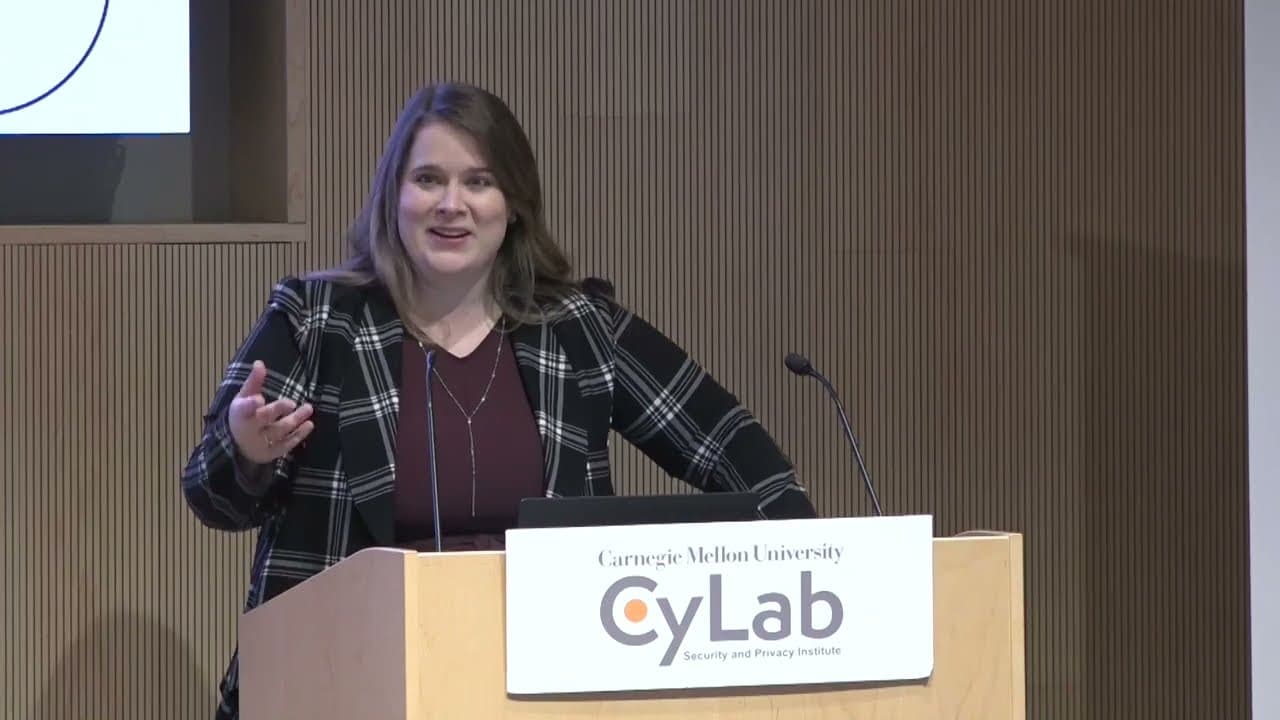
Carole House
Carole House is a cybersecurity and digital policy expert whose career has focused on national security, financial crime, emerging technologies, and digital asset policy. She has held leadership positions across the U.S. government, academia, nonprofit organizations, and industry, with work spanning cybersecurity strategy, financial regulation, distributed ledger technologies, and the intersection of technology and national security. [5]
Education
House graduated from the University of Georgia with a BA in International Affairs in 2010. She later attended Georgetown University, where she earned her MA in Security Studies in 2016. [1]
Career
House began her career in the U.S. Army, serving in a variety of intelligence and operations roles between 2011 and 2014. Her assignments included positions with the 4th Stryker Brigade Combat Team and the 45th Military Intelligence Company, where she worked on operational planning, intelligence collection management, surveillance and reconnaissance coordination, and military readiness. She also served in Afghanistan in support of Operation Enduring Freedom.
Following her military service, House worked as a researcher at Eastern Foundry while pursuing graduate studies in security and national security policy at Georgetown University. In 2016, she joined the Office of Management and Budget as a Presidential Management Fellow, contributing to cybersecurity policy development and oversight of federal cybersecurity programs. During the fellowship, she completed rotations with the U.S. Treasury Department’s Financial Crimes Enforcement Network (FinCEN) and the U.S. Senate Committee on Homeland Security and Governmental Affairs, where she advised on cybersecurity, emerging technologies, supply chain security, and financial crime issues.
In 2018, House joined FinCEN as a Senior Cyber and Emerging Technology Policy Officer. Her work focused on cybersecurity, digital assets, financial crime, and emerging technology policy. In April 2021, she was appointed Director of Cybersecurity and Secure Digital Innovation at the National Security Council, where she worked on cybersecurity strategy and technology policy. She later returned to the National Security Council as Special Advisor for Cybersecurity and Critical Infrastructure Policy from June 2024 to January 2025.
Alongside her government service, House has held a number of advisory, research, and policy positions. She served as Executive-in-Residence at Terranet Ventures from 2022 to 2024, worked as a Senior Research Scholar at Georgetown University's Center for Security and Emerging Technology, and joined the Atlantic Council as a nonresident senior fellow, focusing on the geopolitical, economic, and security implications of emerging financial technologies. She has also served on advisory bodies including the New York State Department of Financial Services Virtual Currency Advisory Board, the Idaho Department of Finance Emerging Technology Advisory Committee, the Digital Dollar Project Advisory Board, and Third Way’s U.S.-China Digital World Order Initiative.
From 2023 to 2025, House served as Chair of the Technology Advisory Committee of the U.S. Commodity Futures Trading Commission (CFTC), advising the commission on emerging technologies, cybersecurity, decentralized finance, and related policy issues. During her tenure, the committee produced reports examining decentralized finance and the use of artificial intelligence in financial markets.
In September 2025, House became a Distinguished Senior Fellow at ACAMS, supporting initiatives focused on fraud prevention, anti-financial-crime programs, regulatory compliance, and the implications of emerging technologies for the financial sector. Throughout her career, her work has centered on cybersecurity, digital assets, financial systems, and technology governance across both public
Presentations
Identity, Security, & Accountability
At the 2024 Carnegie Mellon University Secure Blockchain Summit in May, House presented the critical need to evolve standards for identity, security, and accountability to make blockchain ecosystems more trustworthy. She highlighted the technological and regulatory tensions, particularly between the tech-focused development community and regulators seeking to implement financial controls. House discussed the importance of robust identity verification and continuous monitoring, noting that current systems are rife with synthetic identities and a lack of accountability. She also addressed privacy concerns, advocating for privacy-enhancing technologies over complete anonymity, and stressed the importance of security protocols, standards for threat-indicator sharing, and robust governance frameworks. House underscored the overarching challenge: decentralization complicates accountability, making it difficult to assign responsibility across diverse entities, such as miners and validators. Finally, she called for increased industry-government collaboration in developing standards, R&D efforts, and enforcement approaches to ensure blockchain's potential is harnessed responsibly and securely, extending beyond financial applications into broader infrastructure and emerging technologies like AI. [6]