Subscribe to wiki
Share wiki
Bookmark
CaseFun
0%
CaseFun
CaseFun is a Web3 gaming platform and no-code toolkit that aims to let token issuers and communities build on-chain engagement mechanics—such as loot-box style “cases,” two-player battles, and risk-based upgrades—while automating prize logic and wallet-based interactions. Public materials emphasize quick configuration, transparency of probabilities, and direct distribution of prizes to participant wallets, with a reference implementation published as an open-source, full-stack TypeScript application. [1] [2]
Overview
CaseFun presents an approach to token-based engagement in which creators configure “cases” (digital containers with variable outcomes) and launch short-form games without writing code. The platform positions its core functions around a no-code builder, duels/battles in which pooled token value determines the winner, and an “upgrade” mechanic that exposes risk/reward trade-offs. The interface emphasizes speed of launch, shareable links to drive participation, and a claim of transparency by displaying odds to users before interaction. [1]
Alongside the product description, the project provides a public repository that implements a working application. The codebase includes backend, frontend, and contracts folders; a REST API; wallet-based authentication; and deployment artifacts. The repository is framed as a “Web3 Gaming Platform” scaffold and demonstration with TypeScript across the stack and Docker-based orchestration. The license is MIT. While the code illustrates intended flows and integrations, it does not publish tokenomics, identify founders, or announce partnerships. [2]
Available materials leave several aspects undefined. The site and repository present feature claims and technical scaffolding but do not specify a supported blockchain list, a native token, audits, governance structures, or a dated project timeline. As a result, the project is best described through its stated aims, visible user flows, and code-level implementation details rather than formal organizational disclosures. [1] [2]
Key Features
CaseFun includes a set of interaction mechanisms that define how tokens are distributed, utilized, and engaged with on the platform. These features introduce structured processes through which users can interact with tokens beyond standard transfer or trading activities. This includes: [1] [4]
- Case Unboxing : Users interact with predefined cases containing tokens from different projects. Outcomes are determined according to predefined probability structures. [1] [4]
- Upgrade Mechanism : The upgrade system enables users to use tokens in exchange for probabilistic outcomes that may result in different assets. The process is based on configurable risk parameters. [1] [4]
- Case Battle : Case battles allow multiple participants to open identical cases within a shared session. Results are compared based on the value of outcomes, and distributions follow predefined rules. [1] [4]
- Participation Systems : The platform includes periodic events and referral-based participation mechanisms. The “Luck Hour” system introduces periodic token-related activity, while the referral system allows users to receive a share of platform-generated fees associated with invited participants. [1] [4]
Architecture
CaseFun is structured as an application layer that integrates token creation, distribution, and interaction mechanisms within a single interface.
The platform allows users to deploy tokens and associate them with configurable case systems. These cases define parameters such as probability, reward distribution, and asset allocation. Interaction mechanisms, including upgrades and competitive formats, operate on predefined logic. Outcomes are determined using probabilistic models supported by cryptographic verification processes.
The system incorporates a non-custodial interaction model, where users retain control of their assets while interacting with platform features. Token flows are structured through platform-defined rules rather than centralized custody. [4]
Ecosystem
The CaseFun ecosystem is centered on token interaction through configurable systems. Users can create tokens and define associated cases, which act as distribution mechanisms. These cases determine how tokens are allocated when interacted with by participants.
Tokens are designed to function within multiple interaction layers, including upgrades, case openings, and competitive participation. [4]
Use Cases
- Enable token issuers to set up gamified distribution events through configurable “cases” that can be shared with their communities.
- Facilitate community duels in which participants stake tokens and the highest aggregated token value wins the pooled pot.
- Provide risk-based “upgrade” mechanics that aim to sustain engagement through transparent probability displays and optional retries.
- Serve as a developer reference for building case-based Web3 games, including authentication, API design, and contract scaffolding. [1] [2]
Tokenomics
The primary token of CaseFun is $CF token. It is used across platform features and may be associated with participation, reward distribution, and governance-related processes. [1] [2]
Utilities
The $CF token is used within the CaseFun ecosystem for multiple functions, including:
- Participation in platform-generated reward distribution mechanisms
- Access to token launch and case-related features
- Interaction with upgrade-based mechanisms within the platform
- Participation in governance-related processes, where applicable. [1]
Allocation
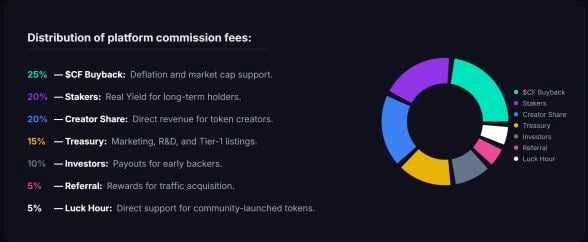
CaseFun plans on allocating platform-generated fees across several functional categories:
- Buyback: 25%
- Stakers: 20%
- Creator Share: 20%
- Treasury: 15%
- Investors: 10%
- Referral Program: 5%
- Luck Hour: 5% [2] [1]
Partnerships
CaseFun has established integrations and collaborations with external blockchain networks and service providers to support its ecosystem and functionality.
- GXChain (REI Network): CaseFun has integrated with GXChain Global’s REI Network, an EVM-compatible blockchain infrastructure. This integration enables interaction with the REI ecosystem, including transaction processing and access to network participants. [3]
- iFlux: CaseFun has collaborated with iFlux Global, a platform that provides transaction solutions designed for large-scale transfers. The integration involves support for structured transaction models, including installment-based execution mechanisms, which are intended to facilitate specific transaction use cases. [3]
The collaboration reflects alignment in infrastructure usage and potential interoperability between the two platforms.. [1] [2]
See something wrong?