Subscribe to wiki
Share wiki
Bookmark
Circle Wrapped Bitcoin
The Agent Tokenization Platform (ATP):Build autonomous agents with the Agent Development Kit (ADK)
0%
Circle Wrapped Bitcoin
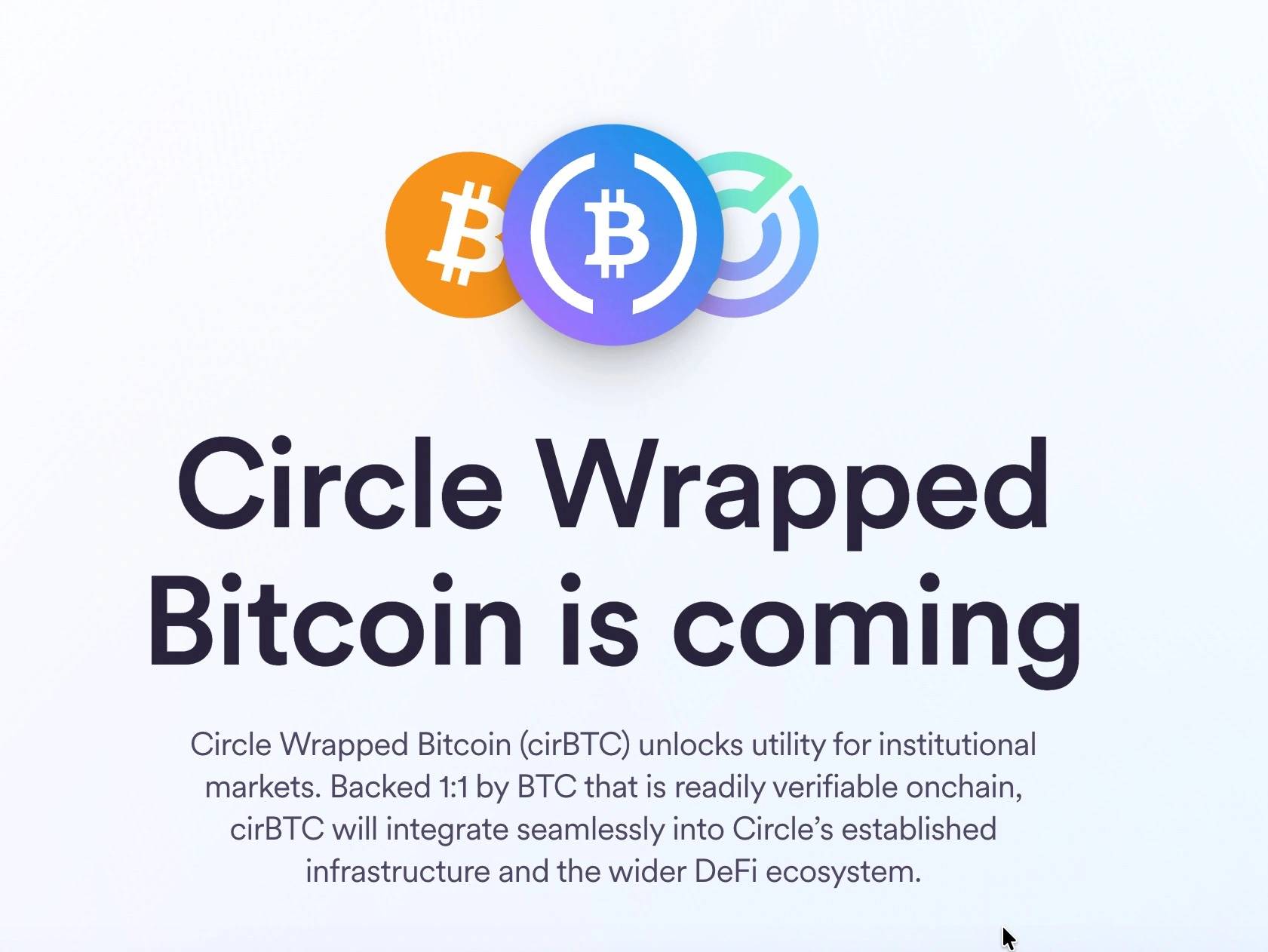
Circle Wrapped Bitcoin (cirBTC) is a wrapped token announced by Circle Internet Financial, designed to be backed 1:1 by Bitcoin (BTC). The token was developed to provide a secure and transparent representation of Bitcoin for use in decentralized finance (DeFi) and other applications on smart contract-enabled blockchains. It is targeted primarily at institutional users, including over-the-counter (OTC) desks, market makers, and lending protocols, who require an institutionally-focused and regulated on-ramp for bringing Bitcoin's liquidity into the broader digital asset ecosystem. [1] [2]
Circle, the issuer of the widely used USDC and EURC stablecoins, positioned cirBTC as a key component of its expanding product suite. The token was designed to be built upon the same audited infrastructure that powers Circle's other digital currency products and to be fully integrated with the Circle Mint platform for issuance and redemption. The initiative represented a strategic re-entry for Circle into the Bitcoin ecosystem, years after the company pivoted away from its earlier Bitcoin-focused services. [3]
History
Circle officially announced its plans to launch Circle Wrapped Bitcoin on April 2, 2026. The announcement was made through the company's official website and social media channels, with Circle's co-founder and CEO, Jeremy Allaire, providing additional context and vision for the project on the social media platform X (formerly Twitter). [3] [4] [5] At the time of the announcement, the product was labeled as "coming soon," with its launch being contingent on receiving applicable regulatory approvals. Circle also established a waitlist for interested institutional parties to register for future access. [1]
The development of cirBTC marked a significant strategic move for Circle, signifying its return to offering Bitcoin-related products. The company had previously operated Circle Pay, a Bitcoin payment application, but discontinued the service in 2019 to concentrate its efforts on developing stablecoins, most notably USDC. The introduction of cirBTC expanded Circle's portfolio beyond stablecoins, adding to its suite of tokenized assets which also includes products like USYC, a tokenized money market fund. [3]
In conjunction with the announcement of the new cirBTC token, Circle undertook a branding consolidation to prevent market confusion. It was reported that the company planned to deprecate and rebrand its pre-existing, distinct wrapped Bitcoin offerings on the Polygon PoS and Solana blockchains to "Bridged USDC (WBTC)," clarifying that these were different from the new, purpose-built cirBTC. [1]
Technical Design and Features
The technical framework for cirBTC was designed to mirror the principles of Circle's established digital currency products, with an emphasis on security, transparency, and institutional-grade infrastructure. [2]
Backing and Reserves
A core feature of cirBTC is its collateralization model. Each cirBTC token is designed to be fully backed 1:1 by native Bitcoin held in reserve. Circle stated that a primary goal was to ensure the reserves are transparently and independently verifiable on-chain in real-time. This commitment to transparency was intended to address concerns present with other wrapped Bitcoin solutions and provide institutional users with greater confidence in the asset's backing. The token's design is based on the same foundational principles that underpin Circle's USDC and EURC stablecoins, which have established track records in the market. [1]
Infrastructure and Issuance
cirBTC is built upon the same audited and battle-tested infrastructure that supports Circle's entire product ecosystem, including its stablecoins and Circle Mint platform. Institutional issuance and redemption of cirBTC are intended to be managed directly through Circle Mint. This platform serves as the primary gateway for qualified institutions to mint new cirBTC by depositing Bitcoin or to redeem cirBTC to receive an equivalent amount of native Bitcoin. [3]
Multichain Functionality
The token was architected from the ground up for a multichain future, enabling cross-chain mobility and utility across various blockchain ecosystems. At the time of its announcement, the planned initial launch chains for cirBTC were Ethereum and Arc. [2]
Arc is a blockchain project incubated by Circle. Sources at the time of the announcement described it with some variation; some identified it as Circle's institutional Layer-2 (L2) network, while others characterized it as an EVM-compatible Layer-1 (L1) blockchain. Regardless of its final classification, Arc's native integration with cirBTC was highlighted as a key part of the strategic vision, creating a dedicated environment for institutional applications utilizing Circle's suite of products. [1] [3]
Ecosystem Integration
A key part of the strategy for cirBTC was its planned native integration into Circle's broader product ecosystem, which the company referred to as a "unified stack" or a "single, end-to-end stack" for institutional clients. This approach aimed to create a seamless and comprehensive toolset for developers and financial institutions operating in the digital asset space. [2]
The ecosystem is designed for native composability between its core components:
- Circle Wrapped Bitcoin (cirBTC): Provides a transparent, institutionally-focused representation of Bitcoin's value and liquidity.
- USDC: Circle's flagship stablecoin, offering a stable unit of account and medium of exchange.
- Arc: The institutional blockchain network (described as both an L1 and L2) designed to support regulated DeFi and other financial applications.
- Circle Mint: The institutional platform for accessing a primary market for minting and redeeming Circle's digital currencies.
By integrating these products, Circle aimed to provide a comprehensive infrastructure where institutions could access tokenized real-world assets, stablecoins, and a high-performance blockchain network through a single, trusted provider. [1]
Market Context
cirBTC was announced in a market with an established leader for tokenized Bitcoin, and its design and marketing were tailored to address specific institutional demands and perceived gaps in the existing landscape. [3]
Strategic Purpose and Target Audience
The primary strategic goal for cirBTC is to unlock Bitcoin's vast liquidity for use in the world of smart contracts. By creating a trusted and transparent wrapped asset, Circle aims to facilitate the use of Bitcoin in DeFi protocols, lending markets, derivatives trading, and other on-chain applications. The project's stated goal was to create a "neutral infrastructure for new applications for on-chain Bitcoin." [2]
The token is explicitly designed as an "institutional-grade global standard" for entities that require high levels of security and regulatory compliance. Circle identified its target audience as:
- Over-the-Counter (OTC) desks
- Market makers
- Lending protocols
- Other institutions seeking what Circle described as "institutional peace of mind" when engaging with tokenized Bitcoin. [1]
Competitive Landscape
cirBTC entered the market as a direct competitor to Wrapped Bitcoin (WBTC), which was the dominant wrapped Bitcoin product at the time of the announcement. WBTC, launched in 2019, had deep liquidity and was integrated into hundreds of DeFi protocols across multiple chains. [2]
Circle's value proposition against WBTC centered on its structure and governance. The WBTC model involves a decentralized autonomous organization (DAO) for governance and relies on third-party custodians, such as BitGo, to hold the underlying Bitcoin. In contrast, the cirBTC model is more centralized, with Circle acting as both the issuer and the custodian of the underlying assets. While this introduces counterparty risk tied to Circle, it also offers a more direct, streamlined, and institutionally familiar model. Some market participants had raised concerns about the governance of the WBTC DAO, particularly regarding the influence of certain member entities, which provided an opportunity for Circle to market cirBTC as a more "neutral" alternative. [3]
Another notable product mentioned in the competitive landscape was Coinbase Wrapped Staked ETH (cbETH), a wrapped product from Coinbase, a long-time partner of Circle in the co-founding of the Centre Consortium for USDC. This highlighted a trend among major, regulated crypto-native firms to issue their own wrapped and tokenized assets.
Key Figures
Jeremy Allaire, the co-founder, Chairman, and CEO of Circle, was the primary public figure behind the announcement of cirBTC. He utilized his social media presence to outline the vision for the product, emphasizing its institutional focus and its foundation in the same principles of trust and transparency that guided the development of USDC. His public statements framed cirBTC as a crucial piece of infrastructure for the future of on-chain finance. [2] [5]
Public Statements
Upon announcing the project, both Circle and its CEO made several key statements to frame the purpose and design of cirBTC.
In its official announcement, Circle described the new token's ambition:
"Introducing Circle Wrapped Bitcoin (#cirBTC). An institutional-grade global standard for wrapped bitcoin, securely and transparently backed 1:1 by bitcoin." [4]
Jeremy Allaire elaborated on the design principles and target market in a thread on X:
"cirBTC builds on the same design principles as USDC & EURC, and aims to provide institutional peace of mind by being a highly secure, high-performance, and a truly neutral version of wrapped BTC." [5] [3]
Potential Challenges and Criticisms
At the time of its announcement, analysts and market observers identified several potential challenges and inherent trade-offs associated with the cirBTC model.
- Centralization Risk: Like all wrapped tokens issued and custodied by a single entity, cirBTC is inherently centralized. The security and availability of the underlying Bitcoin depend on Circle's operational integrity and solvency. This introduces counterparty risk, a fundamental trade-off when using a centrally-issued wrapped asset compared to a more decentralized, trustless cross-chain bridge.
- Market Adoption: The success of cirBTC is contingent on its ability to capture significant market share from the incumbent market leader, WBTC. At the time of the announcement, WBTC was deeply integrated across the DeFi ecosystem with substantial liquidity pools, creating a significant network effect that could be challenging for a new entrant to overcome.
- Regulatory Scrutiny: As a product from a prominent, US-based financial technology company operating in the digital asset space, cirBTC and its reserve operations are expected to be subject to the evolving regulatory landscape in the United States and other key jurisdictions. Any future regulatory actions or changes in policy could directly impact the token's operations and availability.
These factors were seen as the primary hurdles that cirBTC would need to navigate to achieve its goal of becoming a global standard for tokenized Bitcoin. [2]
See something wrong?
The Agent Tokenization Platform (ATP):Build autonomous agents with the Agent Development Kit (ADK)