Orbio
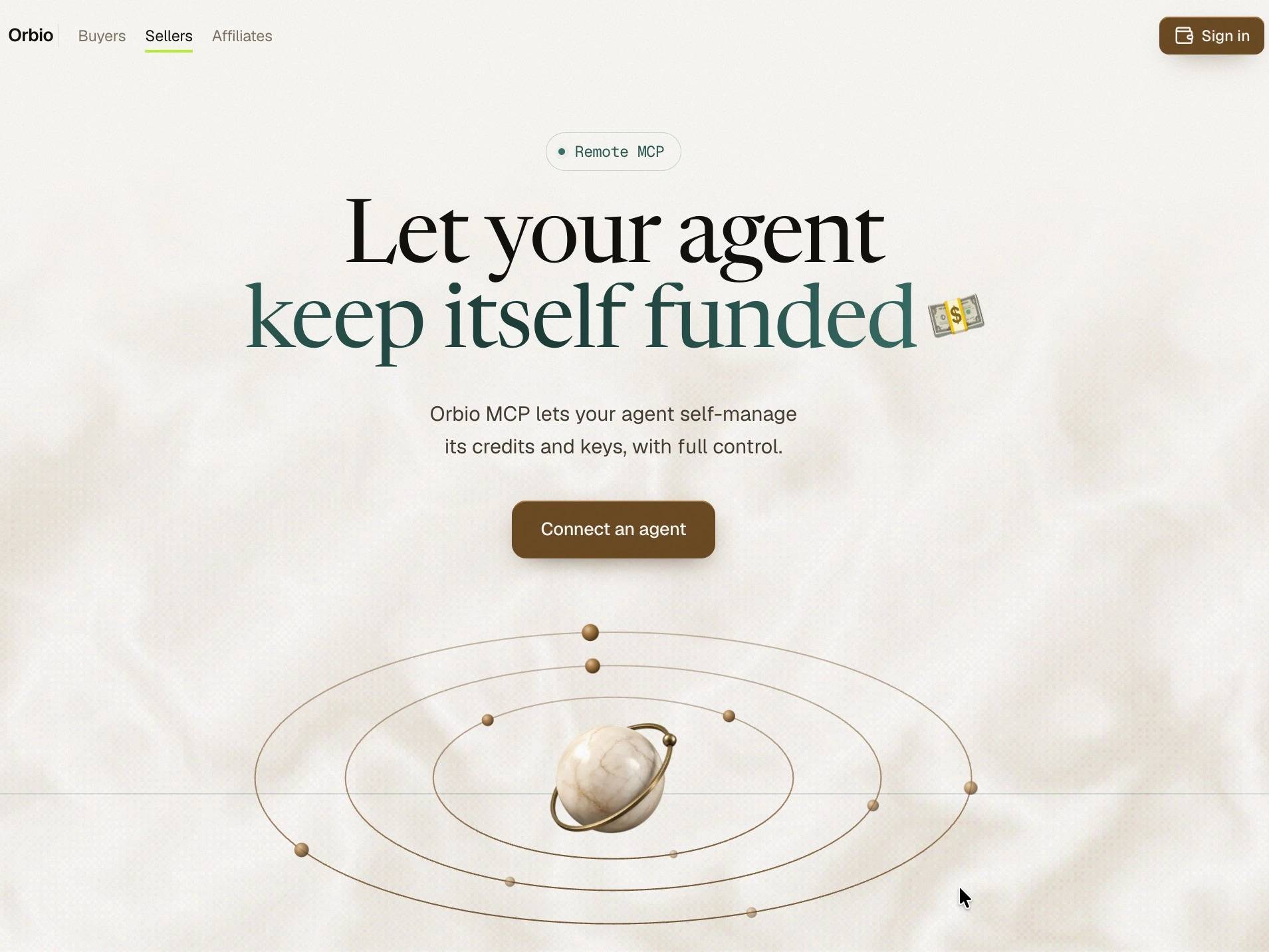
Orbio is a token-based marketplace for discounted access to large language model (LLM) inference, built around a token called $ORBIO that entitles holders to earn artificial intelligence (AI) credits. The project routes trading fees collected on its token into credits redeemable for AI model usage through OpenRouter, an aggregator that provides a single interface to many AI models. Orbio operates on Robinhood Chain, where $ORBIO launched through the Pons launch mechanism, and is categorized as an Artificial Intelligence (AI) asset.[1][2]
Overview
Orbio's central proposition is that owning $ORBIO produces a passive stream of usable AI credits rather than a monetary return. Every trade of the token pays a fixed fee, half of which is converted into inference credits and distributed to token holders. Those credits are ultimately redeemable as an OpenRouter application programming interface (API) key, which works with any model OpenRouter routes to. The listed models include Claude Opus 5, GPT-5.6, Gemini 3.1 Pro, DeepSeek V4 and Kimi K3, among several hundred others.[1]
Because the credits are ordinary OpenRouter keys, Orbio states they function with existing developer tools — including Claude Code, Codex, Cursor and various software development kits (SDKs) — without any Orbio-specific SDK or wrapper. The project frames the wallet itself as the account: a holder signs in with the same wallet that holds the tokens, and there is no separate account to create.[1]
Technology
In the model described on Orbio's website, a wallet holding at least 1,000 $ORBIO earns LLM credits passively, with no staking or sign-up required. Credits accrue to a linked wallet's balance and are settled in dollars, appearing in a dashboard and growing every hour. Holding requires no transaction, and selling is not required to receive credits.[1]
The economics rest on a single trading fee. Every $ORBIO trade pays a 1.50% fee on its volume, settled on-chain in escrow; the rate was fixed at launch and applies to every trade in both directions. Fifty percent of the fees the treasury collects is converted into OpenRouter credits at face value, and each holder's share is written to their ledger every hour. Net of everything, 0.75% of traded volume reaches holders' dashboards as spendable dollars — meaning that for every $100 traded, $1.50 in fees is collected, of which $0.75 becomes spendable credits for holders. Orbio describes this as a direct conversion, stating: "One dollar of fees becomes one dollar of inference. Nothing is minted and nothing is bought back."[1][4]
Payouts occur every hour and are recorded as a ledger row rather than an on-chain transaction. Accrued credits do not expire while the account is active. Claiming provisions an OpenRouter key with a spend ceiling of up to $200.00, issued one tranche at a time; when a key is spent, the holder can claim again for a fresh key while any remaining balance stays in the holder's balance. The site provides an example configuration for Claude Code that points an ANTHROPIC_BASE_URL and ANTHROPIC_AUTH_TOKEN at the claimed OpenRouter key, and notes that a user previously signed into an Anthropic account should log out and confirm with a status check that the base URL points at OpenRouter.[1]
Eligibility and Redistribution
Eligibility is measured as a time-weighted average across a payout window rather than a wallet's balance at a single instant. A wallet must hold at least 1,000 $ORBIO on that time-weighted basis; dropping below the floor mid-window forfeits that window, and topping up just before it closes does not qualify a holder. If a holder sells, weight stops accruing from the block in which the sale occurs, but they keep everything already credited, and the window in which they sold pays only for the fraction actually held — provided the average across the window still clears the minimum. Weight that falls below the floor is redistributed to holders who do qualify.[1]
Smart accounts and wallets delegated under EIP-7702, an Ethereum standard that lets an ordinary account temporarily act as a smart contract, are eligible and treated like other holders. Ordinary contracts are excluded — Orbio lists the liquidity pool, the fee escrow, the locker, the treasury and the burn address as examples — and their share is redistributed to real holders.[1]
Privacy
Orbio states that it does not see users' prompts. Requests travel from the user's own machine to OpenRouter using the user's key, and the operator says it provisions the key and reads only its spend total: "we never proxy the traffic and never see its contents."[1]
Token and Network
$ORBIO is the platform's native token, launched through the Pons launch mechanism on Robinhood Chain. Unusually, the token is quoted against tokenized NVDA — a tokenized representation of Nvidia stock — rather than against a stablecoin.[1][4]
The token has a total supply and maximum supply each reported at 950 million ORBIO, with a self-reported circulating supply also of 950 million, meaning the entire supply is in circulation.[4][2]
CREDIT and Staking
Alongside the passive holding model, Orbio's X account has described a further set of mechanisms in which token holders stake $ORBIO to earn a separate asset called CREDIT, described as "tokenized inference you can own, trade, transfer and use." According to these posts, users can stake ORBIO to earn CREDIT, then claim it, sell it on an on-chain order book, swap it on Uniswap, or activate it to power AI usage. A post reported that 117 million ORBIO had been staked.[3]
Orbio has also described directing platform revenue back into the market, stating that half "buys back ORBIO and stakes it" and half "buys the inference itself and mints CREDIT against it." It characterizes this arrangement as "protocol owned inference, backstopping the book at 20% off." This buyback-and-mint framing differs from the website's claim that "nothing is minted and nothing is bought back," reflecting an evolution of the mechanism as presented across the two sources.[3][1]
Additional features announced through the account include Auto-list, which lets a holder pick a discount once so that staking rewards list themselves on the order book automatically; partial unstake, which lets a user withdraw any amount while the remainder keeps earning; and expanded model coverage bringing audio and embedding models onto the gateway under a single key. Orbio also stated that "staking from fomo wallets is fixed" and that "gas is on us," indicating the platform covers transaction fees for certain actions. Users can access their API key securely with a wallet signature.[3]