Subscribe to wiki
Share wiki
Bookmark
PayAiro

The Agent Tokenization Platform (ATP):Build autonomous agents with the Agent Development Kit (ADK)
0%
PayAiro
PayAiro is a U.S.-focused payments and financial infrastructure platform designed to connect traditional banking systems with digital assets. The service aims to offer a unified application for users to manage, send, and receive both fiat currency and cryptocurrency within a single, regulated ecosystem. [1] [2]
Overview
PayAiro is a financial technology application developed for the United States market, designed for both individual consumers and businesses. The platform's stated goal is to simplify money movement and make payments faster by integrating conventional financial systems, such as bank accounts and card networks, with digital assets. It seeks to address the fragmentation users often experience when managing their finances across separate applications for banking, and cryptocurrency. [1] [2]
The core of the platform is a mobile application, available for iOS and Android, that functions as a unified wallet. This wallet is designed to allow users to add funds via bank transfers and cards, hold balances, and transact in both U.S. dollars and various cryptocurrencies. PayAiro also plans to expand its platform to provide a consolidated view of a user's entire financial portfolio, including bank balances, stocks, cryptocurrencies, and Individual Retirement Accounts (IRAs). [1] [2]
The company emphasizes its focus on operating within the U.S. regulatory framework, stating that its infrastructure is built with bank-level security and compliance measures. By acting as a licensed intermediary, PayAiro aims to provide a compliant bridge between traditional payment rails and the digital asset economy, positioning itself as an alternative to conventional payment systems that can have longer settlement times. [1] [2]
Products
PayAiro's product suite is divided into solutions for individual users and services for business clients. [1] [2]
Consumer Products
For individuals, PayAiro offers a comprehensive application intended to serve as a central hub for personal finance. The primary product is the Unified Wallet, which allows users to connect their U.S. bank accounts and payment cards to fund their accounts. Within the app, users can hold, send, and spend both fiat currency and supported digital assets. [1] [2]
Business Solutions
For business clients, PayAiro provides a suite of tools built on an API-first infrastructure. This approach is designed to offer businesses modern and flexible payment integration options. The platform aims to help companies address operational challenges related to slow settlement times and complex payment processing. [1] [2]
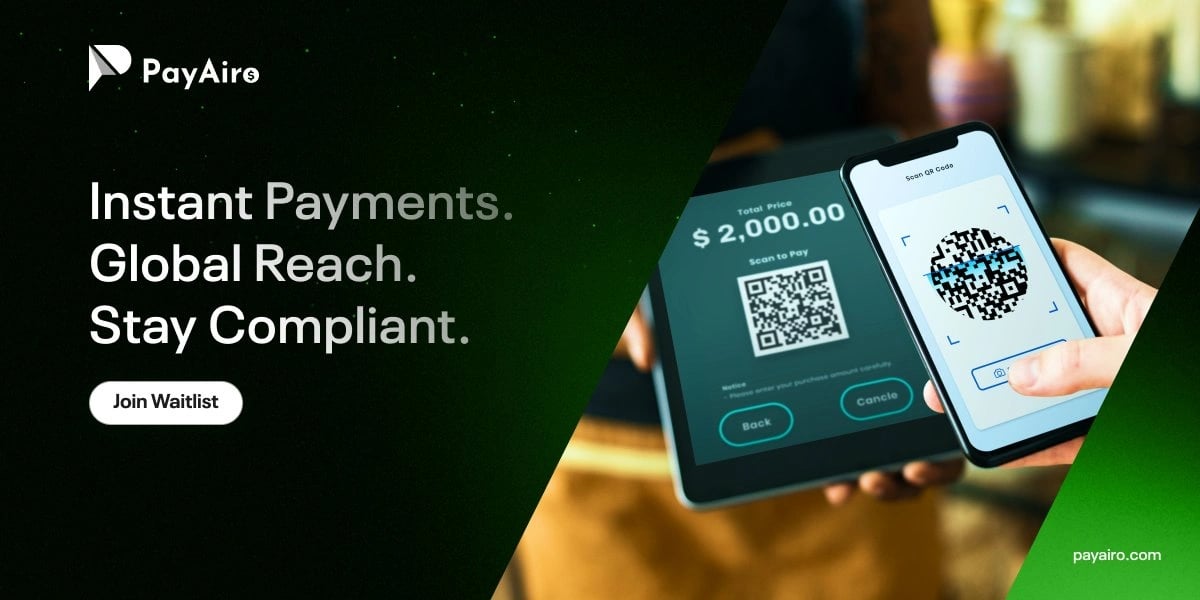
Businesses can use the platform to accept payments from customers in-store or online through QR codes. These payments can be made in fiat, cryptocurrency, or stablecoins. To mitigate price volatility, the system allows for direct settlement of customer payments into U.S. dollars or stablecoins like USDC. Additional business functionalities include tools for managing payroll, executing vendor payments, and handling corporate treasury and remittances from a single dashboard. Businesses are provided with a dedicated merchant dashboard for tracking transactions and revenue. [1]
Features
The PayAiro platform is built around several core capabilities designed to integrate different financial services. [1]
Fiat and Crypto Bridging
A fundamental feature of the platform is its crypto on-ramp and off-ramp functionality. This allows users to add funds (on-ramp) from their linked U.S. bank accounts and payment cards to buy digital assets and withdraw funds (off-ramp) by converting digital assets back to fiat currency sent to their bank. This provides a direct connection between the traditional financial system and the digital asset economy within the application. The platform also supports QR code-based payments for both in-person and online transactions. [1] [2]
Peer-to-Peer Transfers
PayAiro facilitates peer-to-peer (P2P) payments through a system that uses unique "PayAiro Tags." These tags are identifiers that allow users to send funds instantly to one another. The platform states that these P2P transfers are processed with zero fees for the users. [1] [2]
Unified Wallet and Dashboard
All funds and assets on the platform are managed through a unified wallet. This wallet is designed to let users hold, send, and spend their assets from a single interface. Expanding on this concept, PayAiro is also developing a Unified Financial Dashboard. [1] [2]
Ecosystem
The PayAiro ecosystem connects individual users, businesses, traditional financial institutions, and digital asset markets within a single framework. The foundation of the ecosystem is its mobile application, which connects individual users who can transact with each other through PayAiro Tags, and participating merchants who accept PayAiro for payments. [1]
The platform functions as a closed-loop system for its internal P2P transactions while providing an open gateway to external financial networks. It acts as a licensed intermediary that facilitates value transfer between fiat-based banking rails, such as the Automated Clearing House (ACH) and card networks, and Web3 technologies. PayAiro's B2B solutions, built on its API-first infrastructure, are intended to extend this ecosystem to merchants and other companies seeking to integrate modern payment processing. [2]
Use Cases
PayAiro is designed to support a range of use cases for different types of users.
For Individuals and Investors
- Sending fiat currency or cryptocurrency instantly to other PayAiro users in the U.S. with zero fees using a unique PayAiro Tag.
- Managing both fiat and crypto funds within a single, regulated application.
- Buying, selling, and converting various cryptocurrencies, such as Bitcoin and Ethereum.
- Making payments to participating merchants for goods and services using a QR code.
These use cases are based on information from the company's official website and social media channels. [1] [2]
For Businesses
- Accepting customer payments in-store or online via QR codes in fiat, crypto, or stablecoins.
- Receiving customer payments settled directly in USD or stablecoins like USDC to mitigate digital asset price volatility.
- Integrating PayAiro's API for payment processing to potentially achieve faster settlement times.
- Executing payroll, vendor payments, and invoice management using stablecoins.
- Monitoring revenue, transaction history, and other financial data through a unified merchant dashboard.
These use cases are based on information from the company's official website. [1]
Architecture
PayAiro's architecture is a hybrid system that integrates traditional financial infrastructure with blockchain-based technology. The platform is built on an API-first model, which is intended to allow for flexible integration with third-party services and business clients. [2]
On the front end, the architecture supports a user-facing mobile application that features the unified wallet interface. On the back end, the system connects directly to conventional bank and card payment rails (such as ACH and card networks) to process fiat deposits and withdrawals. For its digital asset services, the architecture incorporates an on-chain and off-chain infrastructure to facilitate cryptocurrency trading, P2P transfers, and settlement. [1]
For business clients, the architecture includes a QR-code payment system and a merchant-specific backend that enables transaction settlement in either fiat or stablecoins. The entire system operates as a licensed and regulated entity, indicating a centralized infrastructure designed to prioritize security and compliance with U.S. financial regulations. [1] [2]
Confirmed Partnerships
Confirmed partnerships includes:
See something wrong?
The Agent Tokenization Platform (ATP):Build autonomous agents with the Agent Development Kit (ADK)