0% read
Last updated:
Vara Network
Vara Network is a standalone layer-1 decentralized network constructed using the Gear Protocol and the Substrate framework. It is engineered to be a fast, scalable, and developer-centric platform for building and deploying complex decentralized applications (dApps) using WebAssembly (Wasm). [1] [2]
Overview
Vara Network functions as a decentralized blockchain operating on a Nominated Proof-of-Stake (NPoS) consensus mechanism. It stands as the primary and initial standalone network within the broader Gear Protocol ecosystem and is overseen by the Gear Foundation. [1]
The platform's core objective is to facilitate the transition for developers from Web2 to Web3 environments. It accomplishes this by leveraging advanced computational concepts like the actor model and persistent memory, which are intended to streamline the development of sophisticated, high-performance dApps. [2]
The network is architected to support use cases that demand very low latency and the capacity for parallel processing, such as blockchain-based gaming, advanced decentralized finance (DeFi) protocols, and other real-time applications. [1]
Its design emphasizes asynchronous communication between programs, allowing for the efficient and independent processing of multiple transactions simultaneously. This structure aims to provide a high-performance environment that can handle complex computational tasks on-chain. [2]
Architecture
Vara Network is built as a Layer-1 blockchain using the Substrate framework, which provides modularity and a native Nominated Proof-of-Stake (NPoS) consensus model for network security. [2]
The network's distinctive smart contract functionality is powered by the Gear Protocol, which serves as its execution engine. This protocol is founded on three core technological pillars. [1]
First is the Actor Model, a paradigm of concurrent computation where individual programs, or "actors," are lightweight, isolated units. Each actor communicates with others through asynchronous messages, which allows for a high degree of parallelism and prevents one program's execution from blocking others. [2]
Second is Persistent Memory, a mechanism that automatically preserves the memory state of a program between function calls. This simplifies the development process by eliminating the need for developers to manually write code to save and load state, thereby reducing the potential for bugs and increasing execution efficiency. [1] [2]
Third is the use of WebAssembly (Wasm) as the virtual machine for executing smart contracts, which the network refers to as "programs." Wasm is a high-performance, sandboxed binary instruction format that allows code to be compiled from a variety of common programming languages, such as Rust, C, and C++, offering developers flexibility beyond Solidity. [1] [2]
Products
Vara Network offers several products and tools designed to support development and user interaction on its blockchain. [1]
Vara NFT
This refers to the network's protocol standard for the creation and management of non-fungible tokens. It is intended to support a range of use cases within the Vara ecosystem, including in-game assets, digital collectibles, and identity verification systems. [1]
Vara Explorer
The official block explorer for the network is a customized version of Subscan. It serves as a tool for users, developers, and validators to view transactions, blocks, accounts, smart contract interactions, and other on-chain data in real-time. [1]
Features
The Vara Network's architecture incorporates several distinct features aimed at enhancing performance, developer experience, and user accessibility. [4]
Seamless Ethereum Integration:
Through the Vara.eth layer, the network allows for direct interaction with native Ethereum smart contracts without requiring new tokens or cross-chain bridges. Developers can use familiar Ethereum tools like MetaMask, Etherscan, and The Graph, and users can operate applications from their existing Ethereum wallets. This design avoids the liquidity fragmentation often associated with wrapped tokens. [4]
Parallel Execution and High Performance:
The network's core design, based on the Actor Model, supports the parallel execution of programs. This means isolated programs can run concurrently across different validators, improving efficiency and throughput. [4]
Gasless Experience (Reverse Gas Model):
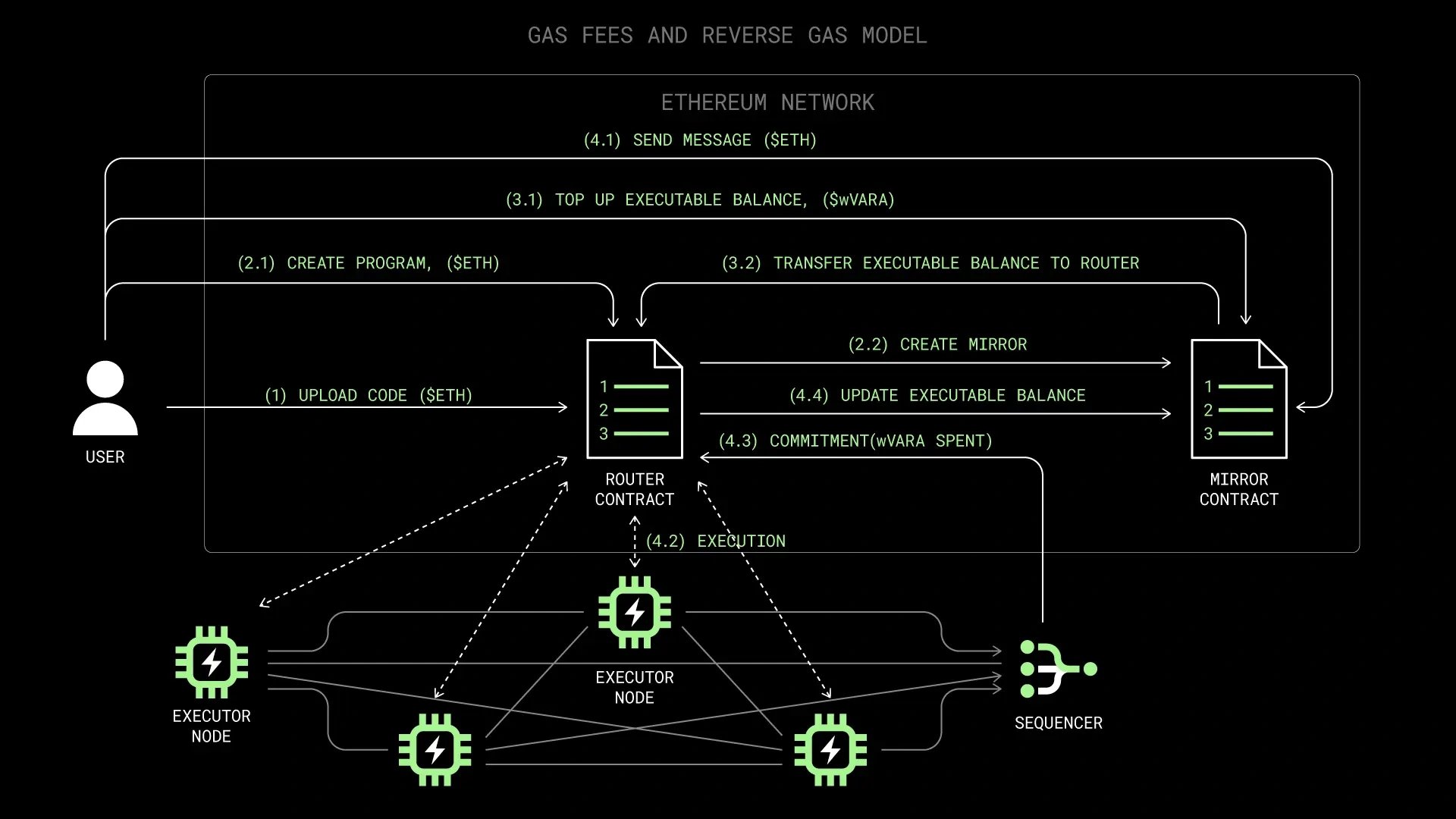
A key economic feature is the "Reverse Gas Model," which expands on the concept of gas reservation. Programs on Vara maintain a dedicated "Executable Balance" to pay for their own execution costs.
This allows application developers to sponsor transaction fees, creating a "gasless" experience for end-users, who only need to pay the base Ethereum transaction fee when interacting from the Ethereum side. This model is well-suited for subscription-based services and improving user onboarding. [4] [1]
Real-time Interaction:
The network offers two mechanisms for fast interactions. Injected Transactions are native Vara transactions sent directly to the network for low-cost operations processed by Vara validators.
Additionally, a Pre-confirmation mechanism allows developers and users to access computation results in sub-second time, before the transaction is finalized on Ethereum. This provides Web2-like responsiveness for latency-sensitive applications while retaining Ethereum's security for final settlement. [3] [4]
Advanced Developer Environment:
Vara utilizes WebAssembly (Wasm) as its runtime, often paired with the Rust programming language for developing secure, high-performance applications. It supports a large memory capacity per program (up to 2GB), enabling more sophisticated use cases like on-chain AI models and financial simulations.
The ecosystem is supported by a rich developer toolkit, including the Sails Framework for simplified development and a TypeScript API for client-side integration. [4] [2]
Ecosystem
The Vara Network ecosystem is composed of its core technology, a supporting foundation, and various community-oriented initiatives. The primary technical components are the Vara Network itself as the Layer-1 blockchain, the Gear Protocol providing the underlying smart contract technology, and the Substrate framework upon which the network is built. [1]
The Gear Foundation is the entity responsible for overseeing the network's development, managing the treasury, funding ecosystem growth, and fostering community engagement.
To encourage adoption and attract builders to the platform, the foundation has established several programs. These include a grants program to fund promising projects, an ambassador program to promote the network, a validator program to support network decentralization and security, and "Varathon" hackathon events to spur innovation. [1]
Another implementation of the Gear Protocol is Vara.eth, an application platform on top of Ethereum that allows decentralized applications to interact with Ethereum users and liquidity without bridging.[7]
Use Cases
The architecture of Vara Network is intended to support a range of applications that are demanding in terms of performance and complexity.
- Gaming and Metaverse: The low latency and parallel processing capabilities are suited for running complex on-chain game logic, managing in-game micro-transactions, and supporting persistent virtual worlds. [1] [2]
- Decentralized Finance (DeFi): The network's high throughput is aimed at supporting complex financial instruments, high-frequency automated trading applications, and other DeFi protocols that require fast execution speeds. [1] [2]
- Real-Time Applications: The platform is designed for decentralized social media, live streaming services, and other interactive applications where immediate data processing and user responsiveness are critical. [1]
- Supply Chain and Identity: The technology is also positioned for use in supply chain management for tracking and verifying goods, as well as for developing secure and private digital identity solutions. [2]
- Secure Systems and Data Management: Other potential applications include the creation of secure systems for private financial authentication, transparent voting systems, and privacy-preserving management of healthcare data. [2]
The use cases cited are based on the network's design and intended functionality. [1] [2]
Tokenomics
The native asset of the Vara Network is the VARA token, which is integral to the network's operation, security, and governance. The VARA token has an inflationary model and the total supply is not fixed at 10 billion. [2]
Allocation
The initial allocation of the VARA token supply is distributed as follows:
- Founders/Team/Advisors - 20.00%
- Investors - 21.50%
- Developer/Project Grants - 12.50%
- Inflation Offsetting Pool - 10.00%
- Airdrop - 7.00%
- Education/Bootcamp/PR/Events - 7.00%
- Validators Incentives Pool - 6.00%
- Foundation and Ecosystem Development - 4.50%
- Protocol Reserve - 5.00%
- Market Makers and Liquidity Management - 3.50%
- Protocol Dev - 3.00% [5]
Utilities
The VARA token and its wrapped version, wVARA, have several key utilities within the ecosystem.
- Transaction Fees: VARA is used to pay for gas fees associated with processing transactions and executing programs on the Vara Network. [1] [2]
- Staking: Token holders can stake VARA to participate in the Nominated Proof-of-Stake (NPoS) consensus mechanism. They can act as validators or nominate validators to help secure the network and earn staking rewards in return. [1] [2]
- Governance: VARA holders are granted the ability to participate in the network's on-chain governance. This allows them to propose and vote on protocol upgrades, parameter changes, and other decisions affecting the network's evolution. [1] [2]
- wVARA for Ethereum Interaction: An ERC-20-compliant wrapped version of the token, wVARA, exists on the Ethereum blockchain. It is used to pay gas fees and fund the execution balance of programs that are interacted with from the Ethereum side via the Vara.eth layer. [3]
These utilities are central to the network's economic model and decentralized operation. [1] [2] [3]
Governance
Vara Network features a decentralized on-chain governance system where VARA token holders have direct control over the protocol's evolution. Holders can create proposals and vote on a wide range of issues, including runtime upgrades, treasury spending from the Gear Foundation, and adjustments to network parameters.
This model ensures that the network's development is guided by its community of stakeholders. [2] [1]
See something wrong?
Average Rating
No ratings yet, be the first to rate!
How was your experience?
Give this wiki a quick rating to let us know!
Edited By
On April 24, 2026. 22:37 UTC
Edit summary:
Removed Vara Network overview, description, and image