ADK-TS Hackathon 2025
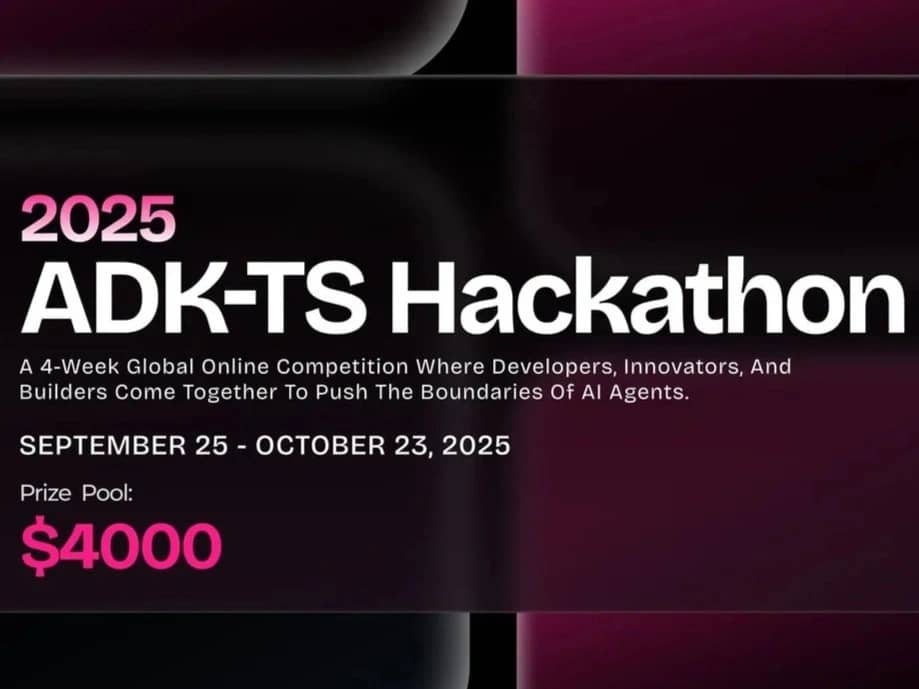
The ADK-TS Hackathon 2025 was a four-week virtual competition organized by IQ AI and hosted on the DoraHacks platform. It was created to encourage developers to build innovative artificial intelligence agents using the Agent Development Kit for TypeScript (ADK-TS). The event, which ran from September 25 to October 23, 2025, featured a $4,000 prize pool paid in stablecoins and attracted significant participation from the global developer community. [1] [2]
Overview
The ADK-TS Hackathon 2025 was a global, online competition designed to showcase the capabilities of IQ AI's open-source Agent Development Kit for TypeScript. Registration for the event opened on September 25, 2025, and it concluded with the submission deadline on October 23, 2025. The winners were subsequently announced by October 30, 2025. The hackathon saw substantial engagement, with 122 builders participating from around the world. This participation resulted in 36 project submissions. A total of $4,000 in prizes was distributed among the top projects selected by the judges. [1] [2]
Background and Goals
The hackathon was launched by IQ AI to accelerate the adoption and demonstrate the versatility of the ADK-TS framework. The event provided a hands-on opportunity for developers to explore the potential of building sophisticated, autonomous AI agents capable of solving complex, real-world problems. The organization outlined three primary goals for the competition. [1]
The main objectives were:
- Foster Innovation: To inspire developers to create novel applications and solutions using AI agents, pushing the boundaries of what was considered possible with the technology.
- Expand the Ecosystem: To encourage the creation of new tools, applications, and especially Model Context Protocol (MCP) servers. These expansions enrich the ADK-TS ecosystem by enabling agents to connect to and interact with a wider array of data sources and APIs.
- Grow the Community: To bring together a global community of developers, innovators, and builders passionate about AI agent technology, fostering an environment of collaboration and knowledge sharing. [1]
Tracks and Judging Criteria
To structure the competition and guide submissions, the hackathon was divided into three main tracks and five bonus tracks. All submitted projects were evaluated by a panel of judges against a consistent set of criteria to ensure a fair and comprehensive assessment. [1] [2]
Tracks
Submissions were categorized into the following tracks: [2]
Main Tracks
The main tracks each had a prize of $1,000. [2]
- Best Agent Application: This track was designed for projects that demonstrated practical, real-world utility. The emphasis was on creating a tangible solution to a specific problem, showcasing the agent's effectiveness and user value.
- Best MCP Expansion: This track focused on projects that created new Model Context Protocol (MCP) servers. The goal was to expand the capabilities of the entire agent ecosystem by enabling AI agents to connect to and interact with new data sources or external APIs.
- Best Web3/Blockchain Use Case: This track was dedicated to agents designed to interact with decentralized technologies. Projects in this category included agents that interfaced with DeFi protocols, analyzed blockchain data, or managed smart contracts.
Bonus Tracks
The bonus tracks each had a prize of $200 and were awarded to projects for specific achievements: [2]
- Most Practical Real-World Use Case: For the project with the clearest potential for real-world adoption.
- Best Bot Integration: For the most effective integration with messaging platforms like Discord, Telegram, or Slack.
- Best Technical Implementation: For the project with the strongest technical execution and architecture.
- Best Improvement to ADK-TS: For a project that extended or enhanced the ADK-TS framework itself.
- Best Collaboration/Team Agent or MCP: For the project that best demonstrated multi-agent collaboration or enhanced group workflows.
Judging Criteria
Projects were evaluated based on four key criteria:
- Innovation: The originality and creativity of the project's concept and its approach to solving a problem.
- Technical Implementation: The quality, complexity, and overall execution of the code and system architecture.
- Real-World Utility: The project's potential for practical application, its impact, and its viability as a useful tool or service.
- Effective Use of ADK-TS: How well the project leveraged the core features, architecture, and capabilities of the ADK-TS framework in its implementation. [1]
Eligibility and Submission Requirements
The hackathon was open to participants worldwide, who could compete individually or in teams of up to four members. All projects were required to be built from scratch during the event. [2]
Submission Requirements
To be considered for judging, each submission had to include:
- A public GitHub repository containing the full source code.
- A recorded video demo (maximum 5 minutes).
- A description of how the ADK-TS framework was used.
- A live demo or hosted version for judges to test. [2]
Winners
The $4,000 prize pool was distributed among the winning teams. Three projects were selected as main track winners, receiving the top prizes, while several other projects were recognized with bonus awards for their outstanding contributions in specific areas. [1] [2]
Main Track Winners
The top three projects each received a $1,000 prize for their exceptional work in their respective categories. These projects were recognized for their comprehensive implementation, innovative concepts, and significant potential impact. [1] [2]
CodeForge AI (Best Agent Application)
Created by Thinh Dinh, CodeForge AI is a multi-agent development platform that orchestrates over 10 specialized AI agents within a unified workflow. The platform is designed to automate a wide range of software development tasks, including code generation, security scanning, testing, and performance optimization. It also integrates with GitHub for version control, generates AI images for projects, and assists with documentation. The platform is accessible across multiple interfaces, including web, Telegram, and voice commands. [2] [3]
OpsPilot (Best MCP Expansion)
Developed by Himanshu Soni, OpsPilot is a Discord-native AI on-call team designed for DevOps automation. The agent monitors systems using Prometheus alerts, triages incidents, analyzes logs with semantic search, and can autonomously generate GitHub pull requests to fix identified issues. It utilizes multiple Model Context Protocols (MCPs) to connect with a suite of DevOps tools, including GitHub, Jira, and PagerDuty, while ensuring that human operators can oversee and approve critical decisions. [2] [4]
ChainInsight (Best Web3/Blockchain Use Case)
Created by Shreshth, ChainInsight is an AI agent that functions as a "DeFi co-pilot," streamlining the entire decentralized finance workflow through a single conversational interface. The agent automates protocol research, performs safety analysis using live data, simulates transactions to assess risk, and prepares those transactions for signing with wallets like MetaMask. Users can issue natural language commands to execute complex DeFi operations. [2] [5]
Bonus Track Winners
In the bonus categories, five projects earned $200 each. [1] [2]
Confluent (Most Practical Real-World Use Case)
Developed by David Ajibola, Confluent is an MCP server and AI agent that unifies the Zoho Books and Xero accounting platforms. It allows users to manage financial data, create invoices, and automate email notifications through either a Discord bot or a terminal interface. The project uses secure OAuth for authentication and Redis for session management. [2] [6]
BingeBird (Best Bot Integration)
Created by Rohit Keerthikanth, BingeBird is a Telegram bot for entertainment discovery. The agent connects to an "Entertainment MCP server" to fetch real-time data on movies, TV shows, and anime. It allows users to manage a personalized watchlist, helps craft review tweets based on the content, and can post them directly to X (formerly Twitter). [2] [7]
Obrix (Best Technical Implementation)
Obrix is an AI-powered monitoring platform designed to detect wash trading and pump & dump schemes in real-time across DeFi liquidity pools, such as those on Uniswap V4. Developed by user , the platform uses Large Language Model (LLM) agents to analyze on-chain swap data, track volatility, and monitor Time-Weighted Average Price (TWAP) metrics, issuing detailed alerts for any suspicious activity it identifies. [2] [8]
Bazaaro (Best Improvement to ADK-TS)
This project integrated ADK-TS with Coinbase's CDP AgentKit to create an AI-powered service aggregator. It utilizes a three-agent system to discover, orchestrate, and synthesize responses from multiple paid APIs. [1]
On Chain Analysis Agent (Best Collaboration/Team Agent or MCP)
A multi-agent system that delivers token intelligence by coordinating specialized agents to detect tokens, fetch market data, perform web research, and synthesize the information into actionable analysis. [1]
Noteworthy Projects
Five other projects were recognized for their innovation. [1]
- Chain Pilot: An AI-powered blockchain terminal for multi-chain operations and NFT portfolio management via natural language commands.
- BlockIQ: An analytics platform for the Stacks blockchain that uses custom MCP tools to turn on-chain data into conversations and visualizations.
- ReflectIQ: An AI-powered journal with semantic search, automatic goal tracking, and team collaboration features.
- KeeperDCA: An agent that automates dollar-cost averaging using the MetaMask Delegation Toolkit, enabling 24/7 execution without giving up custody of funds.
- Mendel.AI: A drug discovery automation tool on Telegram that uses six specialized agents to manage the full discovery cycle and deliver molecular candidates.