0% read
Last updated:
Dankrad Feist
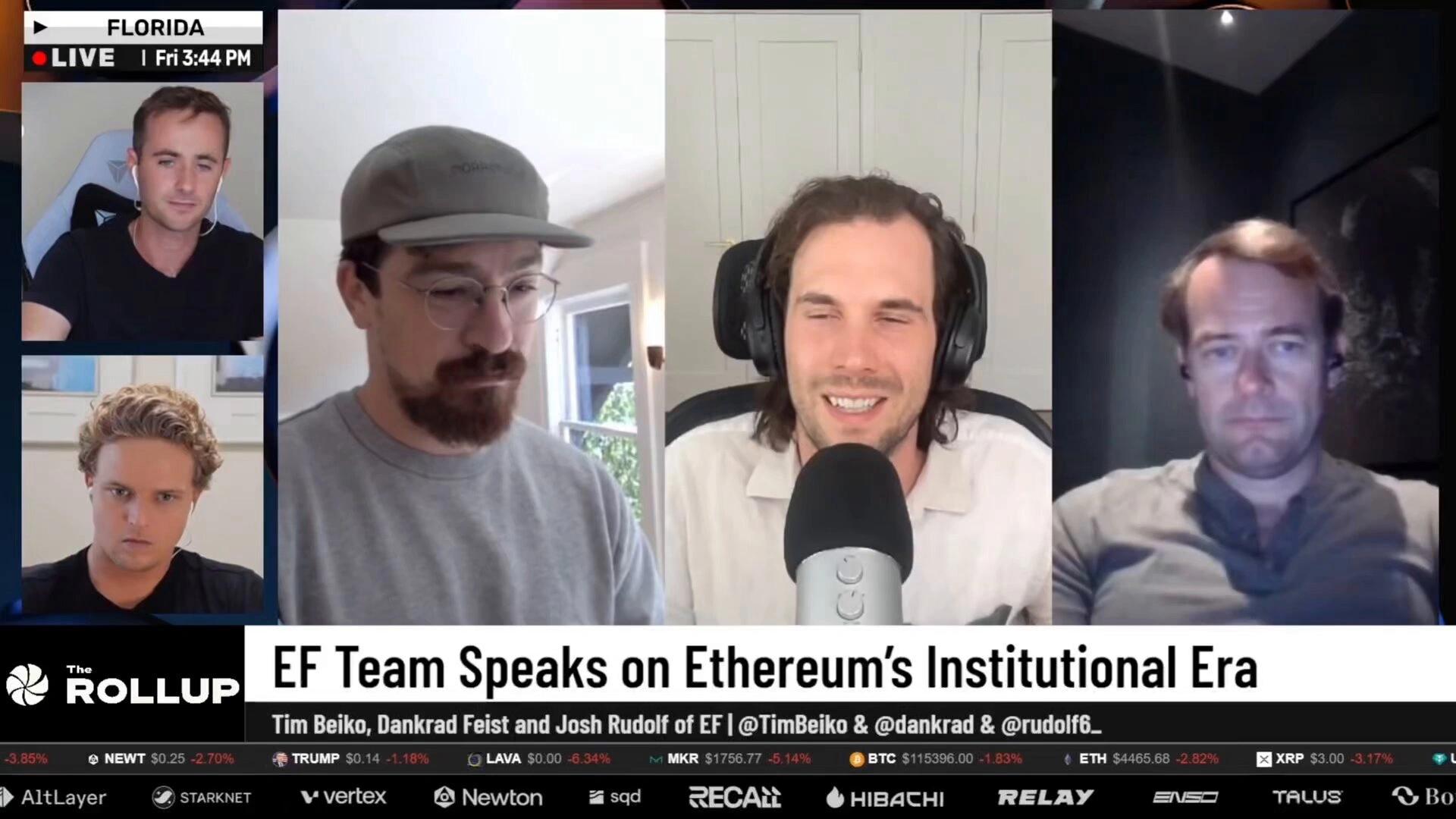
Dankrad Feist is a German researcher and developer in the blockchain industry, recognized for his significant contributions to the Ethereum protocol's scaling solutions. He is a co-creator of the scaling design known as Danksharding and worked as a researcher at the Ethereum Foundation from 2018 until 2025, when he joined the Layer 1 project Tempo. [1] [2]
Career
Ethereum Foundation (2018–2025)
Feist joined the Ethereum Foundation (EF) as a part-time researcher in 2018, later transitioning to a full-time role in 2019. [1] [3] During his tenure, he became a central figure in the research and development of Ethereum's scaling roadmap. His work focused on data availability, consensus mechanisms, and sharding, which is a method of splitting a database to spread the computational and storage workload. In early 2025, during a leadership reorganization within the foundation, Feist was appointed as a Strategic Advisor, with a focus on Layer 1 scaling and user experience improvements. [1]
On October 17, 2025, Feist announced his departure from his full-time position at the Ethereum Foundation. However, he maintained a connection to the organization, transitioning to a role as a Research Advisor to the EF's Protocol Cluster. In this advisory capacity, his work continues to focus on key initiatives, including scaling the base layer (L1), scaling data availability through blobs, and enhancing user experience. [3]
Tempo (2025–Present)
Upon leaving his full-time role at the Ethereum Foundation in October 2025, Feist joined Tempo, a new Layer 1 blockchain project. Tempo is described as a stablecoin-focused, EVM-compatible network optimized for high-scale, real-world financial applications such as e-commerce, remittances, and payroll. The project was incubated by the financial technology company Stripe and the venture capital firm Paradigm. [1] [4]
Feist stated his motivation for joining was his belief that the cryptocurrency industry had reached a "turning point" where its early promise of facilitating everyday payments was finally achievable. In his announcement, he said, "While payments used to be front and center in the early days of crypto, I see a special opportunity to finally achieve this ambitious goal with relentless execution on both the technical and distribution fronts." [1] He characterized Tempo as a complementary platform to Ethereum, not a direct competitor, noting that both projects are built with the same "permissionless ideals in mind." He also suggested that Tempo's open-source technology could eventually be integrated back into Ethereum, benefiting the broader ecosystem. [3]
Major Works and Proposals
Danksharding and Proto-Danksharding
Feist is best known as a co-creator of "Danksharding," a sharding design for Ethereum named after him. The primary goal of Danksharding is to significantly improve the scalability of Layer 2 rollups by creating a dedicated and cost-effective space for data availability on the Ethereum mainnet. This is achieved by introducing "data blobs," which are large, temporary packets of data that can be posted to the network more cheaply than using permanent contract storage (calldata). [1]
A precursor to the full implementation of Danksharding is known as Proto-Danksharding, which was implemented via Ethereum Improvement Proposal (EIP) 4844. Feist's earlier work was foundational to this development. On December 29, 2021, he proposed a new, simplified sharding design where all shard blocks in a single slot would be proposed together with the main beacon block. He described this as a "major simplification" of the sharding architecture, which laid the groundwork for the data blob transaction type introduced in Proto-Danksharding. [5]
EIP-7938: L1 Gas Limit Increase
On April 30, 2025, Feist introduced EIP-7938, a proposal titled "Exponential Gas Limit Increase via Default Client Voting Behavior." The proposal outlined a plan to scale Ethereum's Layer 1 transaction capacity by a factor of 100 over a period of four years. The EIP suggested an unconventional method to systematically increase the network's gas limit, which dictates the amount of computation that can be included in a single block. Feist acknowledged that the approach was unorthodox but argued it was necessary to overcome what he perceived as stagnation in Ethereum's development process and to provide a long-term capacity plan for developers building on the network. [5]
Public Commentary
Ethereum Development and Roadmap
Feist has been an outspoken commentator on the pace and direction of Ethereum's core development. On January 20, 2025, he expressed strong criticism of the protocol's upgrade process, stating, "The current process of upgrading Ethereum IS BROKEN." He argued that for developers to commit to building on the platform, they require long-term commitments to capacity and a more ambitious five-year plan. He asserted that the existing roadmap was "way too unambitious" and that Ethereum needed to be more aggressive in its scaling efforts to succeed. [5]
Economic Security and Competing Protocols
Feist has also commented on the technical and economic models of other blockchain protocols. On April 20, 2025, he criticized the staking mechanism of the Solana network for its lack of a "slashing" penalty, a process where validators lose a portion of their staked tokens for malicious behavior or severe negligence. He stated, "It's very ironic to call it 'staking' when there is no slashing. What's at stake? Solana has close to zero economic security at the moment." His comments highlighted his belief in the necessity of strong economic penalties to secure a proof-of-stake network. [5]
Layer 2 and Data Availability
A consistent theme in Feist's public commentary is the importance of a robust Layer 2 ecosystem supported by a secure and inexpensive data availability layer on Ethereum. In July 2023, he voiced support for the Celo blockchain's proposal to migrate from an independent Layer 1 to an Ethereum Layer 2 solution. He used the example to emphasize the urgent need for Ethereum to provide "native data availability asap" to better support such chains and foster a thriving ecosystem of rollups. [5]
Controversies
EigenLayer Advisory Role
In late 2024, Feist and fellow Ethereum Foundation researcher Justin Drake accepted advisory positions at EigenLayer, an Ethereum restaking protocol. The appointments drew criticism from some members of the Ethereum community, who raised concerns about a potential conflict of interest. The core issue was that researchers responsible for shaping Ethereum's neutral base protocol were simultaneously advising a commercial project built on top of it, which could influence protocol design decisions in favor of that project. [1] [4]
In response to the community feedback, Feist resigned from the advisory role on November 2, 2024. He issued a public apology, stating, "While I believe that the role was negociated in good faith and with the aim of making sure that Eigenlayer is well aligned with Ethereum, I understand that the perception of this relationship has been different..." Both he and Drake pledged to decline similar offers in the future to avoid such conflicts. [5]
Recognition
Upon the announcement of Feist's departure from his full-time role at the Ethereum Foundation, Ethereum co-founder Vitalik Buterin publicly praised his work. Buterin stated, "Dankrad has been an excellent researcher and has made immensely valuable contributions to the Ethereum that we know and love today, including Danksharding, consensus research, and much more. Wishing him luck in his new efforts." [1]
See something wrong?

Average Rating
No ratings yet, be the first to rate!
How was your experience?
Give this wiki a quick rating to let us know!
Edited By
On October 17, 2025. 15:53 UTC
Edit summary:
feat(wiki): Create article for Dankrad Feist, Ethereum researcher and Danksharding co-creator.