Subscribe to wiki
Share wiki
Bookmark
Joao Reginatto
The Agent Tokenization Platform (ATP):Build autonomous agents with the Agent Development Kit (ADK)
0%
Joao Reginatto
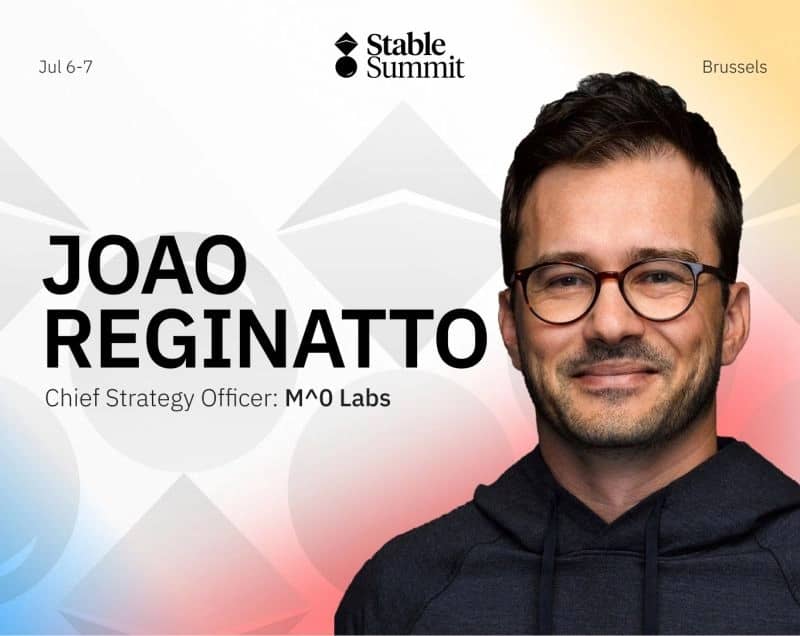
Joao Reginatto is a financial technology executive and the Chief Strategy Officer at M0, a stablecoin infrastructure platform. He is known for his work in the stablecoin sector, particularly for his previous role at Circle, where he was a key figure in the development of USD Coin (USDC). Reginatto's focus is on stablecoin infrastructure, interoperability, and the evolving role of digital currencies in financial systems. [1]
Education
Reginatto earned a Bachelor of Science in Computer Science from the Federal University of Rio Grande do Sul in Brazil, graduating in 2000. He later pursued further education in business, attending the Emlyon Business School in France, where he obtained a Master of Business Administration (MBA) with a focus on Innovation Management and Entrepreneurship in 2013. [3]
Career
Reginatto began his career in software engineering in May 1998 at Peta Systems, where he designed and built network management and security software using languages such as C, C++, Java, and Perl. In February 2000, he co-founded Squid, a venture that developed website management software for clients in the entertainment and gaming industries. From January 2001 to February 2003, he served as a software engineering team leader at Meta, where he led consulting teams on banking software projects for clients that included HSBC and also handled business analysis and requirements engineering.
He continued his work in the financial sector as a software architect at Sicredi from March 2003 to April 2004, designing the technology stack for the institution's next-generation back-office banking systems. In May 2004, Reginatto joined Dell, where he spent nearly six years in several leadership positions. His roles included managing engineering teams for HR systems, financial services IT, and manufacturing IT. From August 2007 to January 2010, he was a product owner for services IT, leading large-scale integration projects that connected CRM systems with multiple legacy platforms and coordinating distributed engineering teams.
Between February 2010 and March 2011, Reginatto worked as a senior software architect at Houghton Mifflin Harcourt, where he contributed to the technical strategy for K–12 educational software platforms. He then joined Dun & Bradstreet as an IT architect from April 2011 to July 2012, managing technical roadmaps for SaaS-based credit risk management products. In September 2013, he founded Preludio, a startup focused on creating communication and knowledge-sharing tools for families and professional caregivers, which he led until April 2014.
Reginatto's career pivoted toward API management and then crypto when he joined Axway in May 2014 as a product manager, overseeing API products for large enterprises. In September 2015, he joined Circle, initially managing European operations and leading the expansion of the Circle Pay application across multiple countries. His focus soon shifted to stablecoins, and from September 2016 to February 2020, he served as Director of Product Management, where he led the development of USD Coin (USDC). He was subsequently promoted to Vice President of Product for Stablecoins in March 2020, a role he held until August 2023. In this capacity, he oversaw the creation and launch of key infrastructure products, including multichain USDC, Euro Coin (EURC), and cross-chain transfer protocols.
In August 2023, Reginatto joined M0 as Chief Strategy Officer. At M0, he leads strategic planning and product direction for the stablecoin infrastructure platform, which is designed to support programmable and interoperable digital currencies. [2]
Interviews
M0
In a November 2025 interview on the Stable School Podcast, Reginatto discussed the evolving stablecoin landscape and M0’s role within it. He described M0 as a stablecoin issuance platform designed to connect application developers with multiple issuers, allowing them to build customized, programmable stablecoins while supporting interoperability across providers. Reginatto characterized the period as a “stablecoin summer,” noting increased sector growth and a shift in how stablecoins were perceived, from simple digital dollar equivalents to core infrastructure for developers building financial services. He explained that M0’s multi-issuer model resembled traditional banking systems, where different institutions issue variations of the same currency, helping create a more liquid and interconnected market. Reginatto highlighted the platform’s growth since its launch roughly a year earlier, citing approximately $750 million in circulating supply and a range of emerging use cases. He also outlined M0’s daily reserve attestation process, which required independent validation to maintain security and trust. Addressing market challenges, he emphasized the need for standardized solutions to reduce reliance on trading activity for stability. Looking ahead, Reginatto stated that M0 aimed to expand from five stablecoins to between 10 and 15, with the goal of becoming a top-10 stablecoin project by total value locked, while continuing to position itself as backend infrastructure for mainstream fintech applications. [5]
OpenAI Stock
In a July 2025 interview on Tokenized, Reginatto discussed developments in the fintech sector, focusing on the growing competition between established platforms and emerging blockchain-based startups. He examined Robinhood’s expansion into the European market, including its launch of tokenized stocks and crypto services that offered exposure to U.S. equities through a proprietary layer 2 blockchain, and noted the company’s efforts to replicate the seamless trading experience familiar to U.S. users. Reginatto raised legal and ethical concerns surrounding tokenized equities, particularly the risks of unauthorized derivative trading and the implications of tokenizing shares of private companies. He analyzed Robinhood’s decision to build its own layer 2 network as a strategy to retain more value internally rather than relying on external infrastructure. The discussion also addressed whether tokenized equities could disrupt traditional capital markets and how regulatory frameworks struggled to keep pace with rapid technological change. Reginatto highlighted the evolving competitive landscape, suggesting that lower barriers to entry could allow newer companies to challenge major incumbents. He emphasized the importance of regulatory clarity for stablecoins and digital asset banks, and commented on Kraken’s launch of a global money app designed to simplify transactions across fiat and crypto. Concluding, he outlined broader trends in fintech, stressing the industry’s move toward simpler, more user-focused applications as adoption continues to grow. [8]
Presentations
Stablecoin Wars Keynote
In a December 2025 keynote at Stable Summit, Reginatto examined the evolution of stablecoins and argued that the sector had entered a new phase he described as the “rise of the networks.” He outlined the early period of stablecoin competition, which centered on branded products such as Tether, USDC, and DAI, where success was largely driven by liquidity and brand recognition rather than technological differentiation. Reginatto explained that this product-focused phase gave way to a “stablecoins as a service” model, which he characterized as inefficient when it merely replicated existing offerings without addressing deeper market needs. He emphasized that while users demanded stablecoins, developers required platforms that enabled the creation of new fintech services rather than standalone digital dollars. Drawing on examples from existing fintech applications, he showed how stablecoins could function as programmable platforms to improve user experience and functionality. Reginatto highlighted growing demand for customizable and interoperable stablecoin issuance, reflecting builders’ preference for flexible tools over rigid products. He described the emergence of stablecoin networks designed to support tailored use cases and cross-ecosystem interoperability, while also noting future challenges around competition between networks and the need for reliable infrastructure. He concluded that the next phase of the industry would be defined by open, interoperable platforms that provided strategic advantages for both developers and users. [4]
Building a Dollar Stablecoin
In a November 2024 presentation at the unStable Summit in Bangkok, Reginatto discussed his outlook on the future of dollar-backed stablecoins. He described stablecoins as a foundational component of next-generation banking over the coming decades, while emphasizing the operational complexity of launching fiat-collateralized assets due to regulatory, infrastructure, and institutional requirements. Reginatto argued that the market had become crowded with isolated issuers and predicted that many would struggle without strong distribution and liquidity channels. He advocated for a shift away from siloed models toward an interconnected framework that mirrors traditional banking interoperability. Reginatto proposed a multi-issuer system that would allow multiple entities to participate in stablecoin issuance, moving beyond single-issuer limitations. He highlighted the importance of industry collaboration and self-regulation, suggesting a global network could help promote shared liquidity. Reginatto outlined M0’s protocol as infrastructure enabling multiple issuers to mint a fungible stablecoin with customizable features and robust collateral management. He also discussed options for issuer customization, including branding, compliance controls, and yield mechanisms, and noted that M0 was actively onboarding partners interested in launching new dollar stablecoins. [6]
Stablecoin Interoperability
In a February 2024 presentation at ETHDenver, Reginatto discussed his background in the stablecoin sector, including his prior work at Circle and his role at M0 Labs, where he focused on interoperability. He outlined the state of the market, noting that fiat-backed dollar stablecoins collectively represented about $130 billion in value, with Tether and Circle controlling more than 95 percent of the supply, which he argued reflected a high level of centralization. Reginatto criticized existing issuance models for offering little differentiation and functioning mainly as payment rails without generating meaningful utility. He anticipated increased competition as more players entered the space, though he suggested many would struggle to stand out. Drawing parallels to private money issuance in traditional banking, he emphasized the importance of shared standards and interoperability. He highlighted the technical and economic challenges of moving between different stablecoins and argued that market fragmentation reduced overall efficiency. Reginatto pointed to examples such as Binance’s BUSD to illustrate the advantages of stronger internal network effects. He then presented M^0’s vision of a decentralized protocol that would allow organizations to issue their own stablecoins while focusing on their core operations. He outlined key principles for the sector’s evolution, including standardizing collateral quality, improving interoperability, and moving away from unsustainable single-issuer business models, and concluded by inviting potential validators and issuers to collaborate on the M0 network. [7]
See something wrong?
The Agent Tokenization Platform (ATP):Build autonomous agents with the Agent Development Kit (ADK)