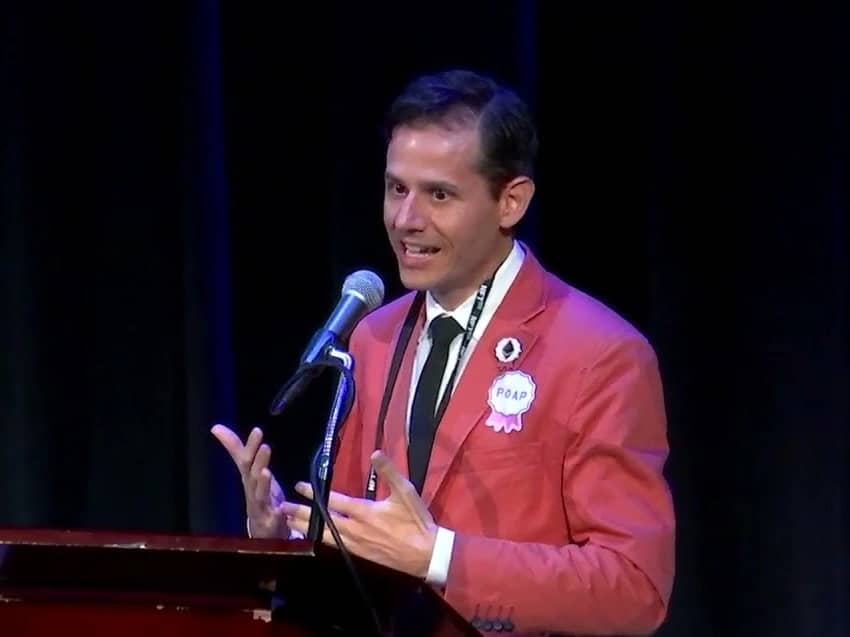
Patricio Worthalter
Patricio Worthalter is the founder of the Proof of Attendance Protocol (POAP), a foundational Web3 project that uses NFTs to create verifiable records of life experiences. [2] [4]
Career
Entrepreneurial Ventures
Before dedicating himself to the Web3 space, Worthalter was a serial entrepreneur in Argentina. From November 2013 to March 2017, he co-founded and served as the Chief Technology Officer (CTO) of Dift, a business solutions company. [5] In 2015, he founded Millares, a software development company. [2] During this period, he also founded Millienium S.A., where he led the development of OrderApp, a point-of-sale system designed for the restaurant industry, from February 2015 to December 2018. [5] Another source identifies him as the CEO of a related venture, Milliwatt, from January 2015 to January 2017. [6]
Proof of Attendance Protocol (POAP)
Worthalter began actively exploring the cryptocurrency and blockchain space around 2017. [2] He conceived the idea for the Proof of Attendance Protocol (POAP) in late 2018, driven by a desire to use blockchain technology to preserve human memories. The project made its public debut at the ETHDenver hackathon in February 2019, where the first-ever POAPs were created and distributed to commemorate participation in the event. This launch marked the beginning of POAP's journey into the Web3 ecosystem. [4] [5]
As the founder, Worthalter has consistently articulated a vision for POAP that prioritizes social connection and shared experiences over financial speculation. He often refers to POAPs as "bookmarks for your life" and has emphasized that the project's goal is to create a reliable, decentralized record of shared human experiences without compromising user privacy. He expressed this sentiment by stating, "I believe in a future where humans will have a new way to express their identity based on their experiences in life. Proof of Attendance Protocol is a step in that direction." [6]
The protocol's technology is built on NFTs, originally minted using the ERC-721 standard on Ethereum. To manage transaction costs and scale, POAP later migrated its issuance primarily to the Gnosis Chain (formerly xDai). [2] [5] POAP Inc. was formally established in August 2020. In January 2022, the company announced a $10 million seed funding round. The round was co-led by Archetype and Sapphire Sport, with participation from other notable investors including Collab+Currency, 1kx, Libertus Capital, Delphi Digital, and Sound Ventures. [2] [3]
As the project's most visible advocate, Worthalter has engaged in a grassroots growth strategy, personally attending major Web3 and technology conferences globally. Between 2021 and 2025, he frequently distributed special-edition POAPs at events in cities such as New York, Miami, Denver, Amsterdam, Paris, and Berlin, fostering direct engagement with the community. [1] This strategy, combined with the protocol's utility, led to widespread adoption by individuals, DAOs, and major brands like Adidas, Budweiser, L'Oréal, Google, and Porsche. [2] [4]
Scaling and Infrastructure Overhaul
The rapid success and adoption of POAP created significant technical hurdles. By early 2022, the protocol had issued millions of NFTs, and its "patchwork of disparate tools" for data indexing was struggling to keep up with the immense volume of queries. The infrastructure suffered from slow performance and instability, which impacted the user experience across the POAP ecosystem. [4]
Worthalter described the period as challenging, stating, "We were leading the charge in a brand new category. That meant solving problems no one else had even encountered yet. Throwing more engineering talent at the issue bought us time, but it wasn’t sustainable." [4]
To address this bottleneck, the POAP team, including Technical Lead Agustin Lavarello, initiated a search for a specialized infrastructure partner in March 2022. They ultimately collaborated with Goldsky, a real-time data infrastructure company, to manage POAP's data indexing layer. Goldsky's solution, which involved hosting POAP's subgraph and using its Mirror product to replicate data into a high-performance database, resolved the protocol's scaling issues. The new system enabled POAP to reliably handle billions of API requests per month with over 99.99% uptime and query latencies under 100 milliseconds. [4] [2]
Reflecting on the successful partnership, Worthalter said, "It was like night and day. We weren’t trying to keep up with demand anymore. We were ahead of it." He further elaborated, "Establishing a relationship with Goldsky has been a pivotal milestone in the history of POAP's tech stack. Before Goldsky we had to run our own indexing infrastructure... The performance gains and overall satisfaction of making Goldsky our main data provider have exceeded our expectations." [4]
Angel Investing
In addition to his leadership at POAP, Worthalter is an active angel investor with a focus on early-stage companies in the High Tech and Blockchain sectors. His portfolio consists of at least nine companies, primarily concentrated on Web3 infrastructure, tooling, and related technologies in the United States and the United Kingdom. [3]
His notable investments include:
- Taiko: A ZK-Rollup project. Worthalter participated in its $12 million seed round on June 8, 2023.
- Salsa: A Web3 messaging platform. He invested in its $2 million seed round on February 16, 2023.
- Evertas: A crypto insurance provider. He was part of its $14 million Series A round on December 12, 2022.
- Laylo: A platform for creator-focused drops. He participated in its seed round on October 12, 2022.
- tokenproof: A company specializing in token-gating solutions. All angel investing information is based on his public investment profile. [3]
Financial Activities
Worthalter's on-chain financial activities have occasionally been the subject of public reports. On September 12, 2025, an on-chain analysis reported by MEXC News and PANews detailed a significant Ethereum transaction he conducted. He sold 2,000 ETH for a total of $8.85 million USDC, at an average price of $4,423 per ETH. The report noted that this sale resulted in a realized profit of approximately $5.37 million from ETH that had been held for about two years. Following the sale, the same address was reported to hold a remaining balance of 41,135 ETH, valued at approximately $183 million at that time. [7]
Interviews
Why POAP and Cultural Value in NFTs #01
In an interview published on November 30, 2021, on the YouTube channel hosted by Adam Levy, Patricio Worthalter discussed his background in technology and his involvement with cryptocurrencies, as well as the development of POAP. According to Worthalter, his early exposure to technological work in Argentina and his experience within an economy affected by monetary controls influenced how he approached cryptoassets, which he described primarily as coordination and record-keeping mechanisms.
Worthalter explained POAP as a protocol that issues blockchain-based tokens to document participation in digital and physical events. These tokens serve as verifiable records associated with specific moments or activities. From his perspective, this system enables individuals and groups to maintain independently verifiable histories of participation without relying on centralized social platforms. He stated that the protocol was developed to explore non-financial applications of blockchain networks, particularly within the Ethereum ecosystem.
During the interview, Worthalter commented on his public bid of approximately ten million dollars for a token from the CryptoPunks series. He indicated that the bid was not primarily intended to result in ownership, but rather to examine how factors such as social context, recognition, and perceived legitimacy influence pricing behavior in NFT markets. According to his account, the event illustrated that valuation in this segment is shaped by more than transactional demand.
Worthalter also outlined POAP’s organizational approach, stating that the project prioritizes functioning as a protocol layer rather than operating consumer-facing applications. He noted that this approach allows external developers and organizations to build services using the protocol’s infrastructure. Reflecting on earlier stages of the project, he stated that limited engagement with partnerships and distribution channels affected the pace of adoption, highlighting the role of outreach alongside technical development.
The interview reflects Worthalter’s view of POAP as a system for maintaining decentralized records of participation and his broader interpretation of NFTs as instruments for recording social activity and affiliation within blockchain-based environments. [8]
POAP, NFTs, and Digital Memory #02
In an interview published on November 30, 2021, on the YouTube channel Adam Levy, Patricio Worthalter discussed his background in the blockchain ecosystem and outlined his interpretation of the origins and evolution of POAP within the broader context of NFTs. According to Worthalter, POAP was conceived as a non-financial application of blockchain technology, with the primary function of recording participation in events and documenting experiences in digital form.
Worthalter characterized POAP as an additional type of collectible that exists alongside physical memorabilia. In his explanation, POAPs serve as digital records of attendance and community involvement rather than as speculative assets. He stated that this framing was intended to align the concept with familiar collecting practices, reducing the need for technical explanations related to blockchain or NFTs. He also noted that early adoption progressed gradually, which he attributed to the predominance of trading-oriented activity in the crypto ecosystem during POAP’s initial development.
According to Worthalter, the use of POAP expanded over time to include a broader range of participants, including enterprises and financial institutions. He stated that banks, payment networks, and other corporate entities adopted POAPs for purposes related to user engagement and event-based interaction. In his account, this adoption demonstrated that blockchain-based collectibles could be integrated into institutional environments without functioning as financial instruments.
Worthalter also addressed structural considerations related to POAP’s operation, including curation, controlled issuance, and the avoidance of financial incentives. He indicated that these elements were considered necessary to maintain the intended function of POAPs as records of participation rather than tradable assets. He further described POAP as an initiative that could function as a digital public good, referencing models of open and neutral information systems such as Wikipedia, while acknowledging the organizational and governance constraints associated with such an approach.
In discussing the NFT ecosystem more broadly, Worthalter presented a long-term view, stating that the sector remained in an early stage of development. He referenced community-based initiatives, including decentralized autonomous organizations and projects such as Nouns DAO, as examples of ongoing experimentation in areas related to coordination, identity, and governance. According to his perspective, these efforts illustrate potential directions for non-financial applications of NFTs within decentralized systems. [9]