Richard Teng
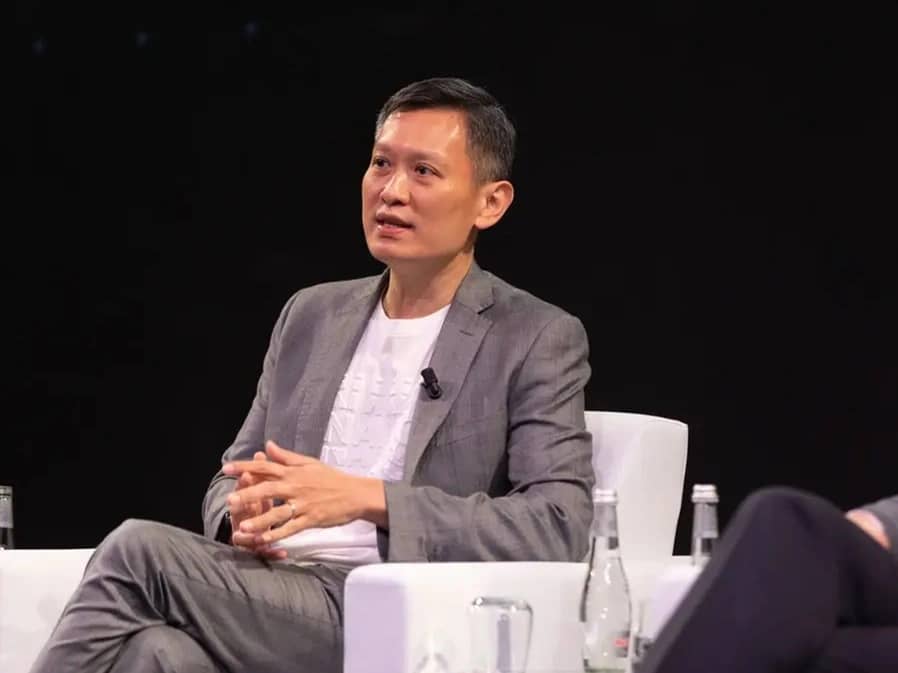
Richard Teng is the CEO of Binance who previously served as the Head of Regional Markets at the exchange. He had previously served as the CEO of the Financial Services Regulatory Authority at Abu Dhabi Global Market, as the Chief Regulatory Officer of the Singapore Exchange (SGX), and as the Director of Corporate Finance at the Monetary Authority of Singapore.[1][4]
Education
In 1998, Richard Teng graduated from The University of Western Australia with a master's degree in Applied Finance with distinction. He previously graduated from Nanyang Technological University in 1994 with a degree in Accountancy with first-class honors. In 2004, he participated in an Executive Leadership Program at The Wharton School.[1][4]
Career
Binance
Richard Teng joined Binance in August 2021 as CEO of Binance Singapore.[4] He became Regional Head of MENA (Middle East and North Africa) in December 2021, a position he held until October 2022, before serving as Regional Head of Europe and MENA from November 2022 to April 2023 and Regional Head of Asia, Europe, and MENA from April to May 2023.[4] In May 2023 he was appointed Head of Regional Markets at Binance, a move that CoinDesk described as positioning him as a potential successor to CEO Changpeng Zhao (CZ).[7] On November 21, 2023, Binance announced that Teng, then Global Head of Regional Markets, would take over as CEO effective immediately, replacing founder CZ.[5]
In its November 2023 announcement of the leadership change, Binance stated that Teng would succeed CZ as CEO and emphasized his roughly three decades of experience in financial services and regulation as preparation to guide the company through its next phase.[5] Teng wrote on X that he regarded it as an honor to lead what he described as the world’s largest [[cryptocurrency]] exchange by volume, stressed the protection of user funds, and outlined priorities of financial strength, regulatory collaboration, and expanding Web3 adoption through partnerships.[17] CZ, in his own post, portrayed Teng as a highly qualified leader whose regulatory background at the Abu Dhabi Global Market (ADGM), Singapore Exchange (SGX), and the Monetary Authority of Singapore equipped him to oversee a new phase focused on security, transparency, compliance, and growth.[23] The leadership transition occurred alongside a settlement in which CZ and Binance both pleaded guilty to money laundering violations, with CZ agreeing to pay $50 million in fines and Binance paying $4.3 billion in fines in a resolution with the United States Department of Justice.[6]
Earlier in November 2023, during Binance Blockchain Week in Istanbul, the company launched the Binance Web3 Wallet, which Teng promoted as part of a broader push to expand user access to decentralized applications and self-custody tools under Binance’s brand.
As CEO, Teng has characterized his main priorities as keeping the exchange user-focused, working closely with regulators, and developing partnerships that support wider Web3 adoption.[17][18] He has described this as part of a longer-term strategy to position Binance for decades of operation rather than short-term growth, outlining what he has called a 50
- to 100-year horizon for the exchange.[19] After taking over, Teng emphasized transforming Binance into a more traditionally governed and highly regulated exchange; under his leadership, Binance has moved from a founder-led structure toward oversight by a board of directors, increased spending on compliance by 36% year-on-year, expanded hiring in compliance and legal functions, and pursued additional licenses in markets including Dubai, Kazakhstan, Thailand, India, and other jurisdictions.[19][20] He has also stated that establishing a global headquarters and improving transparency with regulators are key to building what he describes as a sustainable platform designed to operate over multiple decades.[19][20]
In an interview with Coin Bureau on Binance’s direction after the leadership change, Teng said the exchange aimed to remain “user-focused” while also becoming a “compliance-focused organization,” reflecting his intention to balance growth with tighter regulatory standards.[13] He also stated that Binance’s business and capital structure were strong and that, following scrutiny from U.S. agencies, there were no findings that user funds had been misappropriated.[13]
In October 2025, following significant market volatility that led to degraded performance on the exchange, several tokens, including Ethena's stablecoin USDe, the Binance-issued Solana liquid staking token BNSOL, and the Wrapped Beacon liquid staking token WBETH, experienced dramatic de-pegs. The USDe stablecoin, intended to be pegged at $1, dropped below $0.66. In response, Binance announced it would compensate some users who incurred losses attributable to the platform's issues, and Teng publicly apologized to impacted users, saying that the exchange would listen, learn from the incident, and commit to doing better. Co-founder Yi He similarly stated that when the platform fell short, it would take responsibility without excuses or justifications.[15]
Under Teng’s leadership, Binance has highlighted both retail and institutional usage of the exchange. In public remarks in 2026, he stated that Binance served about 300 million users and recorded $34 trillion in trading volume in 2025, while also pointing to continued institutional participation during periods of market volatility.[16] Teng has discussed institutional and corporate adoption of digital assets as a key driver of long-term growth, alongside trends such as real-world asset tokenization and the use of stablecoins for remittances and financial inclusion.[18][16]
In 2025, Teng addressed a U.S. Department of Justice civil forfeiture complaint seeking about $61 million in cryptocurrency that prosecutors said came from black market sales of sanctioned Iranian oil and was routed through accounts at Binance. He emphasized that the complaint did not name Binance as a defendant or allege wrongdoing by the exchange and stated that Binance has zero tolerance for sanctions violations, cooperates with law enforcement, and freezes accounts where it identifies illicit finance risk.[21] In 2026 comments on the industry’s outlook, he contrasted the estimated sizes of traditional financial services, global payments, and social media markets with the valuation of crypto exchanges, arguing that exchanges represent a small fraction of those sectors and suggesting that even marginal adoption across them could translate into substantial growth for the crypto industry.[22]
Abu Dhabi
Before joining Binance, Richard Teng was the CEO of the Financial Services Regulatory Authority at Abu Dhabi Global Market (ADGM), joining the regulatory body in March 2015. The ADGM is the international financial center in Abu Dhabi and was created in 2013 to contribute to the UAE's economic diversification, as well as consolidate long-term growth.[1]
The market became fully operational in 2015, under Richard's leadership, and is made up of three authorities: the Financial Services Regulatory Authority, the Registration Authority, and ADGM Courts. The ADGM was the first jurisdiction in the region to adopt common law in its entirety.[8]
During Teng’s tenure, ADGM introduced several regulatory initiatives to support investment and new asset classes, including a private real estate investment trust regime, a venture capital framework for fund managers, an aviation financing scheme, and the first foundation regime in the UAE. It also established an early fintech regulatory framework and regulatory laboratory that helped position ADGM as a regional fintech hub, contributing to its recognition as Financial Centre of the Year (MENA) by Global Investor ISF in 2017.[8]
Singapore
Richard joined ADGM from the Singapore Exchange (“SGX”) in September 2007, where he was the Chief Regulatory Officer. Richard also held several senior appointments at SGX including Senior Vice President, Head of Issuer Regulation and Chief of Staff for Risk Management and Regulation, and Head of Regulation.[1][4]
Prior to SGX, Richard served as the Director of the Corporate Finance Division of the Monetary Authority of Singapore from 1997 to 2004.[1][4]
During his 13 years at MAS, where he rose to become director of corporate finance, he was part of the team that started initiatives such as GIC/Temasek, Singapore's sovereign wealth fund, providing capital to encourage the growth of the asset/fund management scene, consolidating local banks, opening up the banking sector to international players and building the private banking sector, and merging Singapore International Monetary Exchange, Securities Clearing and Computer Services and Singapore Stock Exchange to become present-day Singapore Exchange (SGX).[9]
He was posted to New York where he spent two years setting up an MAS outpost to promote Singapore as a financial center in overseas markets.
“I’ve been very fortunate to have been part of that transformation journey. Those were exciting times: the adrenalin rush, rolling out new efforts and initiatives,” - Teng recalls
He left MAS in 2007 for SGX where he became chief regulatory officer in 2014. At SGX, he established a direct listing framework for Chinese companies, introduced a regulatory framework for secondary listings, and augmented safeguards in the stock market.[9]
Board Positions
In April 2021, Richard Teng joined UAE-based LuLu Financial Group, a holding company with investments in financial services and products spanning the GCC, Indian sub-continent, and APAC regions, as a part-time Board Director until 2022.[4][10]
Speaking on his appointment, Mr. Richard Teng said:
“It is a privilege to join the Board of Lulu Financial Holdings that has seen exponential growth under the inspirational leadership of Mr. Adeeb Ahamed. I look forward to supporting the Holding company in expanding its global footprint, with the introduction of more financial services products and services that meet the demands of the evolving market needs in the new digital economy.” [10]
In July 2021, Richard was announced as an Advisory Board Member at Blockchain Association Singapore (BAS).[11]
He was also appointed as an International Council Member at Global FinTech Institute in July 2021, before joining Binance.[4][12]