Ryan Shea
Ryan Shea is an engineer, entrepreneur, and angel investor, best known as the co-founder of Stacks, a platform for building smart contracts and applications anchored to Bitcoin.[10] He has founded or co-founded products including Opus Wallet, a cryptocurrency wallet, and Voterbase, a voter education application that provides information on candidates and issues.[10] Shea has served as a senior advisor and technology advisor on artificial intelligence at the U.S. Department of Health and Human Services and the Food and Drug Administration, and is building AI research tools for biotech and investing while remaining an active angel investor specializing in AI, biotech, crypto, and deep tech.[1][11]
Education
Shea studied Mechanical and Aerospace Engineering at Princeton University from 2008 to 2012, earning a Bachelor of Science in Engineering with additional certificates in Computer Science and Robotics. In the summer of 2010, he completed a program at Stanford University. In 2014, Shea participated in the Summer batch of Y Combinator, an entrepreneurship program focused on early-stage companies.[2]
Career
Shea began his career in 2009 as a co-founder of NowINeed, a local services marketplace that connected users with providers for on-demand tasks and errands. In 2011, he worked as a software engineering intern at ZocDoc, where he contributed to the development of an early consumer-facing product that automated medical forms. In 2012, Shea co-founded GraphMuse, a company that provided social network analysis services for businesses building on social platforms. From January to June 2013, he worked in marketing and operations at OmniActive Health Technologies, a nutraceutical company.[3]
Later in 2013, Shea co-founded Stacks (formerly Blockstack) and served as its chief executive officer until 2018, overseeing the development of a blockchain platform designed to support smart contracts and decentralized applications secured by Bitcoin.[10] He helped lead one of the first SEC-qualified Reg A+ token offerings for the project in 2019 and stepped back from day-to-day work on the Stacks protocol around 2020, while remaining a co-founder.[10] In 2020, Shea created Voterbase, a nonpartisan voter education platform that offered personalized ballot previews and candidate information, and in 2022 he founded Opus Wallet, serving as its chief executive officer through 2024 and focusing on developing tools for managing digital assets.[10] In 2025, he worked as a senior advisor and technology advisor on AI at the U.S. Department of Health and Human Services and the Food and Drug Administration, and he is building AI research tools for biotech and investing while remaining an active angel investor with a focus on AI, biotech, crypto, and deep tech.[1][10][11]
Interviews
A Decentralized Future
In a June 2018 interview on Fortune’s Balancing the Ledger, Shea and Muneeb Ali discussed developments in the decentralized internet and the broader crypto ecosystem. They commented on Coinbase’s acquisitions aimed at securing a broker-dealer license, framing this as a step toward clearer regulatory structures, and outlined how tokenization could change the trading and transfer of assets across markets. Drawing on their experience as advisors for the fifth season of Silicon Valley, they referenced how concepts from decentralized technologies informed elements of the show. The conversation also covered Blockstack’s goal of enabling user-controlled data and developer-built applications, including a funding model that rewarded developers based on application usage and value. Examples such as decentralized document editing and secure messaging applications were cited to illustrate these ideas, alongside criticism of centralized internet models dominated by large platforms. The interview concluded with a discussion of initiatives to encourage decentralized social networks and a longer-term view of internet systems built around user ownership, interoperability, and data control.[6]
Blockstack
In a March 2018 interview with Crypto Bobby, Shea discussed Blockstack’s approach to building a decentralized internet and its underlying design principles. He described the project’s focus on shifting control of data and identity away from centralized intermediaries toward users, and outlined a three-layer architecture combining a blockchain for core transactions, peer-to-peer storage, and existing web protocols for scalability. Shea noted that this structure had attracted experienced developers and highlighted applications such as decentralized document editing tools presented at the Blockstack Summit. He also addressed how the network’s token was used for transactions and incentives, the role of funding and mentorship in supporting developers, and plans to launch the mainnet and expand user adoption while following structured token distribution timelines.[7]
Fireside w/ Ravikant
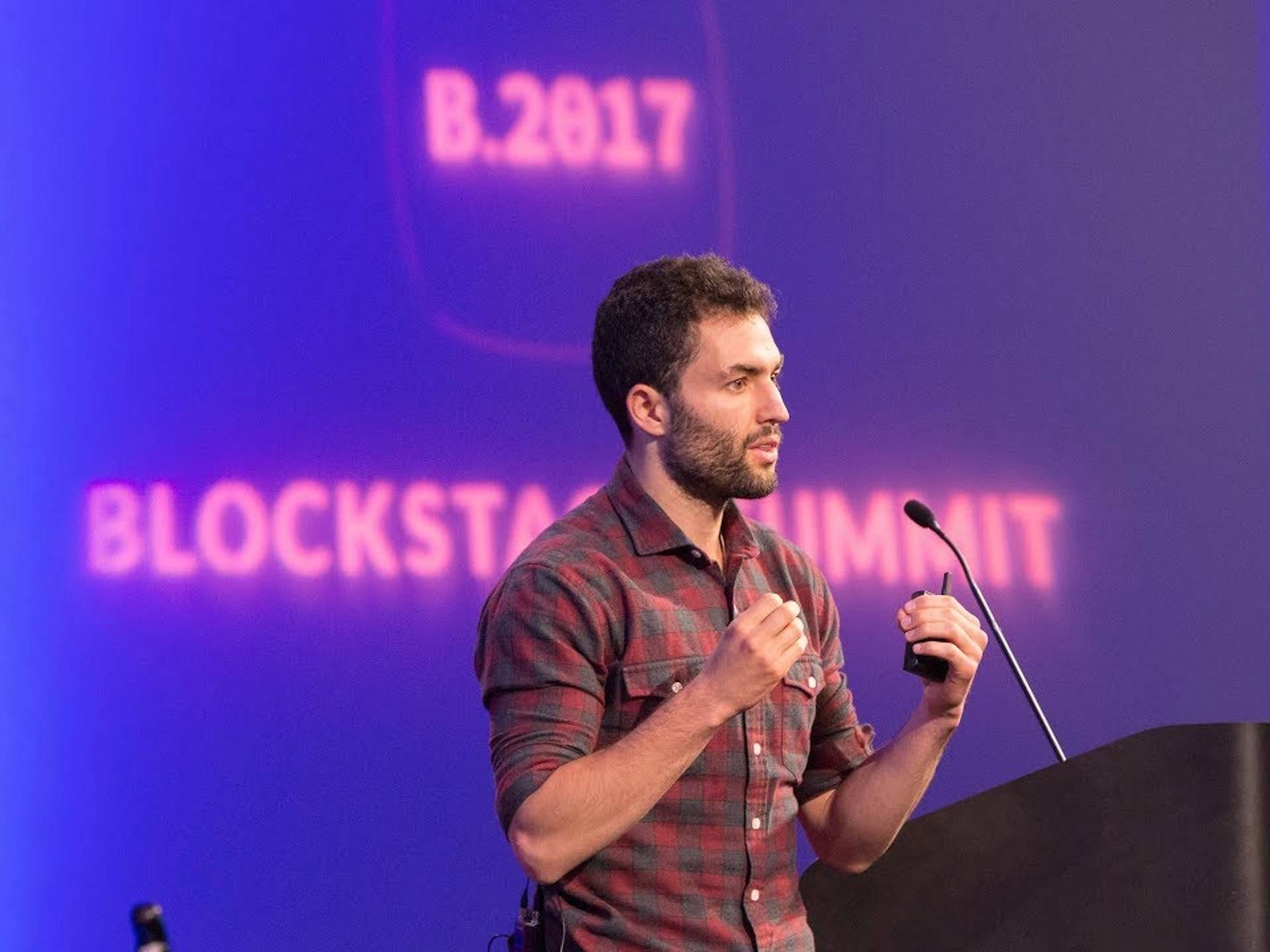
In an August 2017 fireside chat at the Blockstack Summit, Shea and Naval Ravikant discussed the broader implications of blockchain technology for money, governance, and society. Ravikant observed growing interest in blockchain and token models, framing decentralized systems as a potential response to longstanding governance challenges and a counterbalance to highly centralized platforms. The conversation emphasized how decentralization could shift control of data and identity to individuals, enable more open forms of social organization, and support applications beyond finance, including social media, communications, and energy systems. They also acknowledged obstacles to adoption, particularly resistance from entrenched institutions, while suggesting that decentralized technologies could amplify marginalized voices and influence how societies organize in the long term.[8]
Presentations
New Blockstack Internet
In an August 2017 presentation at the Blockstack Summit, Shea outlined Blockstack as a framework for building decentralized applications that enable users to retain control over their identities and data. He described a structured approach to developing decentralized networks, drawing on examples such as email and Bitcoin to illustrate how open systems can outperform closed, centralized platforms. The talk contrasted traditional internet business models that concentrate user data within corporate silos with an alternative architecture centered on user-owned data and decentralized application interfaces. Shea also discussed phased development of the network, mechanisms for incentivizing developers through tokens and usage-based rewards, and the broader objective of shifting value creation from centralized technology platforms toward open, decentralized networks.[9]