Subscribe to wiki
Share wiki
Bookmark
World Rebuilding Trust
0%
World Rebuilding Trust
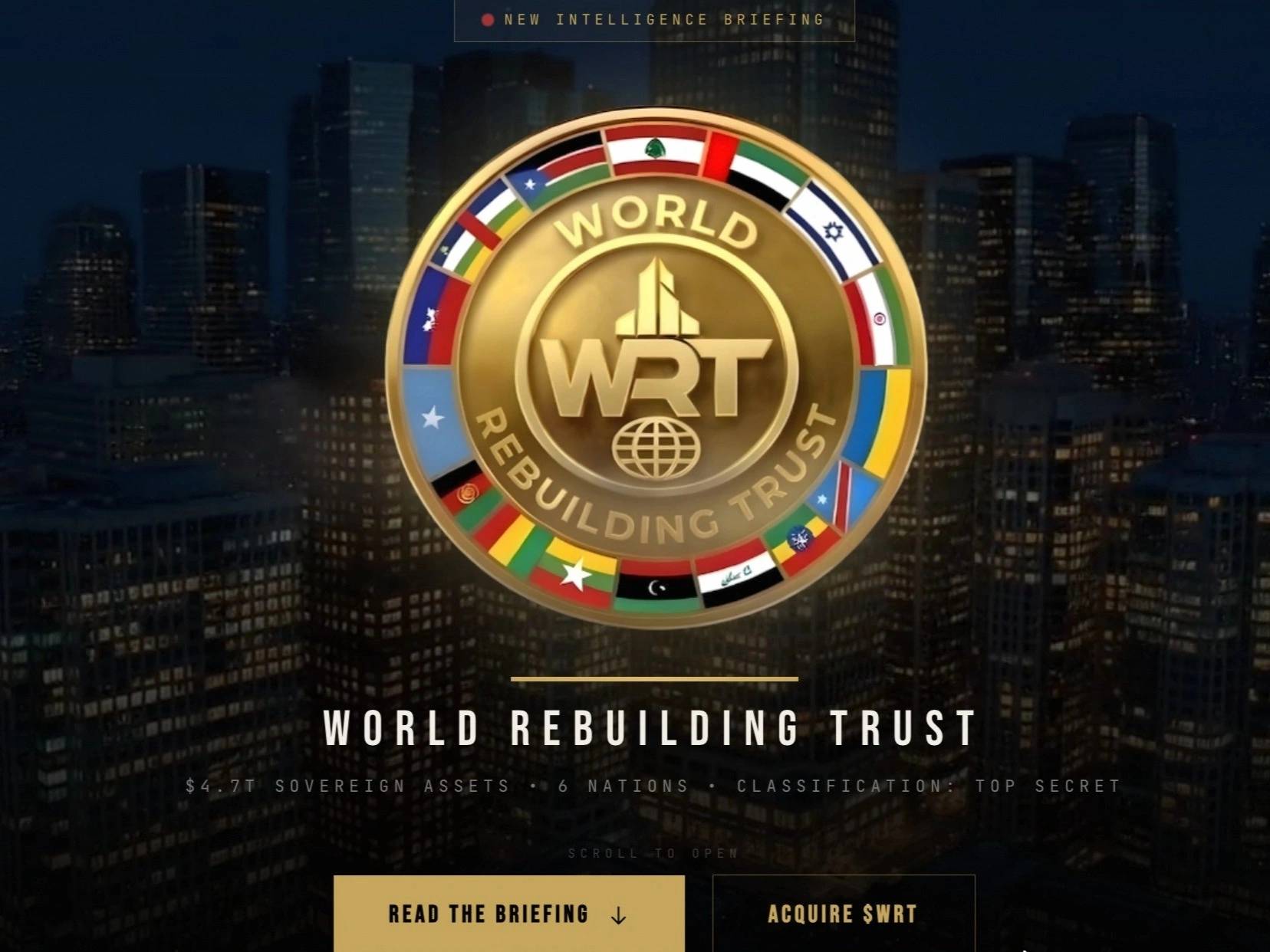
World Rebuilding Trust (WRT) is a meme coin on the Solana blockchain that presents itself through two distinct and conflicting narratives. The project's official marketing frames it as a clandestine, geopolitical "Rebuilding Finance Protocol" tasked with tokenizing a purported 30,000 to $40,000 stands in stark opposition to its multi-trillion-dollar claims. [2] [3]
The project was launched by an anonymous group referred to as the "Founding Council," and it operates on the Solana network, utilizing the Token-2022 standard. [1] [3]
Overview
The central premise of World Rebuilding Trust, as promoted on its official website, is that it functions as a specialized financial protocol designed to manage and deploy capital for rebuilding efforts in post-conflict zones. The project claims its purpose is to tokenize large-scale rebuilding funds to protect their value from the "inflationary erosion" that affects traditional fiat currency reserves over the long term. [1]
The project's marketing is heavily stylized with a "classified intelligence" and "secret government dossier" aesthetic, using redacted text and formal, bureaucratic language to imply a level of authority and legitimacy. This narrative asserts that WRT has an exclusive mandate to finance the comprehensive reconstruction of infrastructure, including transport, healthcare, education, and governance, across six specific nations and territories: Ukraine, Israel, Gaza, Lebanon, Syria, and Iraq. [1] [2]
This official narrative is contradicted by external analysis which classifies WRT as a speculative meme coin. According to data aggregator CoinGecko, WRT's mission is an experiment in decentralized philanthropy. Under this model, the project leverages meme culture and community engagement to generate funds for charitable initiatives through a tax on token transactions. Decisions on which charities receive donations are made via community polls conducted on the project's social media channels. [3]
Project Claims and Stated Asset Backing
WRT's marketing is centered on a series of extraordinary and unverified claims regarding its financing, asset backing, and institutional partnerships. [2]
Alleged Mandate and Capital Pool
The project claims to be tokenizing a capital pool valued at $4.7 trillion designated for global reconstruction. Its website alleges that WRT holds exclusive contracts to finance rebuilding efforts in six unnamed nations. [1] [2] The project also makes a specific but unsubstantiated reference to "USAID page 362" as supposed evidence of its mandate, though no such public document corroborates this connection. [2]
Claimed Asset Reserves
WRT asserts that its token value is not derived from traditional currency but is instead backed by a reserve of "confiscated sovereign resources and federally seized asset pools." The project has made specific, unverified claims about the contents of this reserve. [1]
The claimed assets include:
- Venezuelan Oil: The entirety of seized petroleum reserves from Venezuela, which the project claims to have tokenized.
- Greenland Minerals: An unspecified quantity of rare earth minerals and other strategic resources from Greenland.
- Confiscated Bitcoin: Digital assets allegedly seized from "Iranian state-sponsored mining operations."
As of March 2026, none of these claims are supported by public records, partner statements, or independent verification. [1] [2]
Alleged Institutional Involvement
The WRT website explicitly states that the financial giant BlackRock ($10 Trillion AUM) serves in a "Strategic Advisory Role" for the project. It also claims there is "significant institutional wallet activity" associated with the protocol. However, there are no public statements, SEC filings, or any other form of confirmation from BlackRock or other institutions to support this claim. Analysts widely consider this an unsubstantiated marketing tactic intended to create a false impression of credibility by association. [1] [2]
Technology
WRT is a token built on the Solana blockchain, operating as an SPL token. The project's choice of Solana is attributed to the network's high transaction throughput and low fees. [3] [1]
A key technical feature of the project is its use of the Token-2022 standard, an updated version of the Solana Program Library's token program. This standard enables more complex, on-chain functionality to be embedded directly into the token's contract. For WRT, the Token-2022 standard is utilized to implement an automatic transaction tax. This mechanism is the core of its philanthropic model, as it automatically collects a percentage of every trade and distributes the funds to different wallets designated for charitable donations, liquidity replenishment, and project marketing and development. [3]
The project's contract address is JCcd7NmyHVmiuycHP6drEesBSZhZUJXhBMbhxq42RNg3. A critical technical aspect is that the Mint Authority for the token contract has been revoked. This action permanently prevents the creation of any new WRT tokens, fixing the total supply and providing a degree of security against supply inflation. [1] [2]
Tokenomics
The tokenomics of World Rebuilding Trust reflect its dual narratives, with the official allocation focusing on large-scale funds and the practical application revolving around a transaction tax.
Supply and Allocation
The maximum supply of WRT was initially set at 1,000,000,000 (1 billion) tokens. As of March 2026, market data shows a total and circulating supply of approximately 999,998,137 WRT. The slight discrepancy suggests that minor token burn events have occurred, permanently removing some tokens from circulation. [3] [1]
According to the project's official website, the total supply is allocated as follows:
- Rebuilding Fund: 40% (400,000,000 WRT)
- Liquidity Pool: 25% (250,000,000 WRT)
- Seized Asset Reserve: 15% (150,000,000 WRT)
- Strategic Operations: 12% (120,000,000 WRT)
- Founding Council: 8% (80,000,000 WRT)
No accountability mechanism has been defined for the 8% of tokens allocated to the anonymous "Founding Council." [1] [2]
Transaction Tax
As part of its philanthropic model described by CoinGecko, WRT employs a transaction tax enabled by the Token-2022 standard. This tax is levied on token trades and is designed to fund project operations and charitable goals. The collected fees are reportedly split between a charitable donations wallet, funding for the liquidity pool, and a wallet for marketing and development. Token holders participate in the philanthropic process by voting in community polls to determine which charitable organizations will receive the funds. [3]
Market Data and Trading
As of March 2026, WRT is a micro-cap cryptocurrency with very low liquidity and trading volume. Its market capitalization was reported to be between approximately $31,000 and $40,297. The 24-hour trading volume was approximately $6,790. With this valuation, it ranked outside the top 7,000 cryptocurrencies tracked by CoinGecko. [2] [3]
The token's price history shows extreme volatility, which is characteristic of meme coins. Its all-time high was recorded at $0.002716, while its all-time low stands at $0.00001827. [3]
WRT is traded exclusively on Solana-based decentralized exchanges (DEXs). The primary and most liquid trading venue is Meteora, where the WRT/USDC pair accounts for nearly all of the token's trading activity. While also listed on the Orca DEX, data indicated that its trading pool on that platform was inactive. [3]
Roadmap
The project's official website outlines a three-phase operational timeline for its development.
- Phase I (Status: Active): This phase included the initial deployment of the WRT token on the Solana blockchain, the launch of its liquidity pool, the establishment of community and social media channels, and the launch of the
wrt.fundwebsite. - Phase II (Status: Pending): Future plans in this phase involve submitting applications for listings on centralized exchanges (CEXs), securing partnerships for additional rebuilding contracts, deploying a protocol governance framework, and beginning a process for institutional onboarding.
- Phase III (Status: Classified): The final phase is mostly obscured. Its stated objectives include the deployment of a cross-chain bridge, the full activation of the "Rebuilding Fund," and the establishment of a treasury for a Decentralized Autonomous Organization (DAO). The final objective of this phase is redacted and described only as an undisclosed mission.
All information regarding the project's roadmap is sourced from its official website. [1]
Controversies and Criticisms
World Rebuilding Trust has drawn significant criticism and skepticism, primarily stemming from the vast and irreconcilable differences between its ambitious claims and its on-chain reality. [2]
Extreme Valuation Discrepancy
The most prominent criticism is the chasm between the project's claimed management of a $4.7 trillion financial mandate and its actual market capitalization of approximately $31,000 (as of March 2026). This discrepancy of several orders of magnitude leads analysts to conclude that the project's narrative is a fictional marketing construct rather than a reflection of any real-world financial operation. [2]
Unsupported Partnership Claims
The project's claim of having BlackRock in a "strategic advisory role" is a major point of contention. This claim is entirely unsubstantiated by any evidence from BlackRock or public records and is widely viewed as a fabricated association designed to mislead potential buyers and lend unearned credibility to the project. Similarly, claims of contracts with sovereign nations and links to USAID remain unverified. [2]
Misleading Marketing and Legal Contradictions
The project's aesthetic, which mimics "top secret" government documents, is seen by critics as a deliberate marketing tactic to create a false impression of authority. Social media activity, including the use of recycled slogans like "millionaires by April 15," suggests low-effort or automated promotional campaigns inconsistent with a serious financial entity. [2]
Furthermore, a significant contradiction exists in the project's legal positioning. The website's footer contains a disclaimer stating that WRT is not an investment, security, or financial instrument and that the project makes no guarantees about its price performance. This directly contradicts the entire marketing narrative based on large-scale financial operations and asset-backed value. This disclaimer is likely a measure to mitigate legal liability for what is otherwise presented as a financial venture. [1] [2]
Anonymity and Risk
The development team, or "Founding Council," is completely anonymous. This lack of public accountability is a significant risk factor, as there are no identifiable individuals or entities responsible for the project's operations or the funds allocated to the team. The project's self-description as an "experiment" in decentralized philanthropy, combined with its meme coin classification and extremely low liquidity, positions it as a high-risk, highly speculative asset. [3]
See something wrong?