ADI Foundation (ADI)
The ADI Foundation (ADI) is an influential non-profit organization dedicated to enabling governments, sovereign entities, and regulators to adopt blockchain technology. By providing purpose-built frameworks and infrastructure that align with national priorities, the foundation seeks to advance the integration of blockchain in various sectors. [1]
Overview
Headquartered in Abu Dhabi, the organization aims to bring one billion people onto the blockchain by 2030, focusing initially on markets in the Middle East, Asia, and Africa. Founded as part of a movement to enhance digital infrastructure in emerging markets, the ADI Foundation has positioned itself as a leader in blockchain adoption since its inception. The organization’s efforts are deeply rooted in the vision to level the digital playing field by empowering previously unbanked populations and offering them access to secure, efficient, and transparent financial systems. The ADI Foundation's initial focus has been on countries within the MENA region, particularly emphasizing financial inclusion through their blockchain solutions. [1] [2] [3]
Products
ADI Network
ADI Network is the execution framework underpinning the ADI ecosystem. Built on the ZKsync stack, it functions as a modular execution layer that processes transactions, manages state transitions, and generates zero-knowledge validity proofs. The network includes components such as a bootloader, execution environment, and system layer for handling storage, messaging, and external data inputs. It is designed to support scalable transaction processing while maintaining compatibility with Ethereum-based applications and infrastructure. [7] [3]
ADI Chain
ADI Chain is a Layer-2 blockchain secured by Ethereum and developed to support institutional, enterprise, and government use cases. The network utilizes zero-knowledge rollup technology to execute transactions off-chain while settling proofs on Ethereum. It is EVM-compatible, allowing developers to deploy Ethereum smart contracts with minimal modification. The platform supports applications such as digital payments, stablecoins, tokenized real-world assets, digital identity systems, registries, healthcare data management, and cross-border financial services. ADI Chain also enables the deployment of customizable Layer-3 networks designed to meet specific regulatory, sectoral, or jurisdictional requirements. [2]
Tokenomics
The ADI token serves as the native utility asset of the ADI ecosystem. It was initially launched as an ERC-20 token on Ethereum and is intended to support network operations, including transaction fees, smart contract execution, and settlement activities across ADI Chain and related infrastructure. The token has a fixed genesis supply of approximately 1 billion ADI. [5] [8]
Allocation
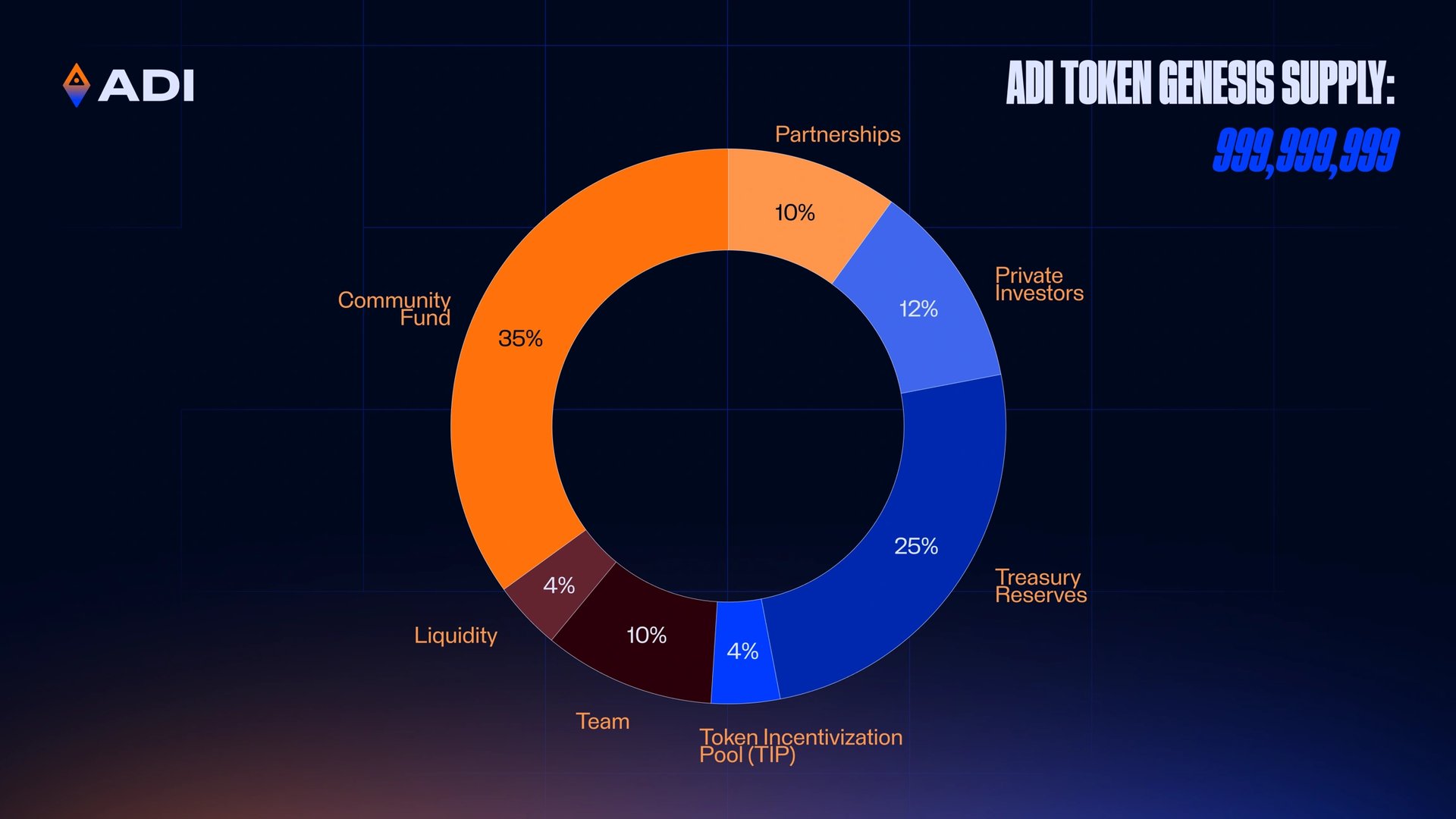
- Community Fund: 35%
- Treasury Reserves: 25%
- Private Investors: 12%
- Partnerships: 10%
- Team: 10%
- Token Incentivization Pool: 4%
- Liquidity: 4% [8]
Token Utilities
- Transaction Fees: ADI serves as the native gas token for transactions, smart contract execution, and decentralized application activity on ADI Chain and associated Layer-3 networks.
- Settlement and Payments: The token is used as a medium of exchange within the ecosystem, facilitating transfers and settlements between users, developers, enterprises, validators, and other participants.
- Staking: Holders can stake ADI in designated staking mechanisms to support network participation and receive rewards, with the system designed around treasury-backed incentives rather than additional token issuance.
- Layer-3 Ecosystem Support: ADI is intended to power future Layer-3 domains built on ADI Chain, including applications related to digital identity, payments, logistics, registries, and other enterprise or public-sector use cases.
- Stablecoin and Infrastructure Operations: The token is also used to pay network fees for transactions involving ecosystem services, including stablecoin infrastructure and other applications operating on ADI Chain. [9]