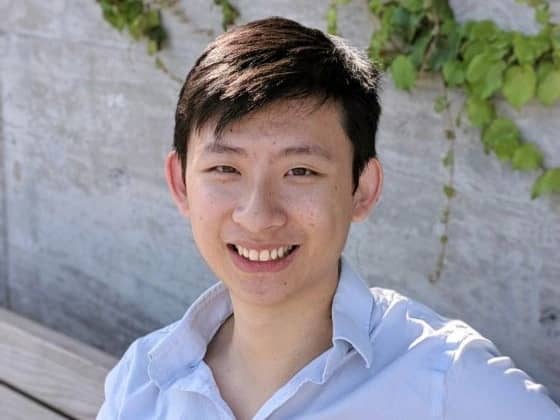
Edward Yu
Edward Yu is the co-founder of Variational Research, a firm building derivatives infrastructure for decentralized finance (DeFi).[1] He founded the company in 2021 with Lucas Schuermann, whom he had met as an engineering student and researcher at Columbia University, and the two previously ran a crypto hedge fund and a large over-the-counter (OTC) trading desk together before turning to protocol development.[2] Yu is based in Taiwan and divides most of his time between New York, Berkeley, and Taipei.[3][4]
Early Life and Education
Yu attended Plano West, a high school in Texas, between 2010 and 2014, before enrolling at Columbia University in New York.[3] He studied Applied Mathematics at Columbia from 2014 to 2017 and graduated with honors, earning a Bachelor of Science degree.[4][5] While an undergraduate he was involved with the Residential Incubator, the Chess Club, and Columbia University Financial Engineering, and his coursework spanned complex analysis, data structures and algorithms, linear algebra, machine learning, partial differential equations, and statistical inference.[5]
It was at Columbia, as engineering students and researchers, that Yu met Lucas Schuermann, his future business partner in three successive ventures.[2] Alongside his degree, Yu worked as a research assistant in the university's applied mathematics environment across several periods between 2014 and 2017. His research assignments included using network analysis and inferential statistics to study the Chinese political network, work in algorithmic statistics and machine learning, and, in the Department of Applied Mathematics, research on Bayesian reinforcement learning.[5]
Yu's early professional experience combined data science and software engineering. In 2013 he was a software engineering intern at The Trade Group in Dallas, where he coded and implemented a vendor management system for tracking suppliers and trained other staff to use it.[5] In mid-2015 he worked as a data scientist at Koddi in Dallas, building mathematical models for automated ad-bidding strategies, and in the summer of 2016 he was a data engineering intern at Facebook in Menlo Park, focused on user acquisition, retention, and experience in a big-data context.[5] He states that his 2016 research on unsupervised anomaly detection was implemented into production during his time at Facebook.[4]
Career
The Trade Group
Edward Yu began his professional experience as a Software Engineering Intern at The Trade Group, where he worked from June to August 2013 in the Dallas-Fort Worth metropolitan area. His responsibilities included developing and implementing a vendor management system for organizing information on suppliers, such as addresses, prices, and descriptions. He also provided training to employees on the use of the system, which served as a basis for later work with blockchain.
Columbia University
Yu held several research positions at Columbia University. From September 2014 to June 2015, he worked as a Research Assistant, applying network analysis and inferential statistics to the study of the Chinese political network.
Between October 2015 and May 2016, he worked in the Department of Computer Science as a Research Assistant, with research focused on algorithmic statistics and machine learning.
From September 2016 to December 2017, Yu worked in the Department of Applied Mathematics as a Research Assistant, where his research involved Bayesian reinforcement learning.
Koddi
From June to September 2015, Yu worked as a Data Scientist at Koddi in the Dallas-Fort Worth metropolitan area. His work involved the development of mathematical models for automated advertising bidding strategies.
Yu worked as a Data Engineering Intern at Facebook from May to August 2016 in Menlo Park. His responsibilities involved developing methods related to user acquisition, user retention, and user experience optimization using large-scale data.
Qu Capital
In August 2017, Yu co-founded Qu Capital with Schuermann and served as a Founding Partner until September 2019. The firm operated as a quantitative trading firm in the digital asset sector and was headquartered in New York, with personnel located in the United States and Vietnam. Yu has described the firm's trading activity as statistical arbitrage involving cryptocurrencies.
Qu Capital raised capital from institutional investors before being acquired in 2019 by Digital Currency Group and its subsidiary, Genesis Trading.
Genesis Global Trading
Following the acquisition of Qu Capital, Yu joined Genesis Global Trading. He served as Head of Quantitative Research from September 2019 to September 2021 in the New York City metropolitan area. Genesis operated as an institutional trading firm providing two-sided liquidity for digital currencies.
Yu's work at Genesis included market making in linear and options markets. According to documentation from Variational, the trading desk handled hundreds of billions of dollars in trading volume during this period.
Variational
Yu co-founded Variational with Schuermann in 2021 following their departure from Genesis. His LinkedIn profile lists him as Founder of Variational Research from September 2021 onward. The company initially operated as a proprietary trading firm, with approximately $10 million raised to support its trading activities. During its first two years, the firm established connections with centralized and decentralized exchanges and provided liquidity to those venues. Trading profits were subsequently allocated toward the development of the Variational Protocol.
Variational developed derivatives infrastructure for decentralized finance. Yu has described the protocol as enabling bilateral, peer-to-peer derivatives linked to underlying time series. The platform supports perpetual futures markets covering assets such as cryptocurrencies, stocks, exchange-traded funds, commodities, and foreign exchange.
Yu has described the firm's approach through three areas: expanding access to perpetual markets across asset classes, connecting directly to liquidity sources in traditional finance, and using alternatives to central limit order books for real-world assets.
In September 2025, Yu reported the launch of a Variational swap tracking the Taiwan Index. The product offered zero fees, leverage of up to 10x, and access to traditional finance liquidity. During the same period, he reported that, on a day when the NASDAQ increased by 2.4%, demand for leverage resulted in a perpetual's annualized funding rate reaching 13%, while swaps remained at 4.85% annualized.
According to Yu's LinkedIn profile, Variational's investors include Bain Capital Crypto, Peak XV, Coinbase Ventures, Dragonfly Capital, Brevan Howard, and North Island Ventures, among others. In October 2024, the company announced a $10.3 million seed round led by Bain Capital Crypto and Peak XV Partners, with participation from Coinbase Ventures. In June 2025, Variational disclosed a further $1.5 million strategic round involving Mirana Ventures, Caladan, Zoku Ventures, and other investors. Yu has also reported a $50 million Series A led by Dragonfly Ventures. His LinkedIn profile records $61.8 million in total funding across four previous rounds.
Variational's company information on LinkedIn lists 2022 as its founding year, while Yu's employment history records his start date as September 2021. The difference corresponds with the transition from the earlier proprietary trading operation to the protocol venture. The company is listed as headquartered in George Town, with operations in the United States and the Cayman Islands and a distributed workforce across nine countries. [2] [1] [3] [4] [5] [6] [7]
Interviews
Bringing OTC Derivatives On-Chain #01
On July 30, 2025, Edward Yu, co-founder of Variational, was interviewed on Flirting with Models, where he discussed his experience in cryptocurrency over-the-counter (OTC) markets, the development of Variational, and the design of Omni. The conversation covered the evolution of crypto OTC trading, derivative pricing, market structure, liquidity provision, and the relationship between centralized and decentralized financial infrastructure.
Yu described his early involvement in quantitative trading and cryptocurrency markets, including his work at Genesis. He explained that OTC trading had evolved from communication through platforms such as Telegram and direct voice conversations toward electronic request-for-quote (RFQ) systems. He also discussed the difficulty of pricing derivatives linked to less-liquid cryptocurrencies, where limited market data required the use of internal models and adjustments made by traders with knowledge of individual assets.
According to Yu, these experiences contributed to the development of Variational, which was established in 2021. He described the protocol as an infrastructure for peer-to-peer derivative transactions in which settlement, collateral requirements, liquidation rules, and derivative payoff structures can be configured separately. The model was intended to reduce the manual processes associated with conventional OTC transactions, including contract negotiation, collateral management, and settlement.
The interview also covered Omni, a perpetual futures application developed using Variational's infrastructure. Yu explained that Omni uses an RFQ mechanism rather than a conventional centralized order book. Trades are quoted by the Omni Liquidity Provider (OLP), while each user's position is associated with a separate settlement pool. According to Yu, this arrangement allows liquidity to be managed through an OTC-style relationship between the user and the liquidity provider.
Yu described the settlement structure as having a different risk profile from centralized exchanges. In his explanation, the protocol itself does not provide capital to cover users' positions, while collateral is held in separate on-chain settlement pools. He stated that this structure can isolate losses within individual pools, but also acknowledged that available trading capacity depends on the capital allocated to the liquidity provider.
Another topic was the role of market making in the Omni model. Yu explained that OLP can retain inventory exposure and use external venues to hedge portions of its risk rather than matching every user transaction with an equivalent external trade. He attributed the resulting pricing structure to the management of inventory, hedging, and trading flow rather than solely to order-book liquidity.
The discussion also examined the relationship between decentralized infrastructure and centralized market mechanisms. Yu stated that Variational and Omni use elements of both models, including on-chain settlement and external venues for pricing and hedging. He described self-custody, on-chain collateral, and publicly verifiable information as areas where decentralization can have direct implications for users, while viewing other aspects of decentralization as matters that may depend on the specific market structure.
Yu further described a long-term concept in which the underlying infrastructure could support different financial networks with their own markets, collateral arrangements, and derivative structures. He also discussed the possibility of external OTC liquidity providers competing for order flow through the same infrastructure.
Toward the end of the interview, Yu discussed Bayesian statistics and uncertainty quantification. He expressed the view that AI systems should provide calibrated measures of uncertainty alongside generated information, particularly when outputs may appear plausible despite containing factual errors. The discussion connected this issue with the broader problem of determining the reliability of model-generated information. [8]