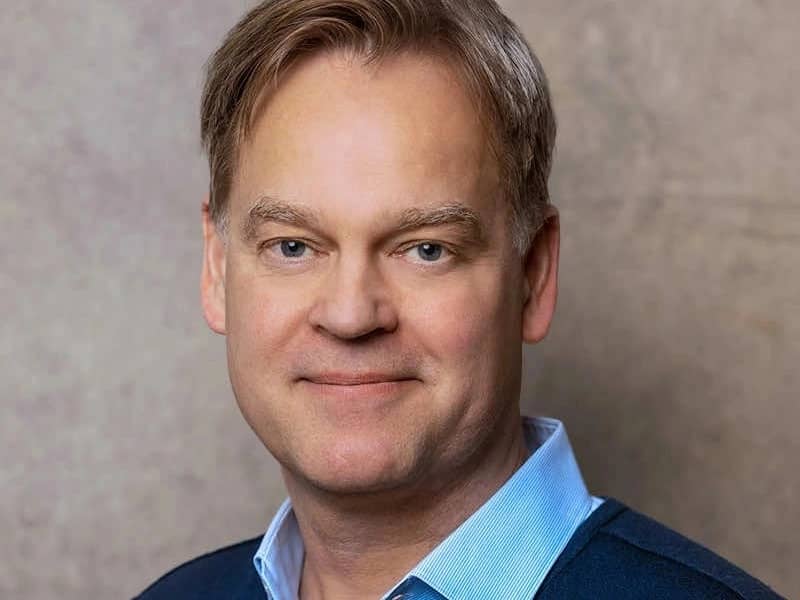
Jon Helgi Egilsson
Jón Helgi Egilsson is an Icelandic economist, entrepreneur, and former central bank official with experience in financial regulation, monetary policy, and payments infrastructure. He is a co-founder of Monerium, a company that issues regulated, fiat-backed e-money on blockchains. His career has included roles in academia, software development, startup incubation, and high-level public service, most notably as Chairman of the Supervisory Board of the Central Bank of Iceland. [2]
Education
Egilsson's academic background is in engineering and economics. He earned a degree in Engineering from Háskóli Íslands (the University of Iceland) in 1991 and graduated from the Technical University of Denmark in 1994. He later returned to academia, receiving a Master of Arts in Economics from the University of Iceland in 2008. In 2024, he completed his Ph.D. at the University of Iceland. [3]
Career
Egilsson began his career in 1999 as co-founder and chairman of Netskil hf., a software company focused on electronic bill presentation and online payment services. After securing funding and launching operations, the company was later acquired by Icelandic banks in 2002. In 2000, he co-founded Cell Objects Inc., which aimed to establish and finance a U.S. technology venture, but the project was paused after 9/11 and remained inactive, aside from holding a 2001 patent.
Beginning in 2003, he served as CEO of the Klak Innovation Centre, a privately run incubator that hosted early-stage companies and supported their development. During this period, he also held academic roles, including an adjunct professorship at Reykjavík University from 2003 to 2008, where he taught financial engineering, and an MBA lecturer at the University of Iceland from 2005 to 2008, offering applied coursework on early-stage ventures. In 2004, he founded and led Seed Forum Iceland, which organized a nomination and pitch-training process for companies participating in Seed Forum events. From 2006 to 2012, he served as CEO of Seed Forum Global, coordinating activities across an international network of not-for-profit foundations.
From 2011 to 2013, he lectured in financial economics at the University of Iceland. During the same period, he co-founded the grassroots group Advice, which opposed a proposed settlement in the Icesave dispute, and participated in public discussions leading up to Iceland’s 2011 referendum. In 2013, he was appointed by an opposition party to contribute to conversations on Iceland’s balance-of-payments issues, and later that year was appointed by the Prime Minister as one of six consultants advising on capital-account liberalization until mid-2014.
Egilsson served on the Supervisory Board of the Central Bank of Iceland from 2013 to 2017, having been elected by Parliament. During this term, he served as vice chairman and, briefly, as chairman from December 2014 to March 2015, overseeing board meetings and related responsibilities. In 2016, he co-founded Monerium, a company developing regulated fiat-backed digital tokens. From early 2023 to mid-2024, he served as Monerium’s head of business development. In 2024, he joined King’s Business School as an executive fellow, contributing part-time to academic and professional engagement activities. [1] [4]
Interviews
Monerium
In this interview from the Blockchain Ireland Summit in June 2025, Egilsson, co-founder of Monerium, spoke with host Sebastian Kuba about his work in blockchain and central banking, noting that he attends events like this to exchange ideas, connect with industry participants, and follow developments in Ireland’s blockchain ecosystem. He explained that institutional awareness of stablecoins was rising, reflected in increasing transaction volumes that he compared to those of major payment networks like Visa and Mastercard, and outlined Monerium’s goal of strengthening its position in the growing euro stablecoin market. Egilsson described Monerium’s integration with European payment systems to improve usability, highlighted real-world examples of stablecoin adoption in regions lacking stable local currencies, and anticipated greater competition among wallet providers, which he believes will lead to more efficient banking experiences. He closed by expressing optimism that upcoming U.S. legislation could shape global regulatory approaches to blockchain and digital assets. [7]
Trends and Challenges
In this October 2023 interview on The Org3D Podcast, Egilsson introduces Monerium as a company issuing on-chain fiat money that connects traditional bank accounts with the Web3 ecosystem, offering euro-denominated e-money that moves seamlessly between bank accounts and crypto wallets under a regulated framework supervised by the Central Bank of Iceland. He explains that Monerium was founded after the 2008 financial crisis with the aim of using decentralized finance to reduce risks tied to traditional banking, and reflects on how developments like PayPal entering the stablecoin market have strengthened public confidence even as U.S. regulations lag behind Europe’s and the UK’s evolving frameworks. Egilsson discusses the uneven global regulatory landscape, the challenges of building a company in a heavily regulated environment, and the persistence needed to maintain a long-term vision. He closes by noting that he would tell his younger self to accept setbacks as part of the process and pursue meaningful projects, reaffirming his belief in improving financial stability through innovations like Monerium. [6]
Presentations
Central Banks & Stablecoins
At Brussels Blockchain Week in July 2023, Egilsson outlined why central banks should not directly support stablecoins, arguing that national currencies are foundational legal and monetary systems that require protection. He emphasized that regulation is essential for turning risky instruments like bank deposits into safe assets and noted that stablecoins, as unsecured IOUs, similarly need clear oversight. Egilsson contrasted Europe’s long-established digital money regulations with the U.S., where the absence of a dedicated framework and recent SEC actions create uncertainty for stablecoin users. He highlighted the geopolitical strength that comes from a trusted national currency and advocated for regulatory approaches that encourage competition and innovation without central banks competing in retail payment systems. Instead, he argued for public-private partnerships in digital currency development, stressing that central bank competition can undermine their role as regulators. He concluded by urging central banks to support innovation—such as by providing deposit facility access to e-money issuers—while avoiding actions that restrict growth in the digital currency sector. [5]
Panels
E-Money to On-chain Euros
At Cosmoverse in November 2025, Egilsson joined Roger H. Hartmann, Guido di Rocco, and Artem Sinyakin for a panel on the future of digital euros, beginning with introductions and a brief overview of Monerium’s work issuing authorized euro stablecoins. The discussion explored the distinction between existing digital money and on-chain euros, emphasizing financial inclusion, while also noting custody challenges, user responsibility, and liquidity fragmentation caused by inconsistent stablecoin standards. Panelists compared the limitations of stablecoins—such as their inability to yield—to traditional interest-bearing financial products and examined why euro stablecoins lag behind U.S. dollar stablecoins, citing regulatory differences and slower innovation in Europe. The conversation closed with mixed views on Europe’s ability to compete globally, underscoring ongoing concerns about the region’s pace of development in digital currency markets. [9]
Regulating Stablecoins
At the Stable Summit in July 2024, Egilsson joined Eli Cohen, Xavier Lavayssiere, and moderator Marina Markezic for a panel examining how EU regulatory developments—particularly MiCA—are shaping the stablecoin and tokenization landscape. After introductions, the panel explored MiCA’s distinctions between e-money tokens and asset-referenced tokens, with Egilsson outlining how these rules affect fiat issued on-chain and the compliance demands placed on regulated issuers. The discussion highlighted mixed market reactions, as communities weigh decentralization against regulatory requirements amid the entry of major players like Circle, and considered the potential of euro-denominated stablecoins in a landscape where Europe and the US are moving toward divergent standards. Panelists also addressed the regulatory complexities surrounding real-world asset tokenization and noted that the EU’s pilot regime for blockchain-based securities has seen limited adoption. They closed by acknowledging that regulation is becoming unavoidable, with the sector evolving along a spectrum of compliant and non-compliant models as decentralized finance adapts to clearer legal frameworks. [8]