RSS3
RSS3 is a protocol that provides an Open Information Layer for the Open Web. It is a decentralized infrastructure composed of a Data Sublayer (DSL) for indexing and serving structured information and a Value Sublayer (VSL), an Ethereum-based Layer 2 blockchain that uses the RSS3 token as native gas. The network is designed to support applications such as AI training, social media, and search engines by enabling efficient access to unified, machine-readable information across multiple chains and platforms.[1][2][12]
Overview
RSS3 is an Open Information Layer that unifies and structures data from multiple blockchains and Web2 sources for use by applications and agents. Its architecture is organized into a Data Sublayer (DSL), where serving nodes and global indexers ingest, index, and expose standardized information, and a Value Sublayer (VSL), an Ethereum Layer 2 chain that settles economic activity and uses the RSS3 token as native gas.[1][12] The network is designed to power Web3 social feeds, cross-chain explorers, search engines, and AI systems by providing low-latency APIs and open data access, enabling developers to build products on top of a shared information commons rather than siloed datasets.[5][6]
History
2021–2023: Origins and Testnet Experiments
RSS3 originated in 2021 as a decentralized feed protocol inspired by the original RSS standard and the open-information ideals associated with Aaron Swartz, aiming to create a permissionless way to publish and consume Web3 activity.[2] During its early testnet phase, the project experimented with formats for representing user activity, indexing data from multiple chains, and running community-operated serving nodes to provide unified profiles and feeds.[1]
2024: Mainnet Design and Launch
On January 19, 2024, the team announced the design of the RSS3 Mainnet, introducing a dual-layer architecture with a Data Sublayer (DSL) for information serving and a Value Sublayer (VSL) as an Ethereum Layer 2.[12] The alpha mainnet went live on March 12, 2024, followed by a beta mainnet on June 3, 2024 that added “public good” nodes to serve open data to applications, and on August 29, 2024 RSS3 launched its production mainnet, establishing the Open Information Layer as a live, economically secured network with the full dual-layer architecture across the DSL and VSL.[12][13] The DSL v1.0 upgrade introduced a push-based design that replaced the earlier v0.4 implementation, requiring developers to migrate to new endpoints while improving data freshness and scalability, and Light Mode was added to give applications a more lightweight way to access the Open Information Layer without running full nodes.[14][15] During this period, the team also announced a plan to merge RSS3 into the broader Open ecosystem, aligning the VSL’s roadmap with Open’s Layer 2 infrastructure and governance.[15]
2025–2026: AI Data Infrastructure and Ecosystem Growth
In January and February 2025, RSS3 extended its AI data infrastructure by enabling decentralized, verifiable data streaming from the network directly to Hugging Face and by integrating real-time Web1, Web2, and Web3 data from the RSS3 AI data network into the Virtuals agent framework so that AI agents could consume unified open information.[19][20] Throughout 2025, the RSS3 Foundation highlighted Folo as a core example of verifiable open information built on the network, detailing follow.is, public desktop and mobile releases, and AI-enhanced reading features, and positioning Folo as a flagship consumer interface to the Open Information Layer.[17][18] By early 2026, RSS3 reported cumulative network request volumes surpassing 400 million and described ongoing refinements to data structures, Global Indexer routing, and AI-agent use cases, including outreach such as participation in Consensus Hong Kong 2026 to promote the Open Information Layer as infrastructure for AI and autonomous agents.[18][16]
Technology and Architecture
The RSS3 Network is structured as a dual-layer system comprising a Data Sublayer (DSL) and a Value Sublayer (VSL). In the DSL, serving nodes ingest data from supported blockchains and platforms, normalize it into RSS3’s information schema, and expose it through APIs, while global indexers coordinate large-scale indexing and provide globally consistent views of activity.[1] In August 2024, the DSL v1.0 upgrade introduced a push-based architecture in which nodes subscribe to on-chain and off-chain data sources, reducing latency and enabling more efficient, real-time feeds compared to the earlier v0.4 pull-based design.[14] The VSL functions as an Ethereum Layer 2 built with a customized OP Stack, using NEAR Fast Finality Layer (NFFL) and Celestia data availability where applicable, and uses the RSS3 token as its native gas and staking asset.[12][15]
Social
RSS3 aims to enhance interoperability among open social platforms by acting as an open social indexer that aggregates activity across multiple protocols. In the Data Sublayer, serving nodes collect social interactions such as posts, follows, likes, and on-chain social actions, and expose them in a unified, structured format that can be consumed through a single API.[4][5] This design allows Web3 social applications to build user profiles and feeds from many sources without directly integrating each underlying protocol, while preserving decentralization through a distributed network of independent node operators.[1]
Search
RSS3 is designed to support Open Web search functions, making it easier to develop search engines, cross-blockchain explorers, and activity feeds. Its network processes data from multiple decentralized and centralized sources and exposes it through a single API that allows access to on-chain and selected off-chain data without requiring separate integrations for each source.[5][6] Structured activity records and standardized schemas enable detailed analytics and filtering, while global indexers maintain real-time retrieval so that queries can return recent transactions, social interactions, and content updates across chains. By separating the information layer from execution environments, RSS3 allows search-oriented applications to focus on ranking and user experience while relying on the DSL for data availability and on the VSL for metering and settlement.[1]
AI
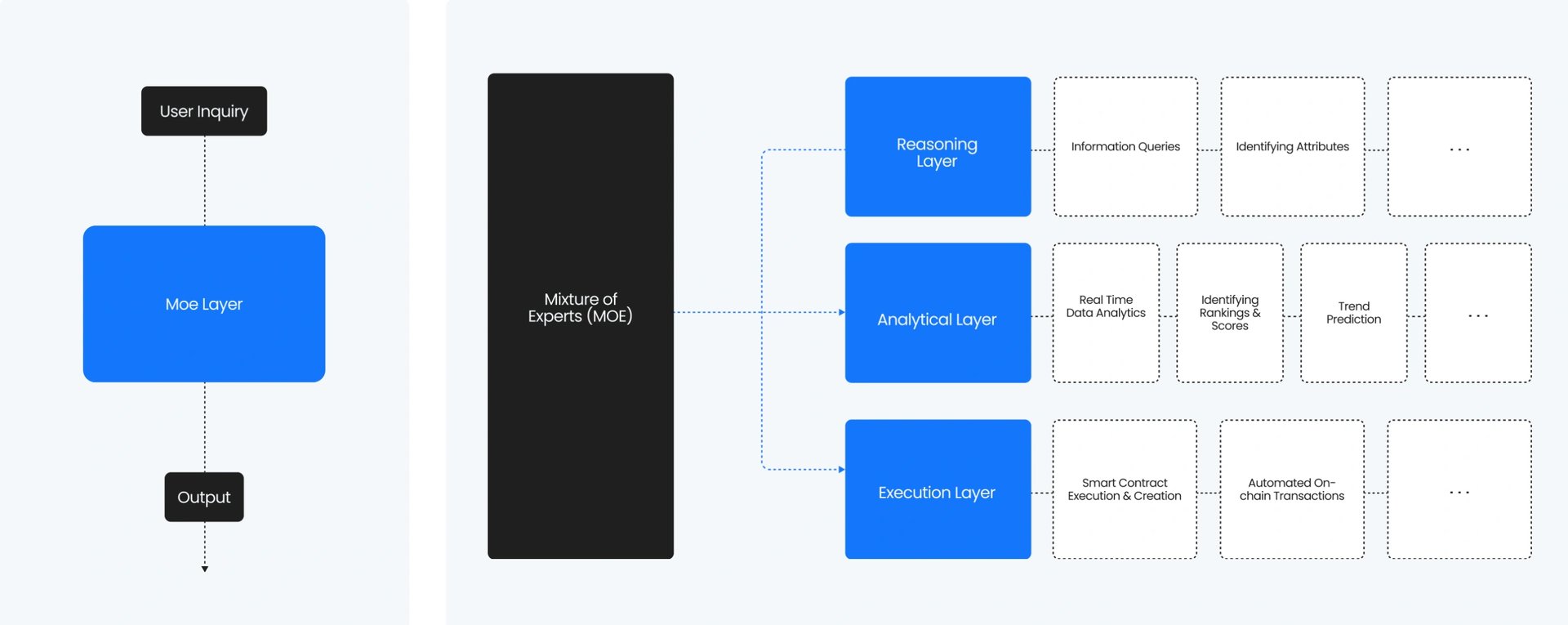
RSS3 integrates AI support into its Open Information Layer to facilitate the use of on-chain and off-chain data by AI models and agents. Its Mixture of Experts (MoE) architecture is intended to route different tasks to specialized expert models, improving reliability when generating content, automating workflows, or analyzing on-chain activity.[8][7] The network offers AI-ready APIs that provide structured histories of user activity, asset ownership, and interactions, enabling use cases such as content generation tools, automated smart contract execution, and risk analysis, while the VSL records usage and supports fee payments for data-intensive or model-intensive operations.[5]
RSS3 Token
On February 12, 2022, RSS3 introduced its native utility token, RSS3, on Copper Launch, with a total supply of 1 billion tokens to be gradually released over 5 years.[3] On the RSS3 Mainnet, the token serves as the native gas and fee token on the Value Sublayer (VSL), used to pay for request fees and other on-chain operations.[12] RSS3 also functions as the staking asset for node operators and as the governance token of RSS3DAO, which oversees parameters such as global indexer and serving node elections and other aspects of the Open Information Layer’s operation and evolution.[10][3]
Allocation
As of January 17th, 2024, the allocation of RSS3 token is as follows:
- Development Purposes: 45% (21.6% for development, 23.4% unspecified)
- Team: 15% (4.87% currently distributed, 10.1% unspecified)
- Private Sale: 10% (6.32% currently distributed, 3.68% unspecified)
- Early Incentives: 10% (entire allocation unutilized)
- Public Sale: 5% (5% currently distributed)
- Natural Selection Labs: 5% (2.4% currently distributed, 2.6% unspecified)
- Seed Round: 4.6% (2.21% currently distributed, 2.39% unspecified)
- Airdrop: 2.4% (2.4% currently distributed)
- Liquidity: 2% (2% currently distributed)
- Advisors: 1% (1% currently distributed)
The last unlock event was scheduled for November 14, 2023, releasing 2.25% of the total supply (22.53 million RSS3 tokens), representing 4.21% of the market cap. On February 14, 2024, the next unlocking event is scheduled to occur, unveiling five rounds and releasing 22.53 million RSS3 tokens (constituting 2.25% of the total supply) along with $2.45 million (equivalent to 3.75% of the market cap) within 27 days.[9]
Use Cases
RSS3 enables a range of applications that rely on structured, cross-platform information. Web3 social applications use the network to assemble user profiles and feeds from on-chain actions and social protocols, while cross-chain explorers and dashboards build unified transaction and asset histories across multiple networks.[4][5] Search engines and discovery tools query the DSL to surface addresses, content, and interactions, and AI agents consume the same structured data to train models or power task-specific assistants.[6][7] Content aggregators, such as following or feed applications like Follow and Folo, use the RSS3 Network to provide real-time activity streams that span different chains and platforms rather than relying on a single data source.[15]
Ecosystem
The RSS3 ecosystem includes node operators who run serving nodes and global indexers in the Data Sublayer, providing ingestion, indexing, and API access for on-chain and off-chain data sources.[1] On the Value Sublayer, stakers delegate or stake RSS3 tokens to secure the chain and participate in network economics, including incentives linked to node performance and data provision.[15] Developers use the RSS3 Network’s APIs and DSL endpoints to integrate structured information into their applications without operating full indexing stacks themselves. The project also supports builders through public goods funding, including the Open Information Grant and a public good pool that provides resources to teams building on or contributing to the Open Information Layer.[15]
Products
Key products of the RSS3 Network include its public API and Data Sublayer (DSL), which expose normalized, queryable information about addresses, assets, and social interactions across supported chains and platforms.[5] The RSS3 Value Sublayer (VSL) is an Ethereum Layer 2 blockchain that settles fees, staking, and other protocol-level transactions using RSS3 as native gas.[12] On top of this infrastructure, end-user applications such as Follow and Folo use RSS3’s feeds to provide unified activity timelines and discovery experiences, demonstrating how the Open Information Layer can support consumer-facing products.[15]
Partnerships
Since 2024, RSS3 has formed several partnerships around infrastructure, data availability, and AI. Google Cloud operates a public good node on the RSS3 Network to help serve open information and support developers building on the DSL.[15] The protocol integrates NEAR’s Fast Finality Layer (NFFL) and Celestia for data availability and fast finality in parts of the VSL stack, and collaborates with Kiln as an infrastructure partner for running validators and related services.[12][15] RSS3 has also joined the Nvidia Inception Program to explore AI-related optimizations and has announced a planned merge of the RSS3 Network into the Open ecosystem, including collaboration with Arbitrum’s Optimistic Virtual Machine for its Layer 2 architecture.[15]
Funding
In January 2022, RSS3 was backed by Fabric Ventures as part of their $6 million seed funding round led by Coinshares Ventures with participation from Coinbase Ventures, Dragonfly Capital, Mask Network, HashKey Group, Arweave, Dapper Labs, Avalanche Asia Star Fund, Youbi Capital, Headline VC, Formless Capital, imToken Ventures, and private investors, including Balaji Srinivasan, Jeff “Jiho” Zirlin, Miss ₿itcoin and Scott Moore.[11]
Team and Governance
RSS3 was founded by a developer known as Joshua and is developed primarily by Natural Selection Labs and the RSS3 Foundation, which oversee core protocol development and ecosystem initiatives.[3][15] Governance of the network is conducted through RSS3DAO, a decentralized autonomous organization that uses the RSS3 token for proposal voting and parameter changes related to the Open Information Layer and its economic mechanisms.[3]