Subscribe to wiki
Share wiki
Bookmark
Squid

0%
Squid
Squid is a cross-chain liquidity and messaging router that enables users to swap any token between any supported blockchain in a single transaction. It functions as an infrastructure layer, aggregating liquidity from various decentralized exchanges (DEXs) and multiple cross-chain bridges to find efficient transaction paths. The protocol provides a developer-focused API, SDK, and front-end widget, as well as a consumer-facing application for direct use. [1]
Overview
Squid is a cross-chain infrastructure protocol that enables the transfer and exchange of digital assets across multiple blockchain networks via a unified interface. It functions as a routing and execution layer that aggregates bridges, decentralized exchanges, and liquidity sources, allowing users or applications to complete complex transactions—such as swapping and transferring assets between chains—in a single process. Its architecture is built to abstract the underlying steps of cross-chain interactions, reducing the need for manual bridging, token conversions, and multi-step execution. Over time, Squid has expanded to support a wide range of blockchain ecosystems, including both EVM and non-EVM networks.
Later iterations of the protocol, including Squid 2.0, introduced a redesigned architecture focused on scalability, routing efficiency, and broader functionality. These updates incorporated graph-based routing to identify optimal transaction paths, support for same-chain swaps, and the ability to bundle multiple actions—such as staking, bridging, and asset purchases—into a single workflow. The system also expanded its access to liquidity by integrating more on-chain and off-chain sources, thereby improving price discovery and reducing slippage. In addition, performance improvements reduced quote times and API response latency, enabling faster transaction execution and integration for external applications. [2] [10]
History

Squid was conceptualized in 2022 and launched in January 2023 as a response to fragmentation in the multichain ecosystem, where moving assets between blockchains required multiple manual steps involving bridges, swaps, and separate interfaces. Its first version (Squid V1) was built on top of Axelar’s interoperability infrastructure and initially connected Ethereum-based networks to Cosmos chains, using systems such as Axelar GMP and IBC. Early functionality routed assets through intermediary steps such as liquidity hubs (e.g., Osmosis), but packaged the process into a single user-facing transaction to simplify cross-chain transfers and swaps.
As adoption grew, Squid expanded to support dozens of chains and a wider range of ecosystems, which exposed limitations in routing speed and system scalability. Squid Boost was introduced to improve execution speed by using external liquidity to front transactions, reducing wait times from minutes to seconds, and introducing early intent-based concepts. This period also saw the rapid expansion of supported networks, which increased routing complexity and led to performance constraints in the original architecture.
Squid V2 was introduced as a full redesign, adding graph-based routing and multi-protocol “hopping” across bridges, DEXs, and liquidity sources within a single transaction. It integrated additional systems such as CCTP and Chainflip to expand cross-chain coverage and improve routing efficiency. Later, CORAL introduced intent-based execution via RFQ auctions, allowing market makers to fulfill user requests with reduced slippage and gas costs. This evolved further into Squid Intents, which moved execution logic off-chain into Trusted Execution Environments, with only final settlement recorded on-chain, further simplifying cross-chain transaction execution and expanding support to non-smart-contract networks. [4]
Technology
CORAL
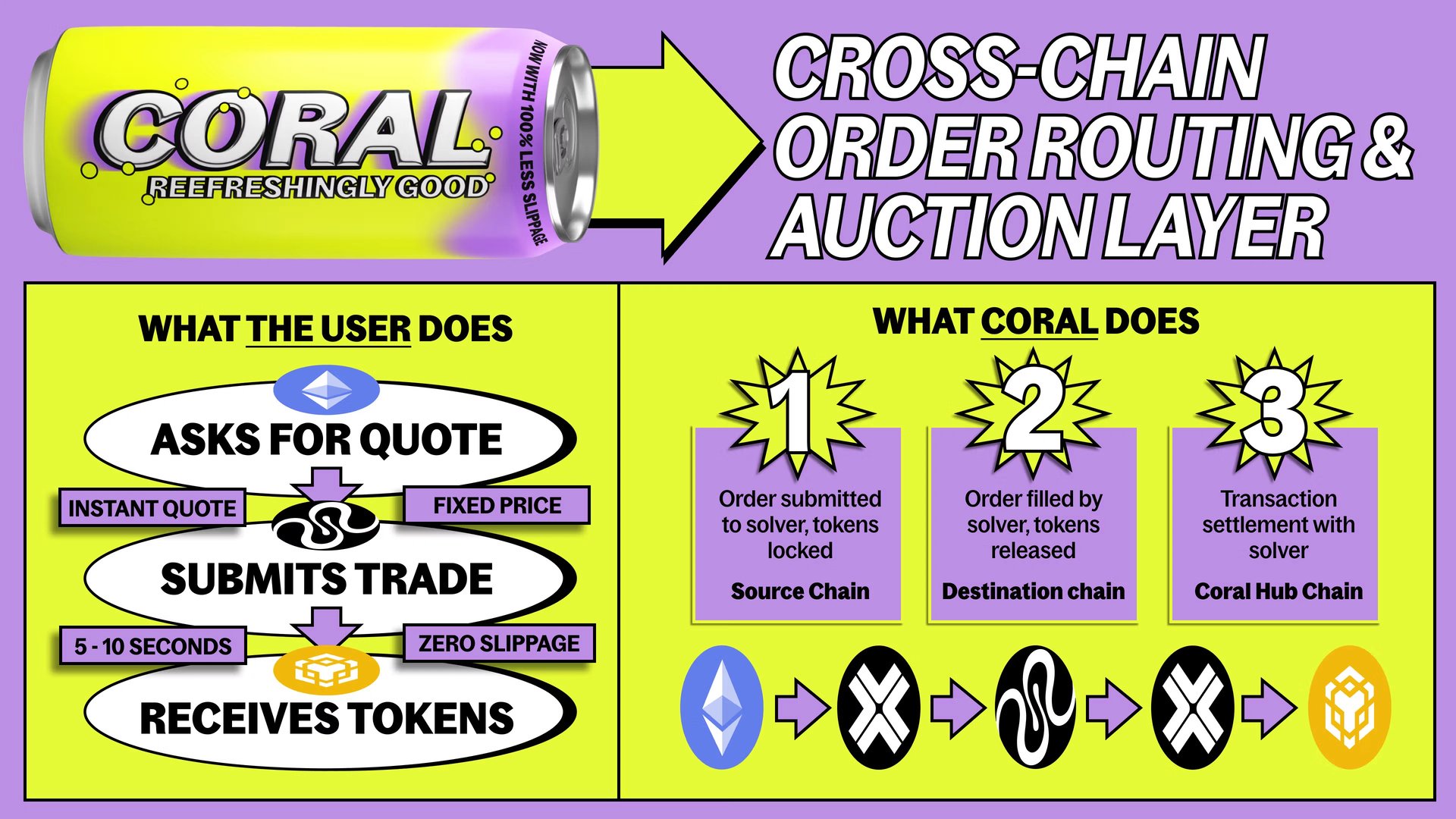
CORAL (Cross-Chain Order Routing and Auction Layer) is an execution system within Squid that introduced intent-based transaction handling using a request-for-quote (RFQ) model. Instead of relying on automated market makers (AMMs) and predefined liquidity pools, it allows users to specify a desired outcome and have external liquidity providers compete to fulfill it. This shifts execution from sequential on-chain routing to a more flexible, market-driven process. CORAL aggregates both off-chain and on-chain liquidity sources, enabling transactions to be executed through direct quotes rather than multi-step swaps across protocols. By reducing reliance on bridges and AMMs, it lowers the number of required transactions and simplifies cross-chain execution. [11]
Squid Intents
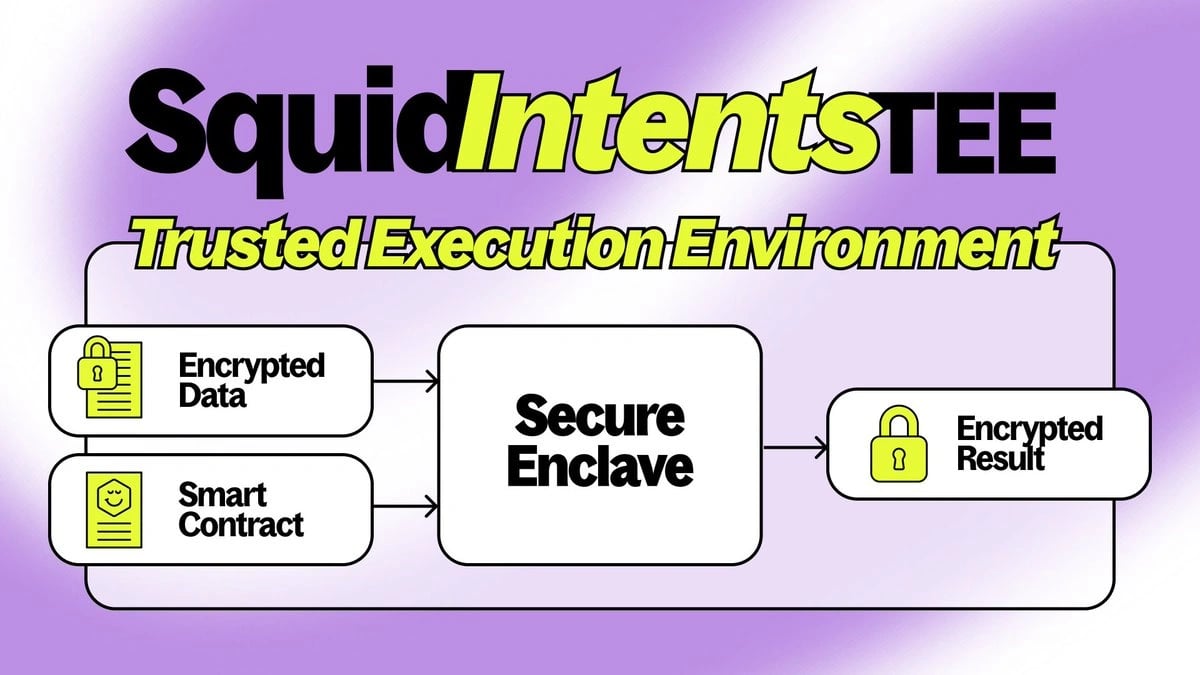
Squid Intents is an intent-based settlement protocol within Squid that changes how cross-chain transactions are executed. Instead of requiring users to perform multiple steps across different blockchains manually, it allows them to specify a desired outcome, such as swapping or transferring assets, while the system handles execution. The protocol translates this intent into a simplified on-chain action, with most of the routing and processing handled off-chain. This reduces the complexity typically associated with cross-chain operations and minimizes the number of transactions users need to manage directly.
Execution logic in Squid Intents is handled within Trusted Execution Environments (TEEs), which process and verify transactions off-chain before submitting a final result on-chain. This design lowers gas costs, reduces transaction failure rates, and simplifies the overall structure of cross-chain swaps. By moving execution off-chain, the protocol can support a wider range of networks, including blockchains without native smart contract functionality. It also uses a request-based model where external liquidity providers fulfill transactions, enabling predefined pricing conditions and reducing reliance on automated market makers. Additional mechanisms include protection against miner extractable value (MEV), non-expiring transaction routes, and automatic refunds if a transaction fails within a set timeframe. [9] [19]
MPP Adapter
The Squid MPP (Machine Payments Protocol) Adapter is a developer tool that enables automated cross-chain payments for applications, services, and AI agents. It allows clients to pay for access to resources—such as API endpoints—using assets from any supported EVM-compatible blockchain, without requiring manual bridging or multi-chain logic. Payments are integrated into a standard HTTP 402 flow, where the server requests payment, the client fulfills it, and then retries the request with a valid credential. This approach enables programmatic, pay-per-request access control for digital services.
The adapter automates key processes, including selecting the optimal source chain and token, routing funds across networks, and completing settlement on a designated chain. It relies on Squid’s routing infrastructure to bridge assets and execute transactions, while client-side libraries handle payment execution and verification. Designed primarily for machine-to-machine interactions, the system supports automated payment flows in which balances are scanned, routes are generated, and transactions are executed with minimal user involvement. [18]
Funding
Squid has raised two publicly disclosed funding rounds since its launch, both focused on expanding its cross-chain infrastructure and developer tooling.
The first round was a $3.5 million seed funding round announced in January 2023. It was led by North Island Ventures, with participation from Distributed Global, Fabric Ventures, Galileo, Chapter One, and Node Capital. The round also included participation from Axelar, alongside a group of angel investors, including Stani Kulechov, Zaki Manian, Dean Eigenmann, and others. This funding followed Squid’s early development phase and supported the initial rollout of its cross-chain routing and swap infrastructure built on Axelar.
The second round was a $4 million strategic funding round announced in January 2024. It was led by Polychain Capital, with participation from Nomad Capital, North Island Ventures, Maelstrom, Chorus One, The Department of XYZ, Breed, Binary Builders, and Typhon Ventures. It also included follow-on investments from earlier backers, including Distributed Global, Fabric Ventures, Node Capital, and Chapter One, as well as additional angel investors. This round supported continued expansion of Squid’s cross-chain capabilities, including improvements to its SDK, API, and routing infrastructure across a broader set of chains and applications. [6] [17]
Partners/Integrations
Infrastructure & Strategic Partners
Wallet Integrations
- MetaMask
- Ledger
- Trust Wallet
- Keplr
- Phantom
- Opera MiniPay
DeFi / dApp Integrations
- Lido
- Frax Finance
- Sommelier
- PancakeSwap
Supported Networks
See something wrong?