Veil Labs is a decentralized finance (DeFi) protocol described as an institutional-grade privacy infrastructure for cryptocurrency assets. It is designed to enable confidential cross-chain transactions by providing a privacy enhancement platform that seeks to reduce on-chain traceability. [1]
Veil Labs aims to provide private, untraceable execution for crypto asset swaps and transfers. The project's stated purpose is to counter the increasing use of blockchain surveillance tools, such as wallet clustering, behavioral analytics, and forensic tracking, which are used to monitor on-chain activity. The core philosophy of the protocol is that true anonymity begins at the point of transaction execution and that privacy should be an inherent part of the system's underlying infrastructure. [2] [3]
The protocol functions as a hybrid routing system, designed to bypass clustering analytics and protect a user's on-chain identity. This is achieved by re-engineering how transactions are executed rather than simply masking them after the fact. The system is engineered for market participants who require a high degree of privacy at the execution layer. This includes high-volume traders, crypto funds, and large asset holders, often referred to as "whales." [3] [2]
Veil Labs offers several products and interfaces for users and developers to access its privacy-focused execution layer.
The protocol's routing engine is accessible through two primary interfaces.
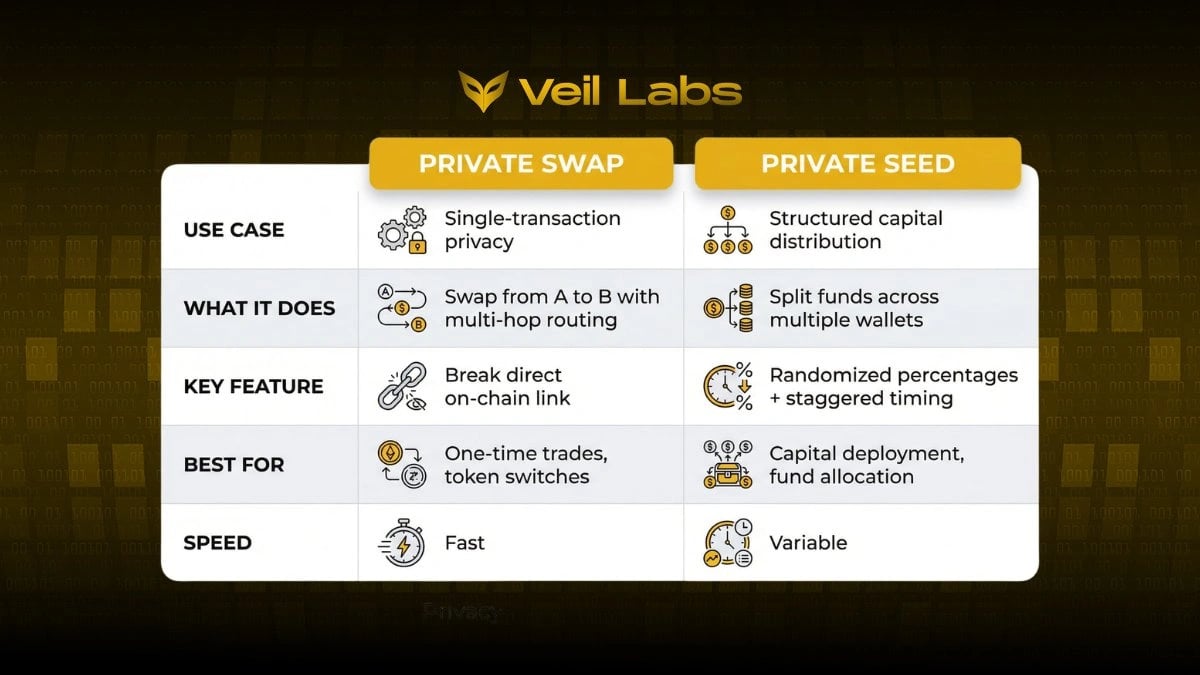
trade.veillabs.app that provides a graphical user interface for executing private swaps and transfers.Private Swap is a non-custodial feature for executing crypto asset swaps with enhanced privacy. Its primary function is to reduce transaction traceability by abstracting the connection between the source and destination wallets. Instead of a direct, linear transaction, Private Swap routes funds through a structured process that uses adaptive routing with multi-hop and cross-chain pathways, transaction splitting, and sequencing across various liquidity venues. This adds a layer of execution variability, which is designed to prevent deterministic and easily traceable patterns that can be flagged by blockchain analytics systems. [4]
"Private Seed" is a feature designed to distribute a single crypto asset deposit across multiple recipient addresses in one structured process. It transforms a single deposit into a one-to-many distribution by programmatically splitting the amount and routing the funds independently. Users can set a "variance percentage" to control the balance range between recipient allocations, allowing the total deposit to be distributed with controlled variability rather than in identical amounts. The goal of this process is to reduce the clear one-to-one address association between the source and destination wallets, which in turn minimizes the "clustering confidence" used by blockchain surveillance tools to group wallets thought to be associated with a single entity. [5]
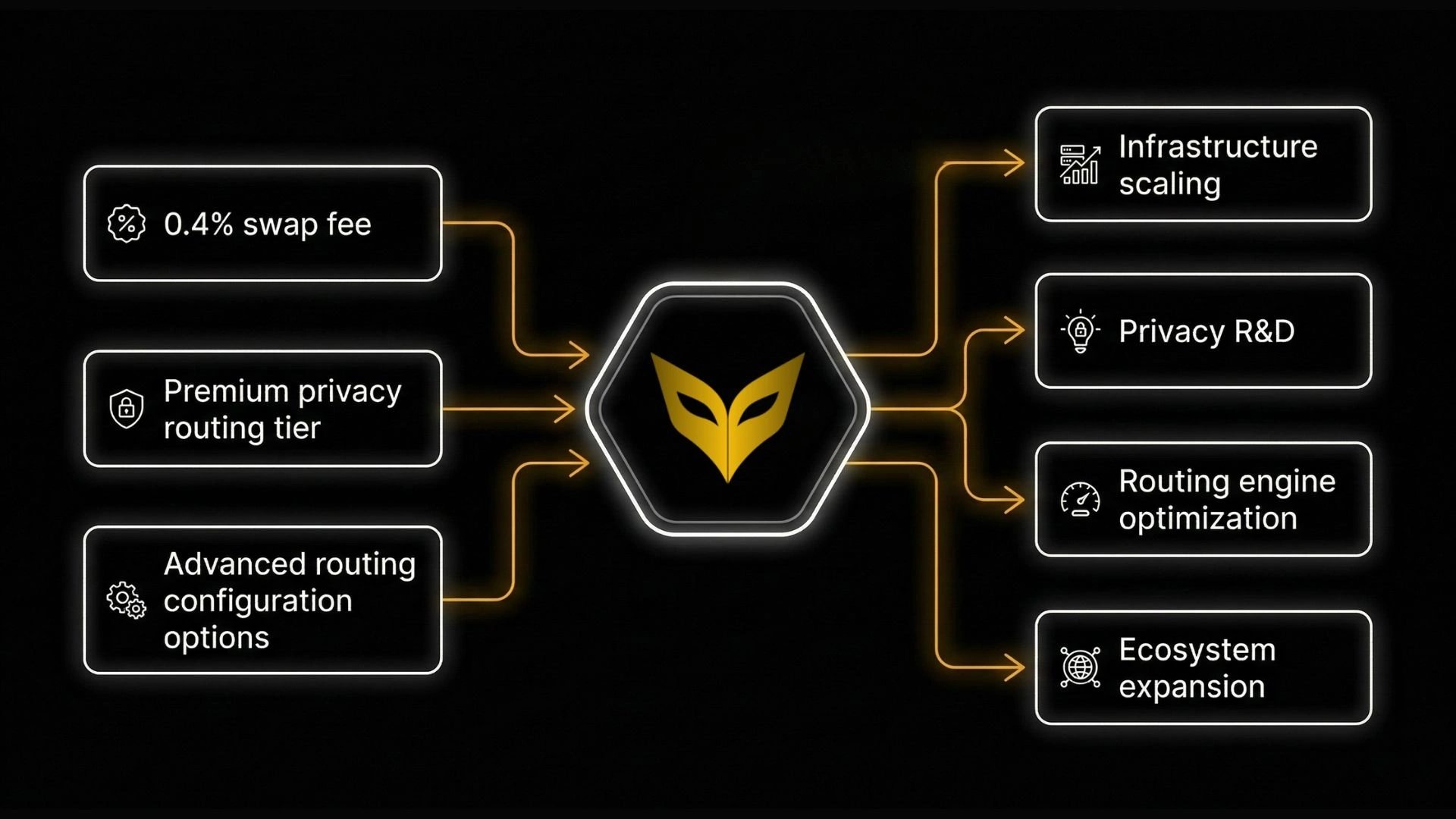
Veil Labs utilizes a two-tiered revenue framework to fund its operations and long-term development. The first tier is a base transaction fee of 0.4% applied to all swaps. The second is an optional premium tier, "Premium Privacy Routing," which offers advanced features like greater routing dispersion and execution fragmentation for users who require a higher degree of privacy. This premium service uses a differentiated fee structure aligned with the enhanced privacy configurations. Revenue from both tiers is allocated to infrastructure maintenance, routing engine improvements, security audits, and building treasury reserves for protocol sustainability. [6]
To allow for broader integration and interaction with its ecosystem, Veil Labs is developing tools for developers:
These tools are being developed using TypeScript. [3]
Veil Labs applies a flat 0.4% swap fee to each execution conducted through the protocol. According to the project, the revenue generated from these fees is allocated toward maintaining the privacy architecture, optimizing routing algorithms, and ensuring the long-term sustainability of the protocol. [2]
The platform's architecture is based on a "privacy by design" approach, focusing on several key technological components intended to ensure user privacy and eliminate wallet traceability. [3]
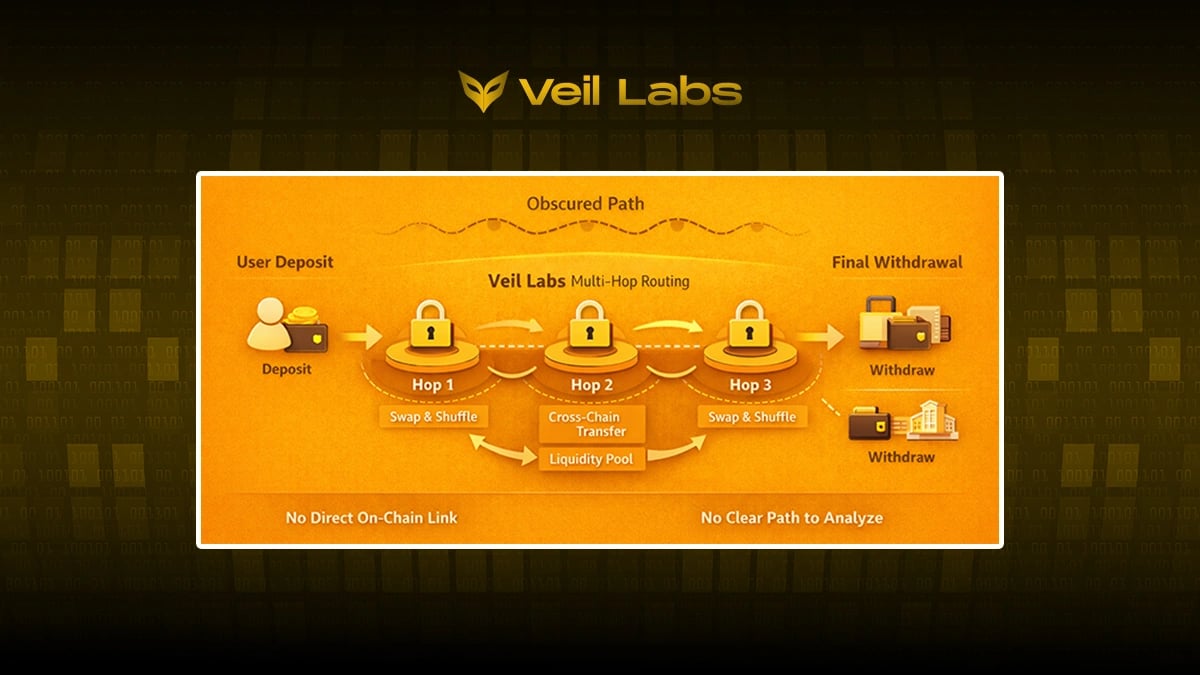
A central feature of the architecture is a multi-hop routing engine. This system routes a single transaction through multiple intermediate steps or "hops" to obscure the direct connection between the sender's origin address and the receiver's destination address. By breaking the direct on-chain link, the protocol aims to make it significantly more difficult for an outside observer to follow the flow of funds. [1] [3]
Veil Labs incorporates an anti-clustering design, a mechanism engineered to prevent analytical tools from linking multiple addresses or transactions to a single user or entity. On-chain analysis firms often use "clustering" techniques to group different wallet addresses based on behavioral patterns, heuristics, and transaction graphs. The protocol employs methods like multi-hop routing and transaction fragmentation to minimize this behavioral linkage, making it more challenging for surveillance software to connect a user's various on-chain activities. [2] [1]
The protocol includes an anonymous identity layer designed to structurally separate a user's real-world identity from their on-chain financial activities. The system is engineered to operate without requiring Know Your Customer (KYC) procedures, persistent identity mapping, or the tracking of user IP addresses. This architectural layer is intended to provide a foundation for private transactions without compromising user data. [1] [2]
The core of Veil Labs' technology is its hybrid routing protocol. This system combines off-chain routing intelligence for computationally intensive route calculation with on-chain settlement for final transaction execution. This separation is intended to reduce the amount of traceable information recorded on the blockchain, thereby obscuring the details of a transaction from public view. [2]
Veil Labs was initially developed for the BNB Smart Chain (BSC). The project has stated plans for future integration into other multi-chain ecosystems to expand its cross-chain capabilities. The project's public repositories indicate the use of the TypeScript programming language for its Software Development Kit (SDK) and Command Line Interface (CLI), which are intended for developer interaction with the protocol. [3]
Based on its described features and technology, the Veil Labs protocol is designed to support several use cases where transaction privacy is a primary concern. The platform aims to facilitate:
The above use cases are derived from the project's features, which are intended to obfuscate on-chain analytics and prevent the linkage of a user's on-chain footprint. [1] [3]
Veil Labs has partnered with NeroX AI to integrate AI-driven insights into its ecosystem. The collaboration focuses on enhancing data analysis and supporting more informed interactions within Web3 applications. [2] [7]
Veil Labs has partnered with REI Network to align private execution with scalable infrastructure. The collaboration focuses on enabling efficient, high-throughput, and privacy-oriented on-chain transactions. [2] [7]