0% read
Magma Finance
Magma Finance
Magma Finance is a decentralized exchange built for Move-based blockchains that uses automated market maker models, including concentrated liquidity and bin-based pricing systems, to structure how liquidity is deployed and traded. It focuses on organizing liquidity into discrete or range-based price structures to improve capital efficiency and support on-chain trading and liquidity provisioning. [1]
Overview
Magma Finance is a decentralized exchange (DEX) built for Move-based blockchains, using an automated market maker (AMM) model with concentrated liquidity. The protocol enables permissionless trading and liquidity provision, allowing users to create trading pools for any supported asset and developers to integrate its liquidity into other decentralized finance (DeFi) applications without requiring approval. Its concentrated liquidity market maker (CLMM) architecture allows liquidity providers to allocate capital within specific price ranges to improve capital efficiency, while also supporting advanced trading functions such as limit and range orders. Magma Finance also incorporates a community governance model that allows token holders to participate in protocol decisions, including changes to fees, features, and supported assets. [2]
Products
CLMM
Magma Finance uses a Concentrated Liquidity Market Maker (CLMM) model, an automated market maker (AMM) design that allows liquidity providers to allocate assets within selected price ranges rather than across the entire trading curve. This approach is intended to improve capital efficiency by concentrating liquidity where trading activity is expected to occur, while supporting multiple fee tiers based on market conditions and risk. The protocol divides prices into discrete "ticks," with each liquidity position defined by upper and lower price boundaries that determine when the position is active. Liquidity positions are represented as non-fungible tokens (NFTs), enabling them to be transferred or used in other decentralized finance (DeFi) applications while recording details such as the selected price range, liquidity provided, and accrued fees. [3]
ALMM
Magma Finance's Adaptive Liquidity Market Maker (ALMM) is an automated market maker (AMM) model that organizes liquidity into discrete price "bins" rather than continuous price ranges. Each bin represents a fixed price level at which trades are executed, allowing transactions within the active bin to occur at a constant price until its liquidity is exhausted, after which trading shifts to the next price bin. This stepwise structure is designed to improve capital efficiency, reduce slippage for many trades, and provide more precise pricing than traditional AMM models.
The protocol also incorporates dynamic trading fees that adjust based on market conditions and supports multiple liquidity allocation strategies. Liquidity providers can distribute capital across bins using different profiles, including uniform, concentrated, or single-sided allocations, thereby tailoring liquidity deployment to varying market conditions and trading objectives. This bin-based architecture is intended to combine features commonly associated with order books while maintaining the decentralized and composable characteristics of an AMM. [4]
MAGMA
MAGMA is the native utility and governance token of the Magma Finance protocol. It is used to support decentralized governance by allowing token holders to participate in proposals and voting on protocol changes, features, and operational parameters. The token also serves as an incentive mechanism, rewarding liquidity providers who contribute assets to the protocol's liquidity pools based on their level of participation. In addition, MAGMA is integrated into a tiered membership system that provides varying levels of access to protocol features and services according to a user's token holdings and platform activity. [5]
Tokenomics
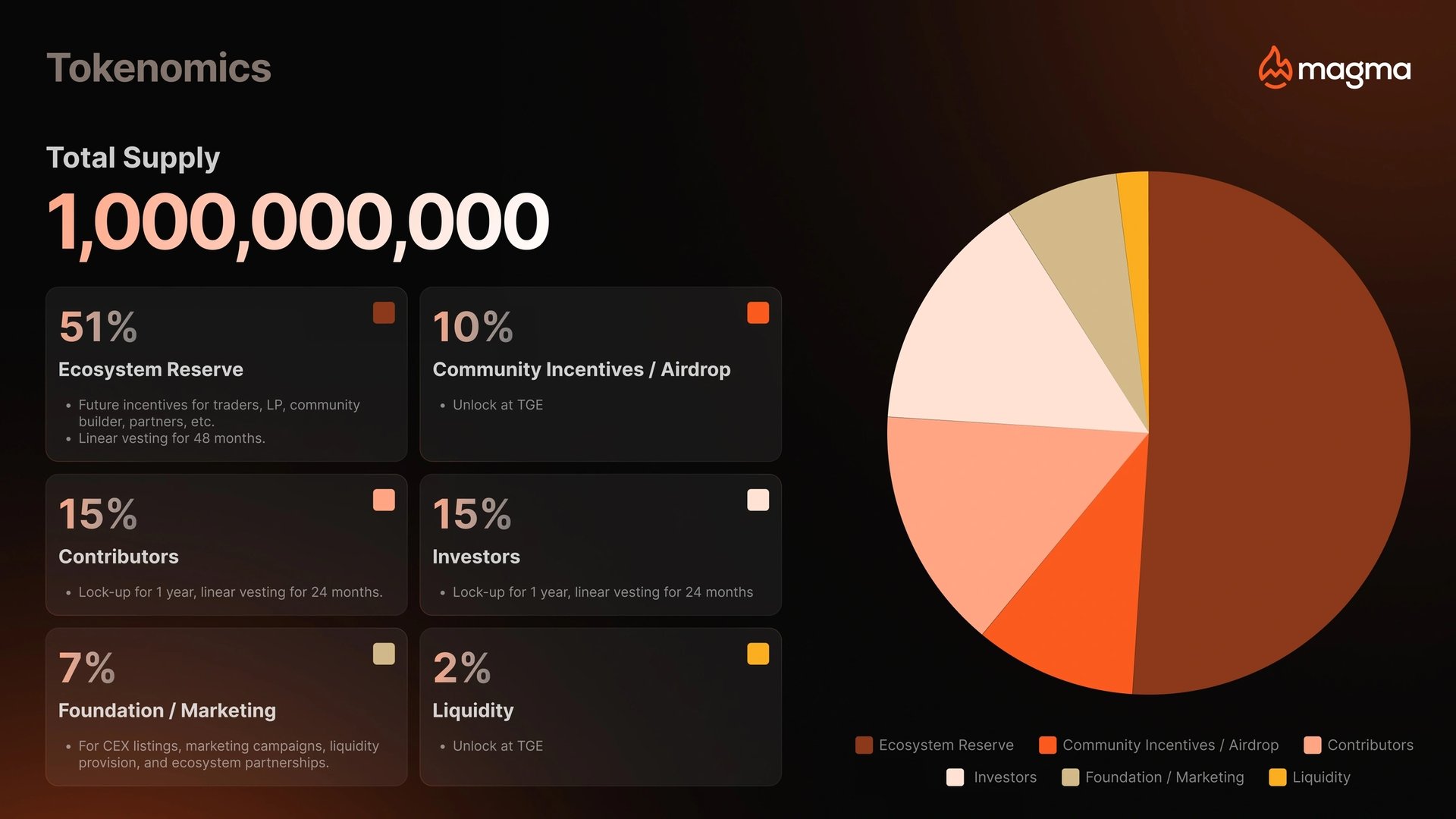
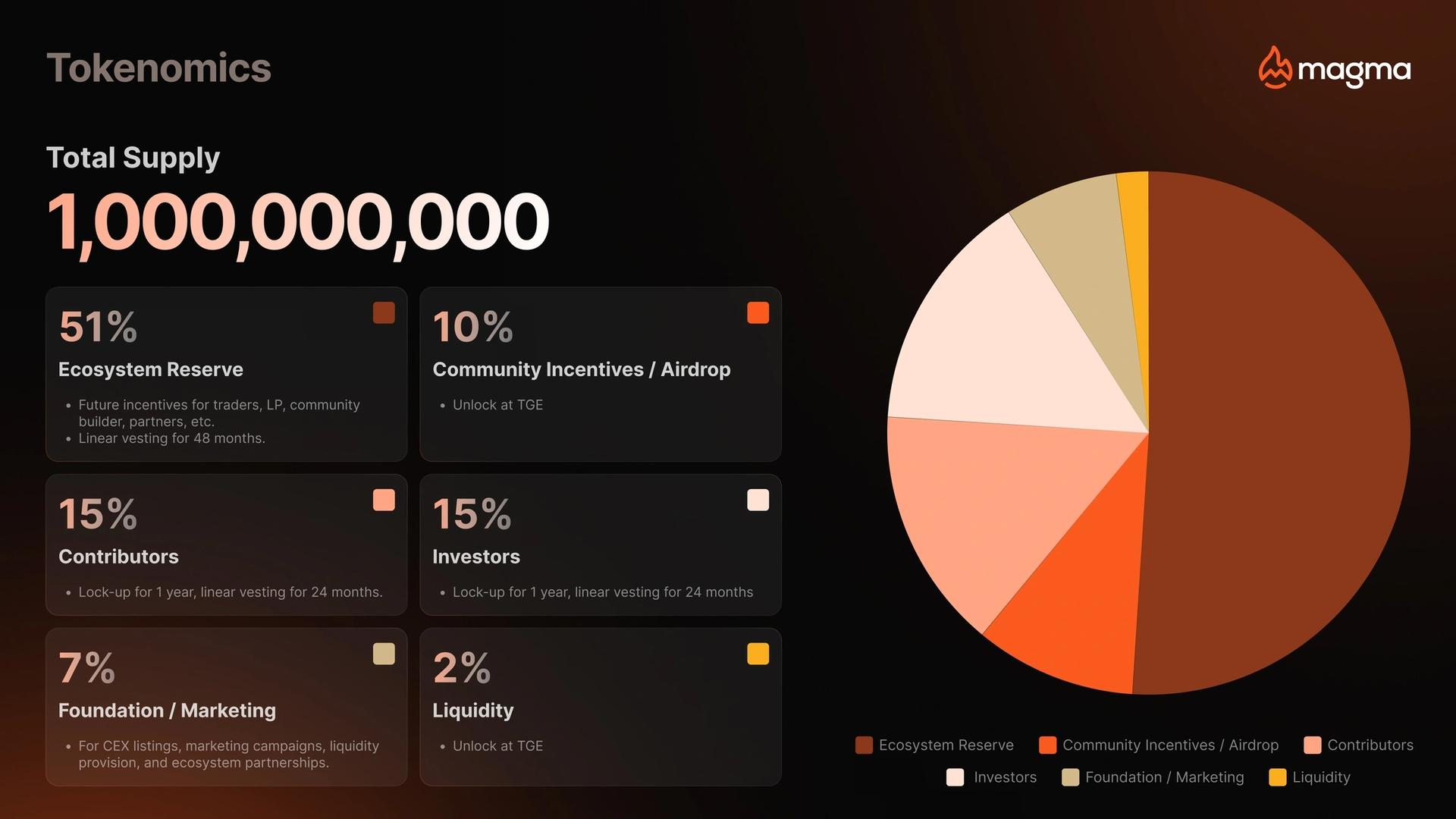
MAGMA has a total supply of 1B tokens and has the following distribution: [5]
- Ecosystem Reserve: 51%
- Contributors: 15%
- Investors: 15%
- Community Incentives/Airdrops: 10%
- Foundation/Marketing: 7%
- Liquidity: 2%
Partnerships
- MoveBit
- Zellic
- Three Sigma
See something wrong?

Average Rating
No ratings yet, be the first to rate!
How was your experience?
Give this wiki a quick rating to let us know!
Edited By
On June 30, 2026. 16:43 UTC
Edit summary:
Updated content: added 22 hyperlinks and changed media (3 -> 1 items)