0% read
Xiao-Xiao J Zhu
Xiao-Xiao J. Zhu is an entrepreneur, investor, and business executive with a background spanning digital assets, private equity, technology ventures, management consulting, and professional music. He is President of Jupiter Exchange, having previously led digital assets and digital value creation at KKR and served as General Manager at BCG Digital Ventures. [8]
Education
Zhu completed an MSc in Managerial Economics and Strategy at the London School of Economics and Political Science (LSE), following a BA in Philosophy and Economics from Humboldt-Universität zu Berlin. He also studied concert piano at Universität der Künste Berlin, where he completed a Konzertdiplom equivalent to a bachelor's and master's degree, and at Universität Mozarteum Salzburg, where he completed a Concert Piano Diplom in the masterclass of Professor Hans Leygraf. [4]
Career
Zhu began his professional career as a concert pianist, performing internationally and appearing at major concert venues and festivals in Europe and China. From 2012 to 2013, he worked at The Boston Consulting Group as a Visiting Associate in Berlin, followed by Summer Associate roles in private equity at Deutsche Beteiligungs AG and Warburg Pincus in 2013. He then joined BCG as a Management Consultant in London in 2014, focusing on strategy and transformation projects across energy, industrial goods, financial services, private equity, and retail.
In 2016, Zhu became General Manager at BCG Digital Ventures, where he led the ideation, incubation, and launch of digital ventures in partnership with large companies. He was also a founding team member of BCG Digital Ventures China and founded and led heycar UK as its General Manager and first CEO from 2018 to 2019. In 2021, he joined KKR as Digital Operating Partner and Digital Assets Lead, where he worked on technology and digital value creation in private equity and led the firm's digital asset and cryptocurrency strategy. In 2025, Zhu became President of Jupiter Exchange, where he works on the company's global onchain finance activities. [3]
Interviews
TradFi
In an August 2026 interview on the 51 Insights podcast, Zhu discussed Jupiter's development from a decentralized exchange aggregator into a broader DeFi platform on Solana. He described Jupiter's original focus on routing trades across decentralized exchanges for optimal execution and noted its reported processing of more than $1.2 trillion in on-chain trading volume, along with plans to expand its super app, launch Jupiter Global, and develop a banking service. Zhu also discussed his transition from KKR, where he led digital asset strategy, to DeFi, citing improvements in blockchain scalability and the emergence of applications that can operate globally in a permissionless, self-custodial environment. The conversation covered Jupiter's expanding product suite, including tokenized equities, stablecoins such as JUSD, prediction markets, and other on-chain financial products, as well as the potential for real-world asset tokenization to bring equities, treasuries, and credit products onto blockchain networks. Zhu further discussed the development of agentic finance, in which AI-powered agents could manage capital, execute transactions, and facilitate payments on-chain, including through Jupiter's agent kit. The interview concluded with Jupiter's work with institutions such as Robinhood and Coinbase and the potential for Solana-based trading, lending, and regulated tokenized equities to connect decentralized finance with traditional financial markets. [5]
Rewiring Banks
In a May 2026 interview on The Market Runup podcast, Zhu discussed the relationship between cryptocurrency and traditional financial systems, arguing that blockchain-based finance would develop alongside banks rather than replace them. He described growing institutional participation through tokenized assets and stablecoins and noted that institutions were adopting a combination of open, permissionless networks and private, permissioned infrastructure depending on their needs. Zhu also discussed Jupiter's focus on payments to connect on-chain finance with everyday transactions, including products such as Jupiter Global and its Visa cards, with the goal of making blockchain-based financial services more accessible across markets. He outlined a future in which on-chain and off-chain financial systems increasingly interact, with traditional financial institutions adopting blockchain technology for greater efficiency without necessarily holding cryptocurrency directly. Zhu also described Jupiter's broader vision of developing financial infrastructure that connects traditional and blockchain-based assets and supports the growth of on-chain finance. [7]
Jupiter Exchange
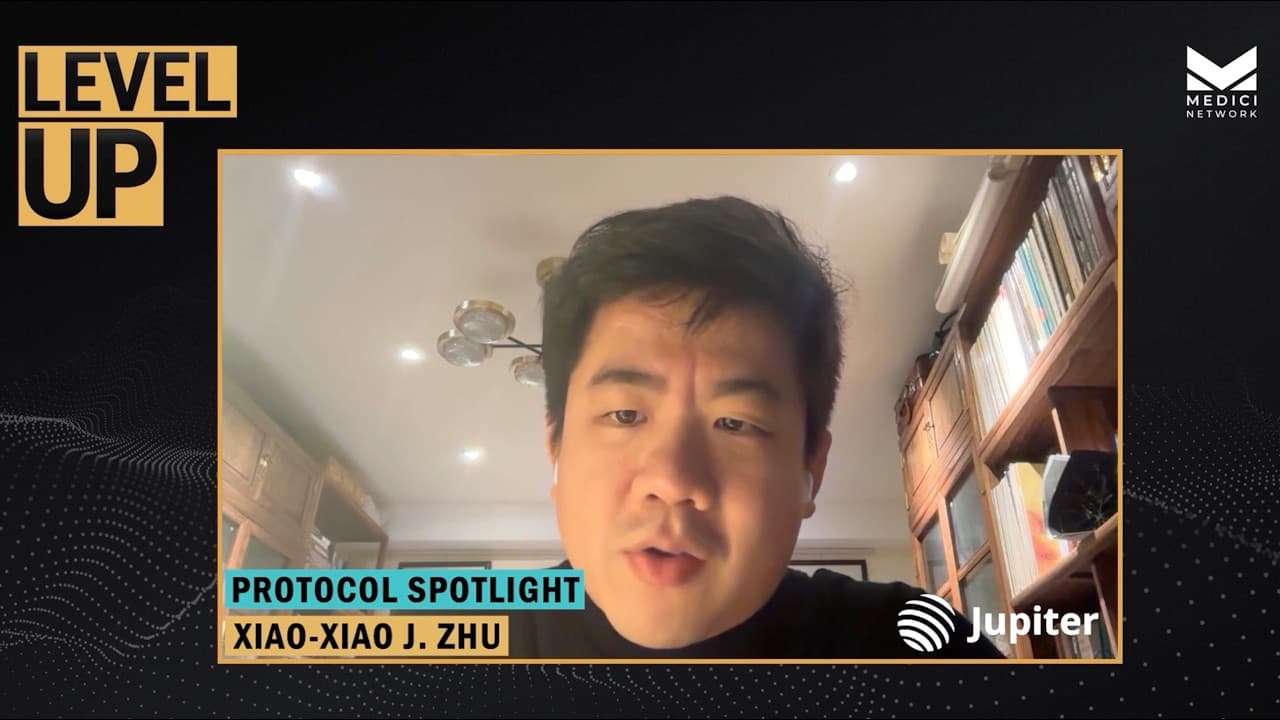
In a March 2026 interview on Medici Presents: Level Up, Zhu discussed Jupiter's development from a decentralized exchange aggregator into a broader on-chain financial platform on Solana. He described the expansion of Jupiter's product suite to include lending, prediction markets, stablecoins, launchpad services, and verification infrastructure, while outlining plans for omni-chain functionality that could extend the platform's role beyond Solana. Zhu also discussed Jupiter's reported 2025 activity, including more than 40 million active wallets, $1.1 trillion in trading volume, $2.5 billion in total value locked, and $500 million in gross revenue, alongside the platform's expansion across multiple product categories. The conversation covered Jupiter's JUP token, including its initial 10 billion supply, the reported burning of 30% of the supply, revenue-funded buybacks, reduced emissions, and a $35 million strategic investment from ParaFi. Zhu further discussed Jupiter's competitive strategy, including expanding omni-chain liquidity, improving the user experience, and developing products such as prediction markets and stablecoins, as well as its governance structure involving the community, team, and DAO. The interview concluded with Zhu emphasizing product development, user utility, and continued expansion as Jupiter seeks to build financial infrastructure for broader on-chain activity. [6]
See something wrong?
Average Rating
No ratings yet, be the first to rate!
How was your experience?
Give this wiki a quick rating to let us know!