zkLLM
zkLLM (Zero-Knowledge Large Language Models) is a technology that combines zero-knowledge proofs(ZKP) with large language models to enhance privacy and scalability in artificial intelligence applications. This innovative approach aims to address critical challenges in the AI and blockchain sectors by enabling secure and efficient processing of sensitive data.[1][5]
Overview
zkLLM, short for Zero-Knowledge Large Language Models, represents a significant advancement in the intersection of cryptography and artificial intelligence. It leverages zero-knowledge proof systems to allow language models to process and generate outputs based on private input data without revealing the actual content of that data. This technology addresses growing concerns about data privacy and security in AI applications, particularly in sectors dealing with sensitive information such as healthcare, finance, and personal communications.
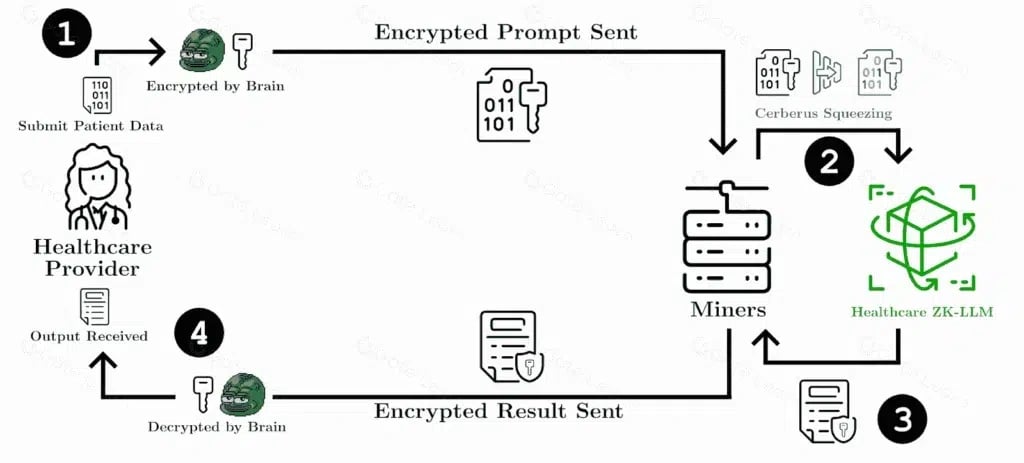
The core principle behind zkLLM is to create a trustless environment where AI models can operate on encrypted data, providing verifiable results without exposing the underlying information. This approach not only enhances privacy but also opens up new possibilities for collaborative AI development and deployment in regulated industries.[2][3]
Utilizing ZKPs in the inference process of an LLM can provide authenticity and privacy. It can confirm the output’s origin from a specific model without revealing any model details, protecting any sensitive or proprietary information. The generated proofs are verifiable, allowing anyone to confirm the output’s authenticity. Some ZKP protocols are also scalable, accommodating large models and complex computations, which is beneficial for LLMs.[3]
Technology
Zero-Knowledge Proofs (ZKP)
At the heart of zkLLM is the implementation of zero-knowledge proofs, a cryptographic method that allows one party (the prover) to prove to another party (the verifier) that a statement is true without revealing any information beyond the validity of the statement itself. In the context of zkLLM, this technology is applied to AI computations, enabling:[5]
- Verification of AI model outputs without access to input data
- Proof of correct model execution without revealing model parameters
- Secure multi-party computation for collaborative AI training and inference
Two key components are laid behind zkLLM:[6]
- tlookup: A new zero-knowledge proof protocol designed to handle non-arithmetic operations prevalent in deep learning models. It is optimized for parallel computing environments and adds no asymptotic overhead in memory or runtime.
- zkAttn: Building upon tlookup, zkAttn specifically targets the verification of the attention mechanisms in LLMs. It is designed to efficiently manage proof overhead while balancing accuracy, runtime, and memory usage.
Integration with Large Language Models
zkLLM adapts zero-knowledge proof systems to work with the complex architectures of large language models. This integration involves:
- Encoding model parameters and input data into a format compatible with ZK circuits
- Designing efficient proof systems that can handle the scale of LLM computations
- Implementing verifiable computation techniques for neural network operations
While ZK proofs are important enough for proving the correctness of computations in zkLLMs, they alone cannot handle the complex computations required by these powerful AI models. This is where Fully Homomorphic Encryption (FHE) comes into play.[6]
Fully Homomorphic Encryption (FHE)
Fully Homomorphic Encryption is a cryptographic technique, by the use of which computations can be performed on encrypted data directly. The FHE method ensures the security of the data throughout the computation process. This technique has the potential to revolutionize the field of secure computing. Data can be put inside and perform computations without opening the box. FHE allows zkLLMs to do calculations or operate on encrypted user data. The LLM can perform complex tasks like sentiment analysis or text generation on the encrypted data itself, without ever decrypting it. When it comes to saving privacy, zkPs and FHE work hand in hand and complement each other working towards the same goal. [6]
zkP and FHE
Zero-knowledge proofs (zkPs) and Fully Homomorphic Encryption (FHE) are two powerful tools that when used together can create a privacy-preserving powerhouse. zkPs allow one party (the prover) to prove to another party (the verifier) the truth of a statement without revealing any additional information about the statement itself. FHE on the other hand, allows computations to be performed directly without decrypting the data. This is useful in situations where privacy is a concern. ZK proofs and FHE form the backbone of zkLLMs. Here’s how they work together.[6]
- FHE encrypts the user data. This ensures the data remains safe throughout the process.
- The user performs asks the LLM to perform computations on the encrypted data. zkLLMs are designed to work efficiently with FHE for these computations.
- ZK proofs prove that the asked queries/computations were solved correctly. The LLM proves it processed the data as instructed without revealing the data or the intermediate steps.
Key Features
- Privacy-preserving inference: Allows users to query AI models without exposing their input data
- Verifiable AI: Provides cryptographic proofs of correct model execution and output generation
- Scalable architecture: Designed to handle the computational requirements of large language models
- Interoperability: Compatible with various blockchain networks and AI frameworks
Applications
zkLLM technology has potential applications across multiple domains:[1][5]
- Healthcare: zkLLMs can be very useful in the healthcare industry. Suppose a patient uploads their medical records to a Cloud-based AI system. zkLLMs could analyze the data while keeping the sensitive patient information still encrypted and still identify any potential health issues. This protects patient privacy while allowing for advanced AI-powered diagnosis.
- Secure processing of patient data for diagnosis and treatment recommendations
- Collaborative research on sensitive medical information
- Finance: One of the primary uses of zkLLMs could be to analyze user’s encrypted financial data. Data from bank statements and investment portfolios can be scanned by the LLMs and asked to provide financial advice based on that. The LLM could identify investment opportunities without ever decrypting the financial information.
- Privacy-preserving credit scoring and risk assessment
- Secure analysis of financial transactions for fraud detection
- Legal
- Confidential document analysis and contract review
- Secure e-discovery processes
- Personal Assistants
- Private query processing for voice assistants and chatbots
- Secure handling of personal information in AI interactions
- Decentralized AI
- Trustless AI computations on blockchain networks
- Privacy-preserving federated learning systems
- Secure Chatbots and Virtual Assistants zkLLMs can also be used to power chatbots and virtual assistants. These bots can solve the queries of a user within seconds.
- Private Content Moderation Another great application of zkLLMs could be to analyze, identify and remove harmful or inappropriate content on the internet. The Large language Model operates on the encrypted chats to identify any violations or inappropriate data. On the other hand, ZK proofs can be used to show that the chats were scanned correctly.
Development and Current Status
The development of zkLLM is an ongoing process, with several research teams and companies working on implementing and refining the technology. Key milestones include:
- Theoretical foundations established in academic papers on privacy-preserving machine learning
- Proof-of-concept implementations demonstrating feasibility for smaller neural networks
- Ongoing research to optimize zero-knowledge proof systems for large-scale AI computations
While zkLLM shows great promise, it is important to note that the technology is still in its early stages. Challenges remain in scaling the approach to handle the full complexity of state-of-the-art large language models while maintaining practical efficiency.
Potential Impact
The successful implementation of zkLLM could have far-reaching implications for the AI and blockchain industries:
- Enhanced data privacy: Enabling AI applications in highly regulated industries
- Improved trust in AI systems: Providing verifiable proofs of correct model behavior
- Decentralized AI infrastructure: Facilitating secure, distributed AI computations
- New business models: Enabling monetization of AI models without exposing proprietary data or algorithms
Future Directions
Research and development in zkLLM are focused on several key areas:
- Improving the efficiency of zero-knowledge proof generation for neural network computations
- Developing specialized hardware accelerators for zkLLM operations
- Creating user-friendly tools and frameworks for implementing zkLLM in existing AI pipelines
- Exploring hybrid approaches that combine zkLLM with other privacy-enhancing technologies
As the field progresses, collaboration between cryptographers, AI researchers, and blockchain developers will be crucial in realizing the full potential of zkLLM technology.
Challenges and Limitations
Despite its potential, zkLLM faces several challenges:
- Computational overhead: Zero-knowledge proofs can be computationally intensive, potentially impacting real-time performance
- Complexity: Integrating ZK systems with LLMs requires sophisticated cryptographic and AI expertise
- Standardization: Lack of established standards for zkLLM implementations and verifications
- Adoption barriers: Requires significant changes to existing AI infrastructure and workflows