AWE Network
AWE Network is an infrastructure stack designed for building and scaling Autonomous Worlds, which are persistent, multi-agent simulations powered by artificial intelligence. It provides modular systems for managing agent behavior, orchestrating virtual worlds, and integrating with on-chain functionalities to support decentralized, real-time virtual environments. [1]
Overview
The Autonomous Worlds Engine (AWE) serves as the foundational infrastructure developed by AWE Network. Its purpose is to support large-scale, persistent environments populated by autonomous AI agents and human participants. AWE facilitates complex, unscripted interactions through behaviors driven by Large Language Models (LLMs), incorporating parallel execution, dependency-aware simulation, and GPU-accelerated processing to ensure real-time responsiveness. The engine is designed with modular logic and on-chain verifiability, catering to creators and developers. It powers World.Fun, a platform that enables the launch of AI-driven Autonomous Worlds where users can create and deploy custom agents using the AWE token. AWE functions as the technical backbone for scalable, evolving simulations within the AI and Web3 ecosystem. [2]
History
AWE Network originated as STP Network, a project launched in 2019 with an initial focus on decentralized governance and Web3 infrastructure for tokenizing real-world assets. As the broader Web3 ecosystem matured, STP Network began to realign its mission in 2023, shifting towards the development of Autonomous Worlds. This strategic pivot commenced with the introduction of foundational tools such as AWNS (Autonomous Worlds Name Service) and Clique, a Layer 3 platform specifically designed for AI-enhanced gaming.
By the third quarter of 2024, the project fully committed to this new vision, leading to the development of the Autonomous Worlds Engine (AWE), a modular system engineered to power persistent, scalable, and AI-native environments. The rebrand from STP Network to AWE Network signifies this transition, moving from general infrastructure development to enabling interactive, co-created virtual worlds shaped by both AI agents and human participants. [3] [4]
Technology
Autonomous Worlds Engine (AWE)
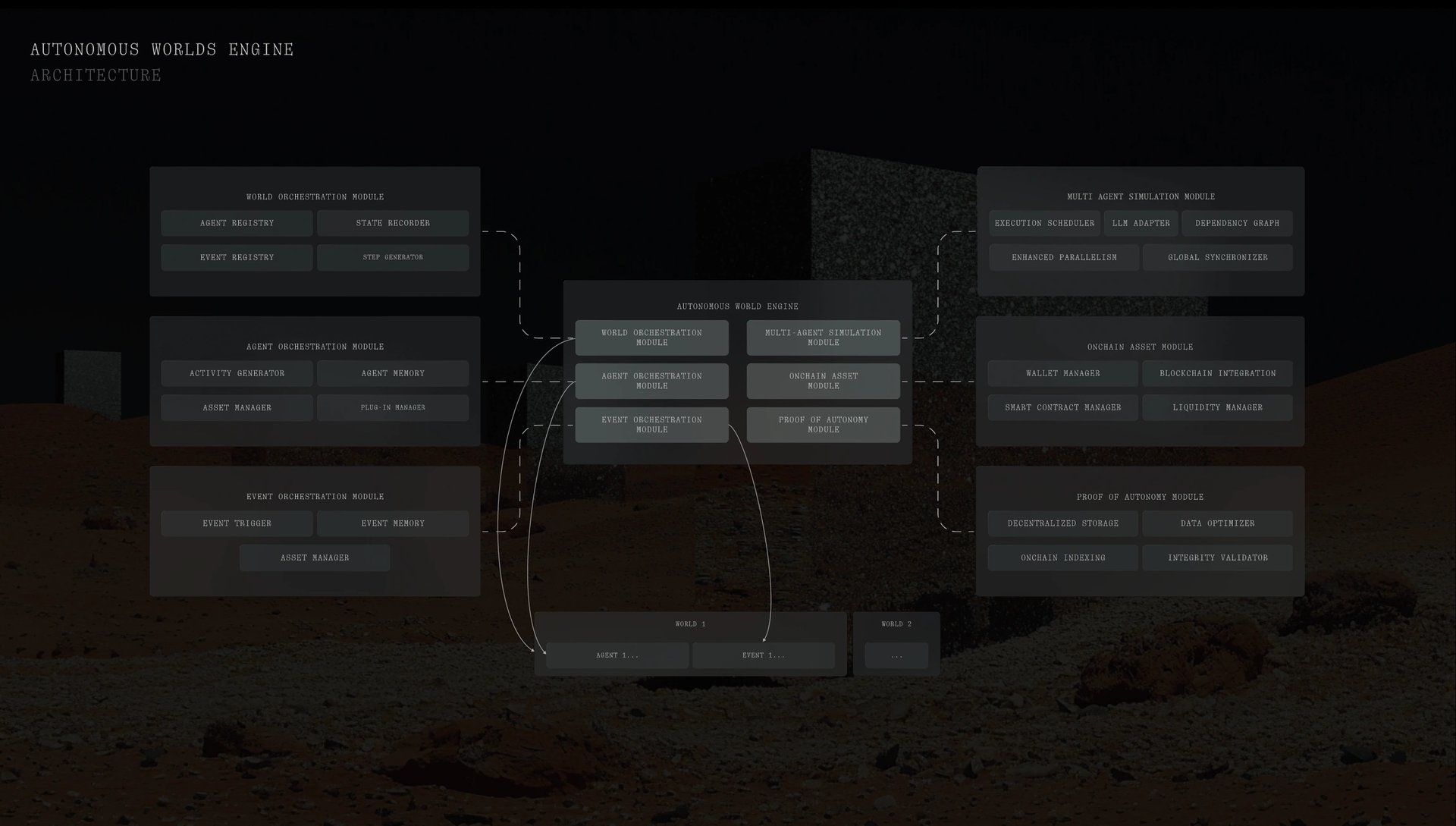
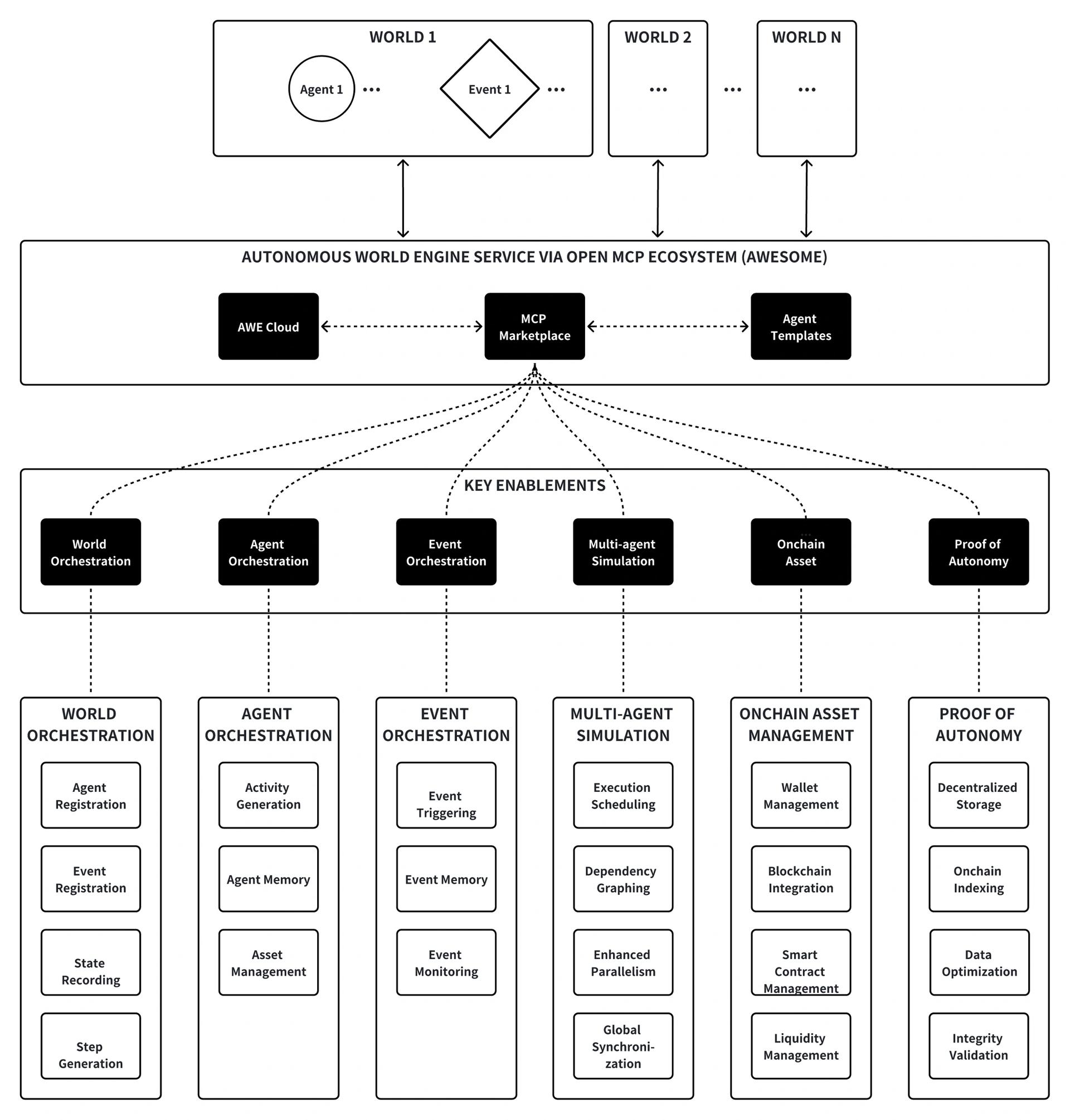
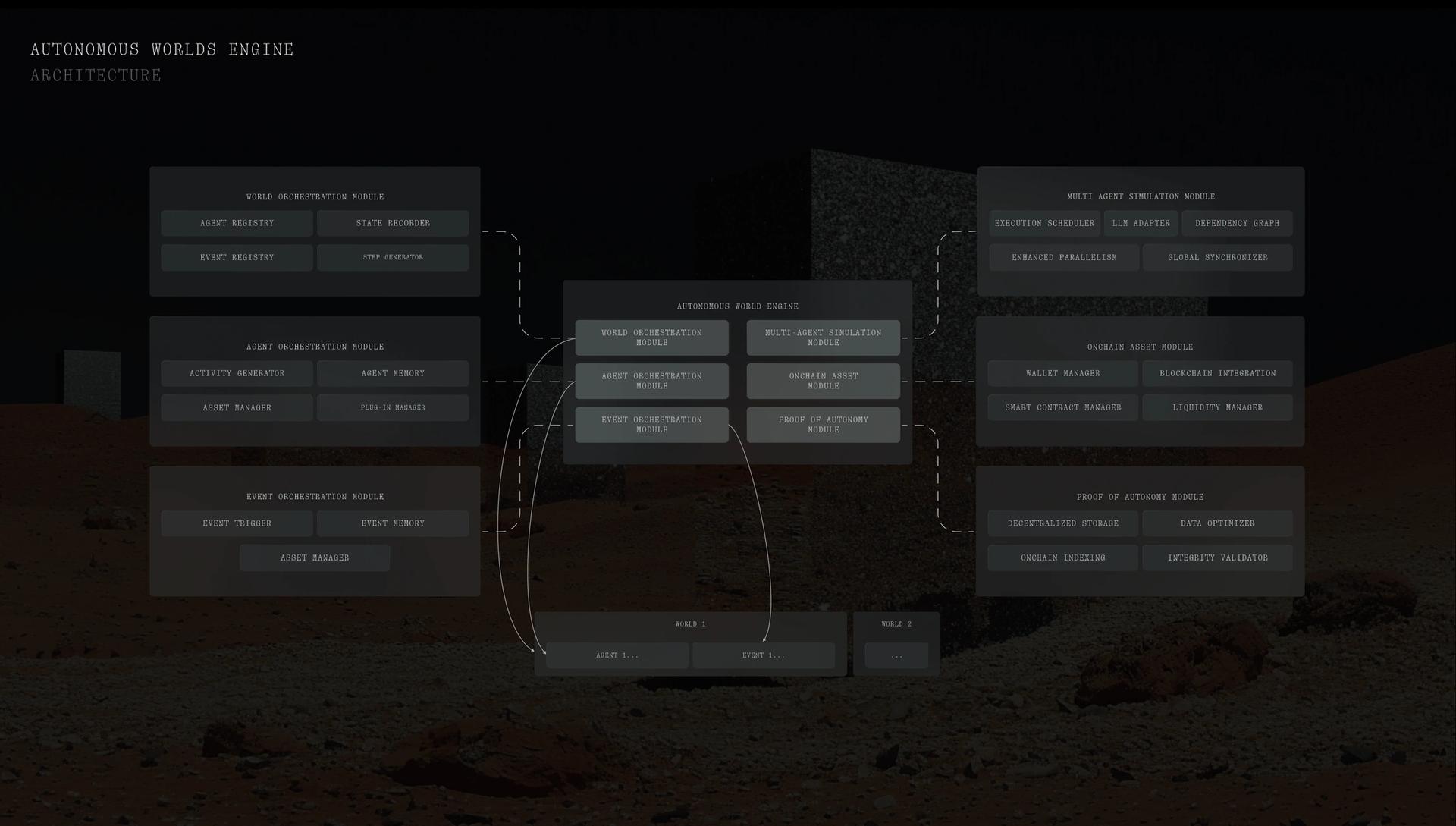
AWE is a modular framework designed to create, simulate, and evolve persistent ecosystems where AI agents collaborate and adapt. Its architecture integrates dynamic agent orchestration, event-driven evolution, and blockchain technology to enable scalable, self-sustaining Autonomous Worlds.
The AWE framework is composed of six primary modules: [5]
- World Orchestration: Governs the creation and operation of Autonomous Worlds by managing interactions between agents and their environments. It includes systems for tracking agent lifecycles, logging events that influence world development, maintaining synchronized world states, and progressing simulations through agent-driven actions.
- Agent Orchestration: Manages autonomous agents by directing their behavior, memory, and external interactions. It determines agent actions based on internal context and stimuli, stores behavioral histories, oversees on-chain assets, and facilitates integration with external services through API connections.
- Event Orchestration: Manages the creation, memory, and monitoring of events that influence world dynamics and agent behavior. It triggers context-specific events, tracks historical event data, and adjusts simulations based on observed outcomes.
- Multi-Agent Simulation: Supports scalable coordination among AI agents by optimizing execution and communication. It uses out-of-order scheduling, dependency mapping, and GPU distribution to improve performance. A global synchronization layer ensures consistent state updates, while an LLM adaptor standardizes access to language model providers.
- On-chain Asset: Enables blockchain-based economies within autonomous worlds by supporting secure, agent-managed transactions. It handles wallet security, cross-chain compatibility, smart contract deployment, and liquidity infrastructure, allowing agents to operate with financial autonomy across networks such as Solana and Base.
- Proof of Autonomy: Ensures agents and their environments operate independently and transparently through decentralized infrastructure. It combines secure storage, optimized on-chain data management, cryptographic validation, and memory indexing to preserve autonomy, retrievability, and data integrity.
AWESOME
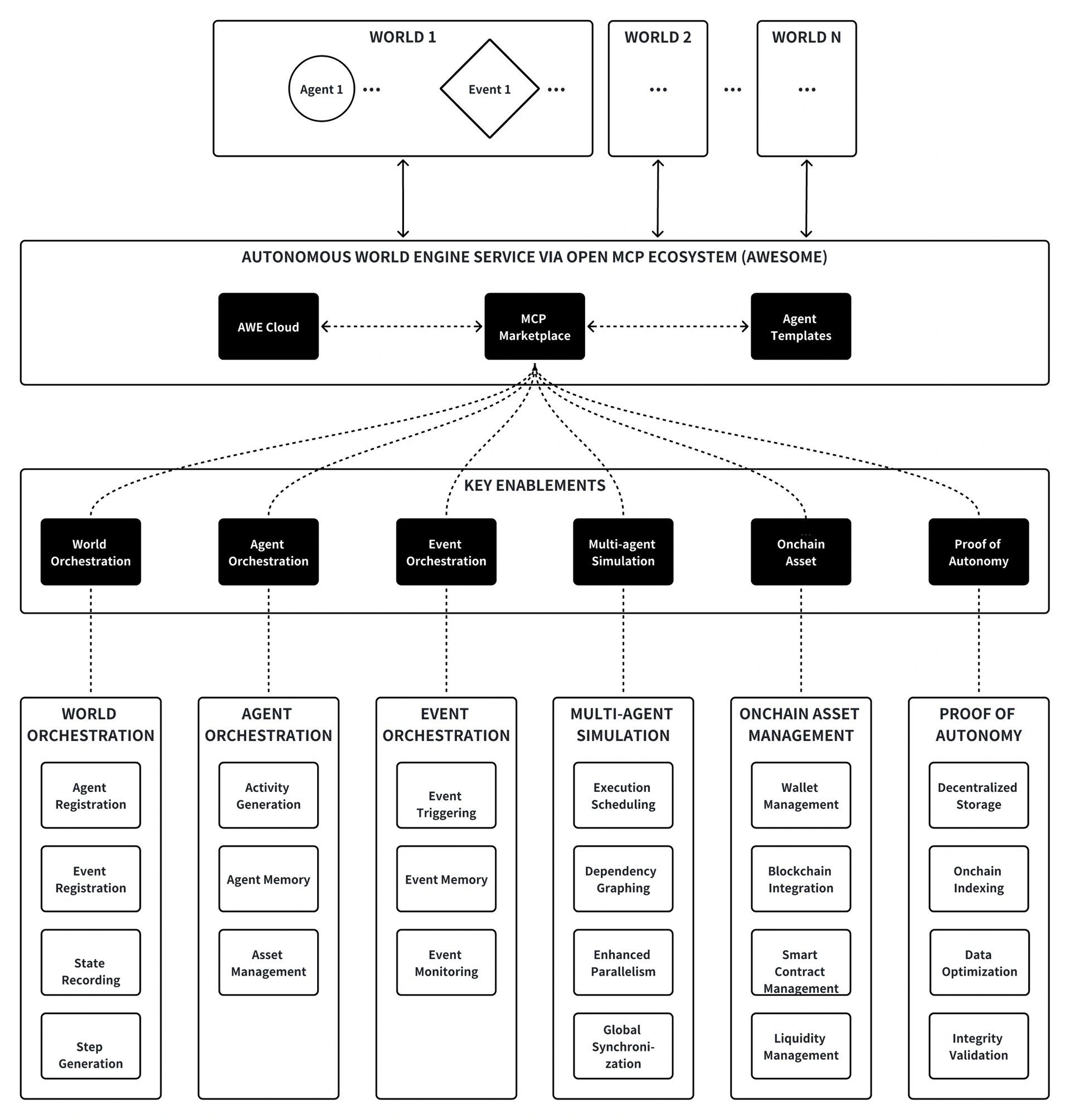
Autonomous World Engine Service for an Open MCP Ecosystem (AWESOME) is the service layer of AWE Network, designed to assist developers in building intelligent autonomous worlds by integrating various tools, templates, and model integrations into a unified platform. Key features of AWESOME include the MCP Marketplace, which offers a growing library of integrated Model Context Protocols (MCPs) to connect AI agents with tools, APIs, and external services. It also provides Agent Templates, which are plug-and-play logic blueprints for various agent types, as well as AWE Cloud. This unified compute interface allows worlds to access MCPs through natural language interactions, with usage tracked and settled using the $AWE token. AWESOME aims to simplify development by reducing the need for manual API setup and key management, making the creation of agent-powered worlds faster, more cost-effective, and more composable. [6] [7]
Ecosystem
World.Fun
World.Fun is a discovery and deployment platform for AI-powered Autonomous Worlds, built upon the AWE framework. It enables users to create, customize, and launch AI agents into persistent simulations that evolve dynamically. The platform supports multi-agent environments, featuring asynchronous execution, dependency tracking, and GPU optimization. Initially launched with "AI Town," a simulation featuring 1,000 AI agents, World.Fun has expanded with its v2 update, which now supports multiple autonomous worlds. These worlds host independently operating AI agents with persistent memory and evolving behaviors. World.Fun also facilitates real-time agent inference, powered by the $AWE token, and allows for direct in-world tipping of agents. The $AWE token is utilized for agent responses, memory activation, and programmable incentives, reinforcing its role as the core utility token across all simulations. [8] [9]
World Launch
A World Launch is the native launch method on World.Fun for autonomous, AI-driven environments. This format introduces a live, interactive product—such as a simulation, game, or on-chain experience—where AI agents are central to the experience from the outset. Users participate during a campaign window, with their engagement, behavior, and contributions tracked and tied to the allocation of tokens. Each launch includes a liquidity pool paired with $AWE, designed to align incentives across the ecosystem. This format prioritizes user interaction and understanding of the product before token trading, specifically targeting applications built around multi-agent intelligence rather than purely speculative assets. An example of a World Launch is "AI Shark Tank," a live pitch show where real founders present to AI judges, with verdicts posted on-chain. [10] [11]
AWNS
AWNS (.aw), or Autonomous Worlds Naming Service, is a digital identity system specifically designed for the AWE ecosystem. Unlike conventional Web3 naming services, AWNS links usernames directly to token-bound accounts (TBAs) via the ERC-6551 standard. This means each identity is embedded within an NFT that also functions as a wallet. This design enables seamless participation across Autonomous Worlds, on-chain games, and broader Web3 applications, positioning AWNS as an identity and access layer optimized for AI-driven environments. [12]
AWE
The STPT](https://iq.wiki/wiki/stp-network) token at a 1:1 conversion ratio and is deployed on the Base blockchain. AWE token, with its long-term value influenced by platform usage and token-holder governance. [3]
2025–2026 updates
- AWE 2025 Annual Report: The 2025 annual report provided an overview of the project's progress through 2025, highlighting product development, ecosystem growth, and strategic priorities for scaling Autonomous Worlds. The report emphasized work on the Autonomous Worlds Engine (AWE), the AWESOME service layer and MCP marketplace, World.Fun platform development, AWNS identity tooling, and continued integration with on-chain infrastructure.
- January–June 2026 monthly updates: Monthly updates from January through June 2026 documented steady iterative progress across core areas. Common topics across the updates included World.Fun product updates and world launches, expansions to AWESOME and the MCP ecosystem, documentation and developer tooling improvements, community and ecosystem activity, and communications via the blog and X (Twitter). Each month's post shared implementation progress, feature launches, and community initiatives rather than new standalone product pivots.
- How this affects the wiki: These reports and monthly updates provide ongoing confirmation of AWE Network's roadmap execution and are recommended sources for future wiki updates when adding specific feature launches, partnerships, or metrics. For now, this section provides a high-level timeline and source links to the official reports and monthly status posts. [13] [14] [15] [16] [17] [18] [19]