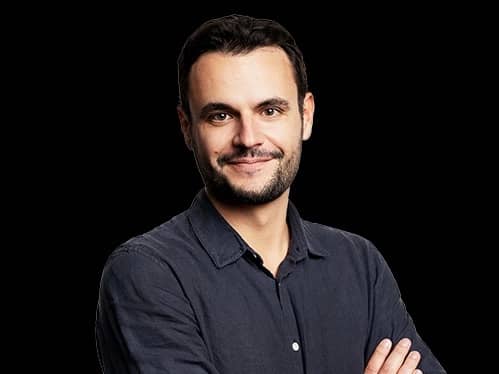
Johann Kerbrat

The Agent Tokenization Platform (ATP):Build autonomous agents with the Agent Development Kit (ADK)
Visit IQ AI

Johann Kerbrat

Johann Kerbrat is the Senior Vice President and General Manager of Robinhood Crypto, the division of the financial services company Robinhood. He is responsible for the overall strategy, product development, and business operations of the crypto unit. Since joining Robinhood in 2021, Kerbrat has overseen a significant expansion of its digital asset offerings, including the launch of a self-custody wallet, international expansion into the European Union, the acquisition of the global exchange , and the introduction of products like crypto and tokenized stocks. [1] [2] [3]

Early Life and Education

Kerbrat grew up in Nice, France. [2] His interest in the space began as early as 2010, driven by a belief in potential to improve the financial system. [4] [5]

He pursued a comprehensive education in computer science, earning a Master of Science degree from the EPITECH European Institute of Technology. [1] [6] His studies also included international programs at Beijing Jiaotong University and the University of Kent. [1] [3] Some corporate biographies also note that he holds a Master of Science in Software Engineering from Oxford Brookes University. [2]

Career

Early Career

Kerbrat began his career in software engineering, holding roles at several technology companies. He worked at the financial software firm Murex in Paris and New York, eventually becoming a Tech Lead. [1] His career also includes engineering positions at Canonical, the company behind the Ubuntu operating system, and Jive Software. [3]

As his career progressed, Kerbrat took on leadership roles at major technology firms, including serving as a Tech Lead Manager at Airbnb. [3] Before joining Robinhood, he deepened his experience in the digital asset space, working at the privacy-focused startup Iron Fish and later as the Head of Engineering for the core product division at the crypto exchange . [1] [3]

Robinhood Crypto

Kerbrat joined Robinhood in January 2021 to lead its engineering team. [1] He progressed rapidly through a series of leadership positions, including Chief Technology Officer of Robinhood Crypto and later Vice President of Engineering for the division. [3]

In November 2022, he was promoted to General Manager of Robinhood Crypto, taking full responsibility for the business unit's product, engineering, and operational strategy. [1] His title was later updated to Senior Vice President and General Manager. [3]

Leadership at Robinhood Crypto

As the head of Robinhood Crypto, Kerbrat has publicly framed the company's investment in the space as a "long-term big bet" on the technology's future role in finance. [7] His strategy centers on a two-pronged approach: providing a simple, low-cost custodial platform as an on-ramp for new users, and offering a self-custody wallet for experienced users to explore the broader ecosystem. [7]

Robinhood Wallet

Kerbrat led the development and launch of the Robinhood Wallet, a self-custody, multi-chain wallet designed to give users full control over their digital assets. [8] The wallet's beta version was released to a waitlist of 10,000 users in September 2022, with initial support for the network for its speed and low transaction costs. [8] The wallet was made publicly available to all iOS users in March 2023 after a phased rollout to over one million waitlisted individuals. [8]

Under Kerbrat, the wallet expanded its support to include multiple networks such as , , , , , , , and . [1] [8] The wallet also integrates with (DEX) aggregators like 0x and LI.FI, allowing users to trade thousands of tokens not available on Robinhood's main custodial platform. [1] Kerbrat has stated that the wallet's goal is to onboard millions of new users to by abstracting away its complexities. [7]

International Expansion and Bitstamp Acquisition

A key part of Kerbrat's strategy has been international expansion, driven in part by the challenging regulatory environment in the United States. In December 2023, he led the launch of Robinhood Crypto's trading services in the European Union, which became the company's first dedicated international crypto product. [1] He cited the EU's Markets in Crypto-Assets (MiCA) regulation as providing the regulatory clarity necessary to operate and innovate with confidence. [4]

To further accelerate this global growth, Robinhood announced its agreement to acquire the exchange on June 6, 2024. [4] Kerbrat was the public face of the acquisition, which was finalized on June 2, 2025. [8] He highlighted the deal as a major milestone that brought a globally-scaled exchange with customers across the EU, UK, US, and Asia under the Robinhood umbrella. [8]

Service and Asset Expansion

Under Kerbrat's leadership, Robinhood Crypto has diversified its product suite and expanded the number of available assets. [6]

  • Crypto Staking: The company introduced crypto staking, first launching the service in the EU before rolling it out in the United States in June 2025. [6] [3]
  • Asset Listings: Kerbrat has announced the addition of several popular cryptocurrencies for trading, including (SOL), Pepe (PEPE), (), (ADA), and (). [8]
  • Derivatives: Robinhood launched crypto perpetuals in Europe, allowing users to trade derivative contracts based on the future price of assets with leverage. [3]
  • Layer 2 Development: Robinhood announced it was building a Layer 2 scaling solution on , leveraging Arbitrum's technology stack to enhance transaction speeds and lower costs for its users. [9]
  • Strategic Investments: In November 2025, Kerbrat announced a strategic investment from Robinhood into Lighter.xyz, a decentralized exchange specializing in perpetuals, as a way to support innovation in the DeFi derivatives market. [8]

Views and Philosophy

Kerbrat is a frequent public speaker and commentator on the future of finance, often aligning his views with Robinhood's mission to "democratize finance for all." [7]

On Tokenization and Financial Accessibility

Kerbrat is a strong proponent of tokenization, arguing it can make any asset in the world accessible, divisible, and tradable 24/7. [6] He views tokenization as a critical tool for financial inclusion, capable of giving retail investors access to previously restricted asset classes like private equity and real estate. [6]

He has defended Robinhood's model of offering tokenized derivatives of pre-IPO stocks without requiring issuer permission, framing it as a way to "bridge the wealth gap." He argued that the traditional system of private market investing excludes most people, who are then used as "exit liquidity" when companies go public. [3]

On Regulation

Kerbrat has been vocal about the need for regulatory clarity in the digital asset industry. He has praised the EU's MiCA framework as a model that enables companies to operate with certainty, contrasting it with what he describes as the "regulation-by-enforcement" approach in the United States. [4] He revealed that Robinhood had met with the U.S. Securities and Exchange Commission (SEC) 16 times in an unsuccessful attempt to register its crypto business. [4]

Furthermore, he has publicly criticized wealth-based investor accreditation rules, suggesting they should be replaced with knowledge-based qualifications. In his view, investors should be able to participate if they can demonstrate an understanding of the risks involved, rather than being gated by their net worth. [3]

On User Experience and Adoption

A central theme in Kerbrat's public statements is the importance of simplifying the user experience to drive mass adoption of technologies. He believes the complexity of crypto, including concepts like seed phrases and network fees, is a major barrier for new users. The Robinhood Wallet was designed specifically to provide a familiar, "Web2-like" experience that abstracts away these technical hurdles. [1] [5]

Public Engagement

Kerbrat actively represents Robinhood Crypto at major industry events and in the media. He was a speaker at several conferences in 2025, including Consensus in Hong Kong, Consensus in Toronto, and in Singapore. [10] [6] [3]

In June 2025, he participated in a fireside chat in Cannes alongside founder and CSO A.J. Warner, an event that was part of Robinhood's push to engage with mainstream audiences. [8] He has also been a guest on numerous industry podcasts, including The Defiant, Unchained, and Edge of NFT, where he has discussed Robinhood's strategy and his vision for the crypto industry. [7] [4] [5]

Controversies

US Regulatory Scrutiny

Operating in a difficult U.S. regulatory environment, Robinhood's crypto division, under Kerbrat's leadership, has faced legal challenges. In May 2024, the company received a Wells notice from the SEC, indicating a potential enforcement action related to its listings. Kerbrat publicly expressed disappointment with the notice, particularly given the company's prior attempts to proactively register with the agency. [4]

Tokenized Pre-IPO Stocks

In July 2025, Robinhood launched tokenized derivatives in Europe that tracked the value of private, pre-IPO companies, including OpenAI and SpaceX. The move drew public criticism from OpenAI, which stated it had no involvement with the offering. Kerbrat defended the product, arguing that it was an important innovation for providing retail investor access to private markets that are typically reserved for venture capitalists and accredited investors, thereby promoting a more equitable financial system. [3]

Interviews

Robinhood–Bitstamp Acquisition and International Crypto Operations #01

In an interview published on June 13, 2024, on the CNBC Television YouTube channel, Johann Kerbrat commented on Robinhood’s announced plan to acquire the exchange for approximately $200 million in cash. According to Kerbrat, the transaction is intended to support Robinhood’s expansion of its crypto operations outside the United States, with particular relevance to markets in the European Union, the United Kingdom, and parts of Asia.

Kerbrat stated that holds more than 50 regulatory licenses across multiple jurisdictions, which may allow Robinhood to operate in additional markets under existing regulatory frameworks. He explained that Bitstamp’s established compliance structure and institutional customer base could be integrated into Robinhood’s broader crypto business, which has historically focused on retail users. He also referenced Bitstamp’s services, including trading infrastructure, lending, , and application programming interfaces, as components that could be incorporated into Robinhood’s crypto offerings.

According to Kerbrat, is expected to continue operating as a separate entity until the acquisition process is completed, which is anticipated to occur in the first half of 2025. He noted that no immediate changes to Bitstamp’s brand or operations were planned prior to the closing of the transaction, and that any future integration would occur incrementally.

Kerbrat also discussed the regulatory environment affecting Robinhood’s crypto activities, including the Wells notice issued by the U.S. Securities and Exchange Commission. He contrasted regulatory conditions in the United States with those in the European Union, referencing the Markets in Crypto-Assets framework as an example of a more defined regulatory structure. He indicated that Robinhood continues to engage with U.S. regulators while pursuing expansion in jurisdictions with established regulatory guidelines.

In Kerbrat’s view, the proposed acquisition of reflects Robinhood’s approach to developing its crypto business across multiple regions while adapting to differing regulatory environments. [11]

A Closer Look at Robinhood Crypto #02

In an interview published on the Web3 Deep Dive YouTube channel on October 9, 2025, Johann Kerbrat discussed the development and structure of Robinhood Crypto, outlining the company’s approach to digital asset services. In conversation with host Rachel Wolfson, Kerbrat described how Robinhood positions its operations within the broader framework of its financial platform.

Kerbrat explained that Robinhood Crypto is structured to integrate digital asset trading into an existing brokerage environment. He referenced recent additions to the platform, including tokenized stock offerings, perpetual futures products available in Europe, services for certain assets in the United States, and social features incorporated into the application. These elements were described as part of an expanded product set rather than as isolated initiatives.

The discussion also addressed the use of artificial intelligence within the platform. According to Kerbrat, AI-related tools are being developed to assist users in processing market information and news content, with an emphasis on data presentation rather than automated decision-making. He noted that these tools are intended to function alongside existing trading features.

Regulatory considerations were another focus of the interview. Kerbrat stated that evolving regulatory frameworks in the United States and Europe influence product development and operational decisions. He referenced the acquisition of and the development of a based on as infrastructure-related measures connected to licensing, scalability, and compliance requirements.

The interview reflects Kerbrat’s perspective on Robinhood Crypto as a component of the company’s broader financial services offering, combining traditional brokerage functions with -based infrastructure under established regulatory conditions. [12]

REFERENCES

HomeCategoriesRankEventsGlossary