0% read
Last updated:
JUST Foundation
JUST Foundation is an organization focused on developing decentralized financial (DeFi) solutions on the TRON network. It provides a range of financial tools, including lending, stablecoin issuance, staking, and energy rental solutions. The foundation contributes to the governance and development of the JUST ecosystem, which includes platforms such as JustStable, JustLend DAO, and JustCrypto. [1] [2] [3]
Overview
The JUST ecosystem consists of decentralized finance solutions, primarily focusing on stablecoin issuance, lending services, and cross-chain interoperability. Its main products include:
- JustStable: A decentralized stablecoin system featuring USDJ, a TRON-based stablecoin pegged 1:1 to the US dollar.
- JustLend DAO: TRON's first official lending platform, where users can borrow, lend, and earn interest on digital assets.
- sTRX Staking: A staking program that allows TRX holders to earn additional yields through TRON Stake 2.0.
- Energy Rental: A service designed to reduce transaction costs on TRON by enabling users to rent Energy instead of burning TRX.
- JustCrypto: A cross-chain asset platform that facilitates token swaps and liquidity bridging across different blockchain ecosystems.
The ecosystem operates with two primary tokens: JST and USDJ. JST is the governance token that allows holders to vote on protocol upgrades and manage system risk. USDJ is a decentralized stablecoin generated when users lock collateral assets in smart contracts known as Collateralized Debt Positions (CDPs). The primary collateral accepted is PTRX, which is obtained by exchanging TRX. To retrieve the collateral, users must repay the generated USDJ along with a stability fee, which is paid in JST. The JST collected from these fees is subsequently burned, reducing its overall supply. Mining and staking mechanisms provide incentives for ecosystem participants. [10]
JST Airdrop Program
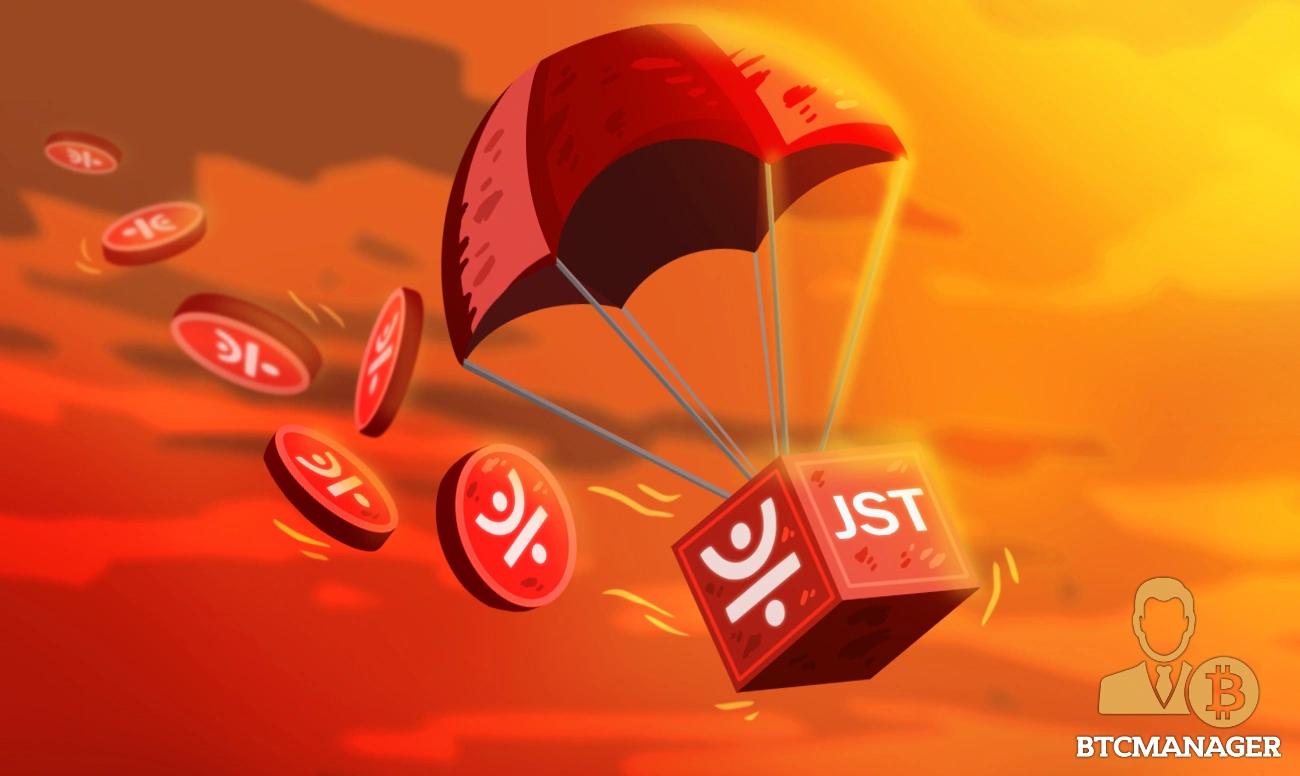
JUST Foundation introduced an airdrop program to distribute JST tokens to TRON (TRX) holders over a two-and-a-half-year period. The initiative was structured to allocate 10% of the total JST supply to eligible addresses through periodic distributions.
The first snapshot for the airdrop was recorded at 00:00 UTC on May 20, 2020, with an initial allocation of 217,800,000 JST to TRX holders possessing at least 100 TRX at the time of the snapshot. The distribution followed a predefined schedule:
- June 2020 – May 2021: 237,600,000 JST (2.4% of total supply)
- June 2021 – May 2022: 257,400,000 JST (2.6% of total supply)
- June 2022 – October 2022: 277,200,000 JST (2.8% of total supply)
Monthly snapshots were taken on the 20th at 00:00 UTC, ensuring consistent allocation to TRX holders. The airdropped JST was distributed to supported wallets and exchanges, including Poloniex, KuCoin, Bitpie, and Atomic Wallet. [1] [2] [3] [4] [10] [11]
History
JUST Foundation was established to address the need for decentralized financial solutions within the TRON ecosystem. In 2020, it introduced JustStable and the USDJ stablecoin, allowing users to generate a TRON-based stablecoin through collateralization. That same year, JustSwap was launched as a decentralized exchange (DEX) to facilitate token trading within the TRON network. The introduction of JustLend followed, providing lending and borrowing options for TRON users.
By 2021, JustSwap underwent a rebranding after being acquired by SUN.io, transitioning into SunSwap to further integrate with the TRON DeFi landscape. That year also saw the launch of JustLink, a decentralized oracle service that supplies price feeds for smart contracts. In 2022, JustLend transitioned to a decentralized governance model and was renamed JustLend DAO. Additionally, the JST token was recognized as an authorized digital currency in the Commonwealth of Dominica, providing regulatory legitimacy.
In 2023, the foundation expanded its staking and lending features, launching new markets within JustLend DAO, including sTRX and wstUSDT, which enabled users to leverage their assets for borrowing and staking. Revenue from the stUSDT protocol was also directed toward JST/TRX liquidity pools to support the ecosystem.
Developments in 2024 included the first burn of JST-TRX LP tokens from SunSwap in January as part of its buyback program. In May, the TRON Energy Rental feature was updated to support multiple addresses, and a risk alert feature was added to notify users of potential liquidations. The JustLend DAO website was redesigned in August for improved transparency and user experience. Also during the year, JST was listed on MercadoBitcoin, Brazil’s largest cryptocurrency exchange.
The ecosystem saw significant expansion in 2025, starting with the January release of the USDD V2.0 protocol, a decentralized and freeze-free stablecoin. Subsequently, a market for USDD V2.0 was added to JustLend DAO, along with associated mining rewards. In April, the USDD protocol was updated to allow sTRX as collateral. Later in the year, JustLend DAO launched new markets for USD1 and Wrapped Bitcoin (WBTC), formed a partnership with WLFI to increase liquidity, and initiated a JST buyback and burn program funded by protocol revenue. [1] [12] [6] [7] [8] [9]
Governance
The JUST ecosystem operates under a decentralized governance model where holders of the JST token manage the system's risk and guide its evolution. Any TRON account can deploy a smart contract as a proposal for system changes, which JST holders then vote on. The proposal with the most votes is executed.
Key responsibilities of JST voters include managing a set of risk parameters for the USDJ stablecoin system:
- Debt Ceiling: The maximum amount of debt that can be created by a single collateral type.
- Liquidation Ratio: The collateral-to-debt ratio below which a Collateralized Debt Position (CDP) is subject to automatic liquidation.
- Stability Fee: An annualized fee charged for borrowing USDJ, which influences demand.
- Penalty Ratio: A fee applied during liquidations to discourage risky borrowing.
JST holders are also responsible for choosing a set of trusted Oracles to provide reliable price feeds for the system and appointing "global settlers" who have the authority to trigger an emergency shutdown (Global Settlement) in response to severe market risks or system attacks. This shutdown process freezes the system and allows holders of USDJ and CDPs to claim a fixed amount of collateral. Smart contracts within the ecosystem undergo regular security audits to maintain system integrity. [10]
Technical Architecture
JUST Foundation's ecosystem is built on the TRON blockchain and utilizes smart contracts to automate financial operations. The TRON Virtual Machine (TVM) supports contract execution, enabling decentralized applications (DApps) within the ecosystem. The infrastructure includes mechanisms for staking, lending, collateralized stablecoin issuance, and resource management through Energy rental.
USDJ Stablecoin System
The core of JustStable is the USDJ stablecoin system, built on automated smart contracts. USDJ is generated when users deposit PTRX (pegged TRX) as collateral into a Collateralized Debt Position (CDP). To ensure USDJ maintains its 1:1 peg with the US dollar, the system employs a Target Rate Feedback Mechanism (TRFM). If the market price of USDJ deviates from its target price, the TRFM automatically adjusts the Target Rate, making it more or less expensive to generate USDJ. This creates economic incentives for market participants to restore the price to its peg. [10]
Key Features
- Smart Contract Automation – Transactions are executed automatically through smart contracts without requiring third-party intermediaries.
- Cross-Chain Interoperability – JustCrypto enables asset transfers between TRON and other blockchain networks.
- Energy Optimization – The Energy Rental system provides a way to minimize transaction costs by allowing users to rent Energy instead of burning TRX.
- Decentralized Lending – JustLend DAO supports multiple token markets, providing liquidity and yield opportunities.
JUST Foundation continues to develop its DeFi ecosystem within TRON, offering financial products and governance mechanisms. [1] [5]
See something wrong?

Average Rating
Based on over 1 ratings
How was your experience?
Give this wiki a quick rating to let us know!
Edited By
On September 2, 2026. 12:20 UTC
Edit summary:
Fix heading levels