Rick Tapia
Rick Tapia is an attorney specializing in blockchain, digital assets, and emerging technology law, and is the founding partner of Restored Law, PLLC. His work has focused on legal counsel, regulatory matters, and strategic advisory services for companies operating in the cryptocurrency and blockchain sectors. [3]
Education
Tapia graduated from Indiana Wesleyan University with a BS in Business Management. He later received his JD from Indiana University Robert H. McKinney School of Law. [1]
Career
Tapia founded Restored Consulting in 2016, serving as chief executive officer and providing consulting services to businesses across a range of industries, including blockchain and digital assets. In 2021, he co-founded the Blockchain Law Alliance, an organization focused on legal collaboration and education related to blockchain technology, and remained involved until 2024.
In 2022, Tapia joined Bull Blockchain Law, LLP as an attorney, where he advised clients on matters involving digital assets, cryptocurrency regulation, decentralized technologies, and related legal issues. During this period, he also served as a strategic advisor to Kaimeta beginning in 2024, providing guidance on legal and business strategy.
In August 2024, Tapia founded Restored Law, PLLC, where he serves as founding partner, focusing on legal services for blockchain, digital asset, and technology-focused clients. That same year, he became general counsel of Digital Ascension Group, a position he held until April 2025. In 2025, he was appointed Indiana chapter president of Stand With Crypto, supporting the organization's state-level advocacy and community engagement efforts. [2] [3]
Interviews
AI & Blockchain in Law
At the Digital Fusion Summit in February 2025, Tapia joined Ray Fuentes for a discussion on the intersection of artificial intelligence, blockchain technology, and the legal industry. Tapia, speaking in his role as CEO of DraftChain.AI, described the platform as a legal co-pilot designed to assist attorneys with drafting, research, and decision-making, similar to how conversational AI tools support general workflows. He highlighted the potential for AI and blockchain systems to improve evidentiary integrity, including applications in authenticating digital media and mitigating risks associated with deepfake content in legal proceedings. The conversation also addressed the emergence of evolving regulatory frameworks across jurisdictions and their impact on both the legal profession and digital asset markets. Tapia emphasized DraftChain.AI’s model for enabling legal professionals to contribute and monetize their expertise through structured data systems, while noting that increased automation could shift legal services toward more efficient pricing models such as flat fees. He acknowledged concerns about automation’s impact on employment but maintained that human judgment would remain central to legal decision-making, particularly in complex cases, and pointed to growing institutional engagement with blockchain-based systems. [6]
Panels
Tech, Community, and Policy
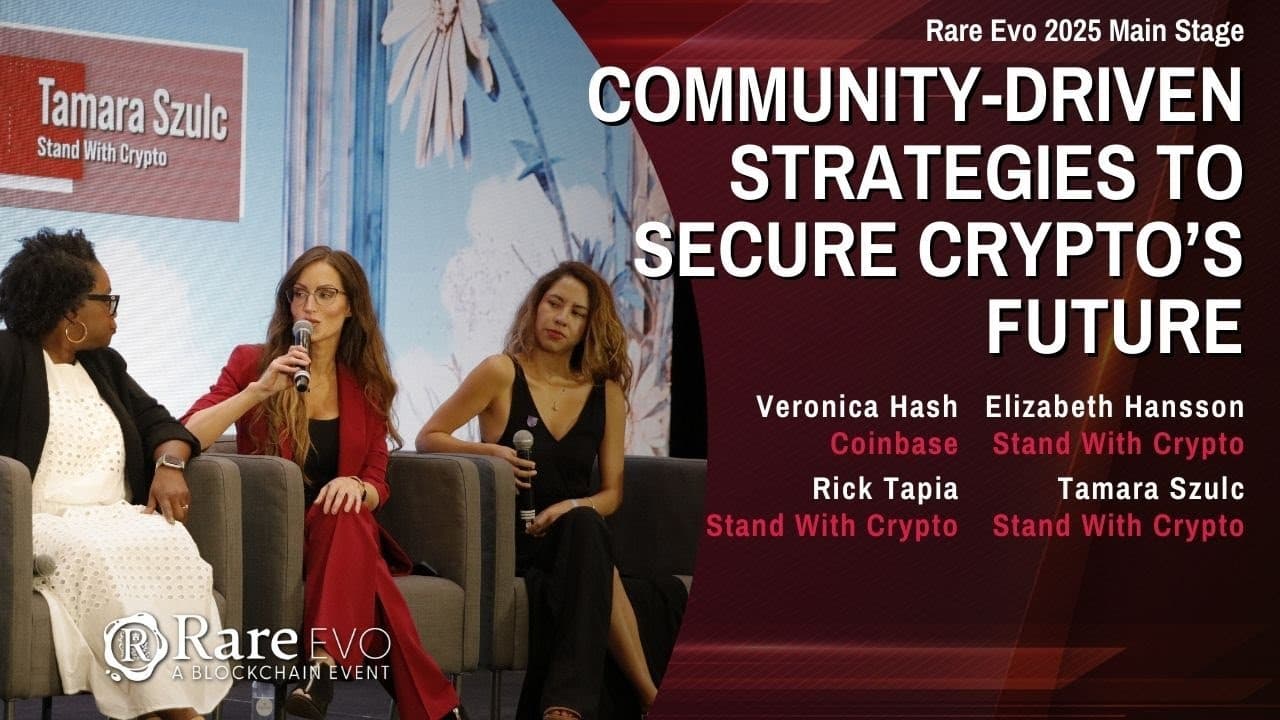
At Rare Evo 2025, Tapia moderated a panel titled “The Intersection of Tech, Community, and Policy,” featuring Veronica Hash (Coinbase), Elizabeth Hansson (Stand With Crypto), and Tamara Szulc (Stand With Crypto), which focused on the role of advocacy in shaping the future of crypto regulation in the United States. The discussion emphasized the need to bridge gaps among builders, policymakers, and the broader crypto community to create clearer, more effective regulatory frameworks. Tapia drew on his experience advising founders on compliance, highlighting the importance of aligning legal strategy with technological development. Panelists from Coinbase and Stand With Crypto stressed bipartisan cooperation, the importance of legislative clarity around areas such as stablecoins and decentralized finance, and the need for both federal and state-level engagement to address regulatory uncertainty. They also underscored the value of grassroots participation and public engagement in shaping policy outcomes. Overall, the conversation framed effective crypto policy as a collaborative effort among industry, government, and community stakeholders, with sustained advocacy viewed as essential to the sector's long-term development. [7]