0% read
AEON
AEON is a crypto payment infrastructure project focused on connecting digital assets with merchant payment systems and settlement networks. Its products include AEON Pay, AEON Checkout, and an AI payment framework designed to support transactions involving AI agents. [1]
Overview
AEON is a crypto payment and settlement infrastructure project focused on connecting on-chain assets with real-world commerce, fiat payment networks, and AI-driven transactions. Its infrastructure includes AEON Pay, which connects cryptocurrency payments to fiat acquiring rails for merchants; AEON Checkout, a checkout infrastructure for Web2 and Web3 businesses; and AEON AI Payment, which enables AI agents to initiate and complete payments for services such as travel bookings, mobile top-ups, and access to paid digital platforms. The system is designed to support payments across different blockchains and between on-chain and off-chain environments.
AEON also provides cross-chain settlement infrastructure that allows users to pay with assets on one blockchain while completing transactions on another. Its unified node network is intended to coordinate payment and settlement across different networks and payment environments, while supporting fiat settlement for merchants and other platform participants. The broader system is aimed at applications spanning retail payments, online commerce, cross-chain transactions, and AI-agent commerce, with the goal of providing a common payment layer rather than requiring users or merchants to manage separate crypto payment systems for each use case. [2] [4]
Features
AEON Pay
AEON Pay is a crypto payment infrastructure that connects digital assets with existing fiat payment and merchant networks, allowing users to spend cryptocurrency at participating merchants without requiring merchants to integrate new payment systems. It supports in-store payments through QR codes and local payment methods across markets including Vietnam, the Philippines, Brazil, and Nigeria, and is designed to work through wallets, exchanges, and decentralized applications. The system handles the conversion and settlement between users paying in crypto and merchants receiving fiat, while supporting cross-border transactions through its payment acquiring and clearing infrastructure. AEON Pay also emphasizes a non-custodial, pay-as-you-go model that does not require physical cards, preloaded balances, or merchant-specific onboarding. [2]
AEON Checkout
AEON Checkout is a cryptocurrency payment checkout infrastructure for Web2 and Web3 merchants that supports crypto-to-fiat and crypto-to-crypto settlement. It allows users to pay through direct wallet transfers, centralized exchange accounts, or connected wallets, with support for multiple tokens and blockchain networks. Merchants can integrate the service through APIs and offer checkout through external browser pages, embedded miniapps, or bots, including integrations with platforms such as Telegram. AEON also provides a merchant dashboard for transaction monitoring and settlement management, while supporting both crypto and fiat withdrawals through different payout methods. The platform includes onboarding, geographic and industry restrictions, and transaction risk controls, including KYT monitoring and manual procedures for unsupported or incorrectly submitted deposits and withdrawals. [3]
AEON AI Payment
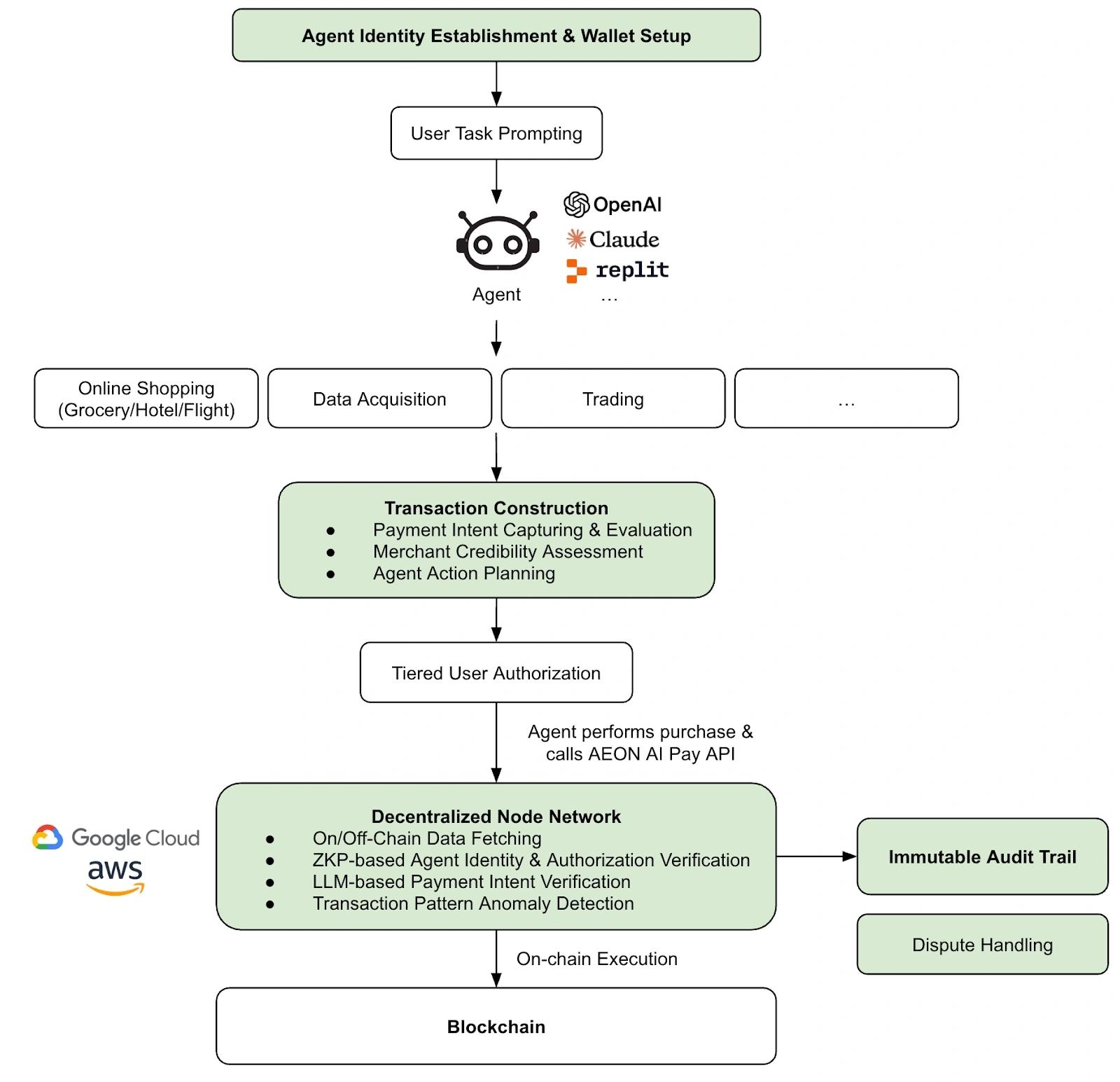
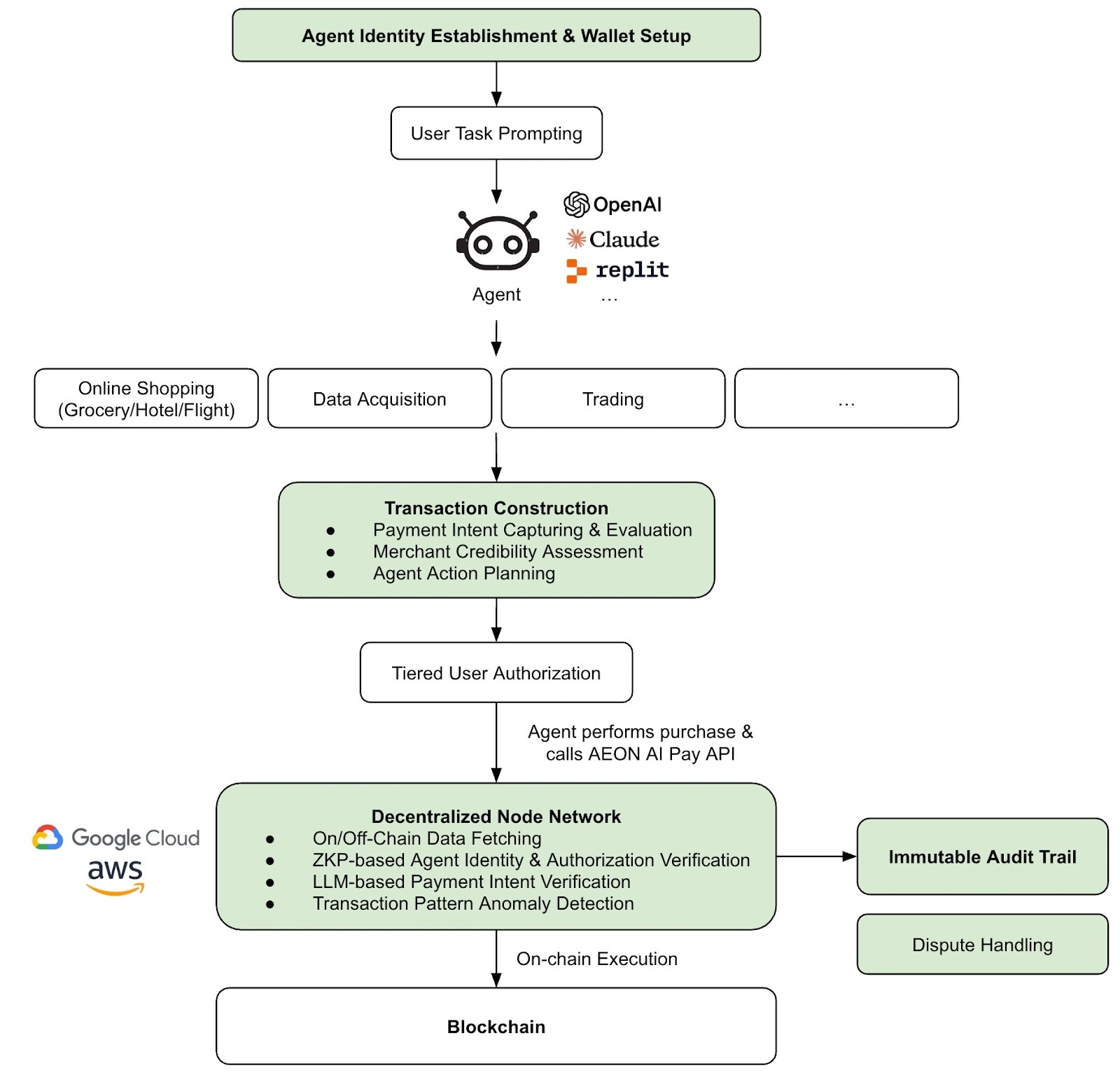
AEON AI Payment is a payment infrastructure designed to allow AI agents to execute transactions with real-world merchants and online services on behalf of users. Its AI Payment Framework (APF) combines agent identities and wallets with transaction construction, intent verification, merchant assessment, user authorization, and execution through a decentralized node network, creating an auditable process for AI-initiated payments. AEON currently supports a User Wallet Payments model, in which agents initiate payments using the user's wallet, while its proposed AI Agent Wallet Payments model, where agents transact using their own wallets, is not yet available. The system is intended for use cases such as autonomous ticket purchases and other online payments, connecting AI-driven workflows with both traditional payment systems and blockchain-based assets. [4]
Agent Identity Protocol
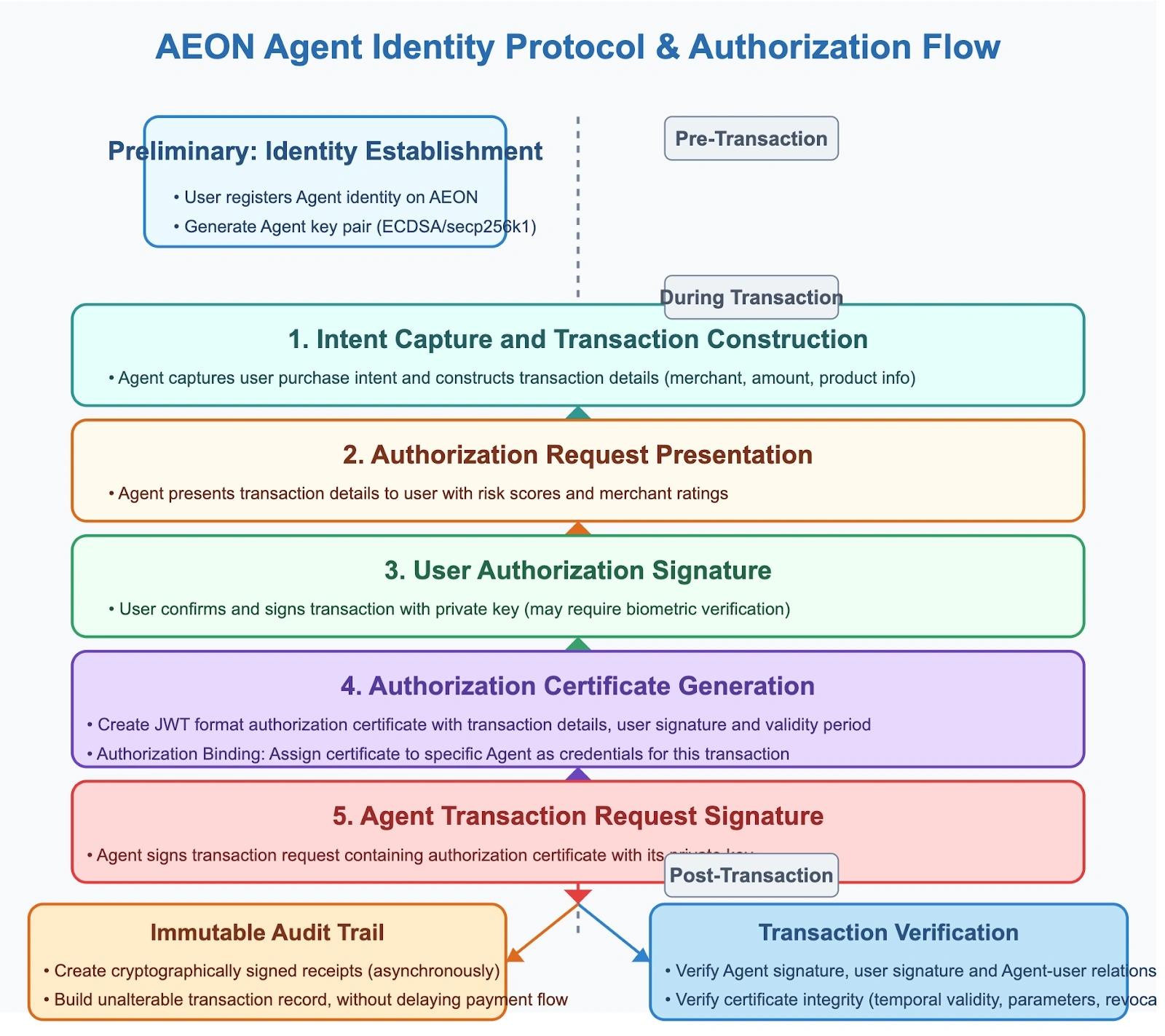
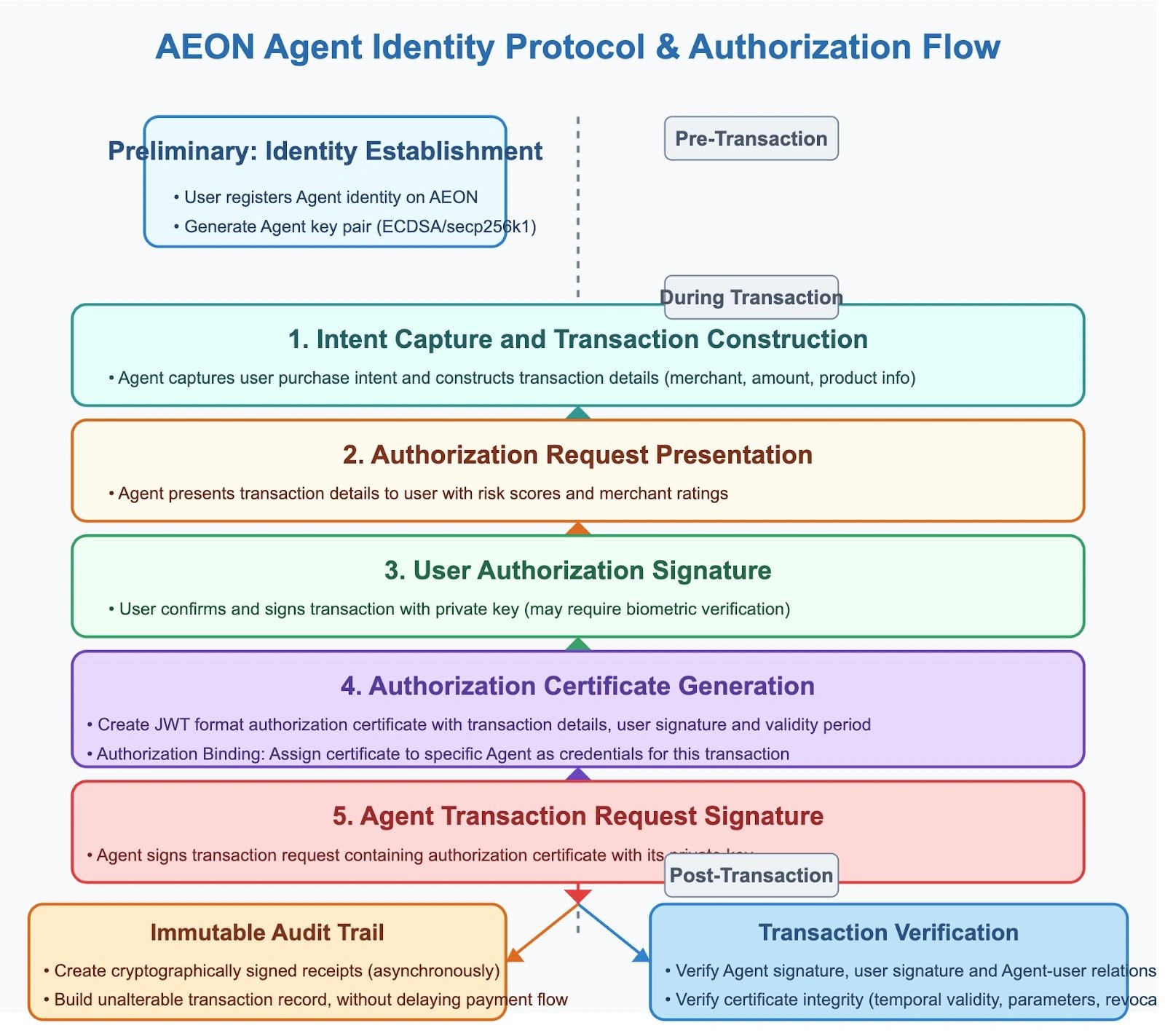
AEON’s Agent Identity Protocol is a cryptographic identity and authorization framework for verifying that AI agents conducting financial transactions are legitimate agents acting with user permission. Each agent receives a unique cryptographic identity based on an ECDSA key pair and derived address, while user authorization certificates bind permissions to a specific Agent ID and transaction parameters such as amount, merchant, and purpose. During transaction verification, AEON checks the agent’s signature, the user’s authorization signature, agent ownership and permission records, certificate validity and revocation status, and whether the transaction falls within the authorized scope. The protocol also generates cryptographically signed transaction receipts containing agent, user, transaction, and timestamp information, with hash chains, digital signatures, trusted timestamps, distributed storage, and Merkle-tree verification used to preserve an auditable record of the authorization and execution process. [5]
LLM-based Payment Intent Verification
AEON’s LLM-based Payment Intent Verification system is designed to translate natural-language user instructions into structured transaction parameters and verify that AI-initiated payments remain consistent with those instructions. Its Financial Intent Embedding Model (FIEM) is described as a specialized model for extracting payment intent from financial conversations and directives, using financial concepts, merchant information, and payment-specific data structures. Cross-Context Semantic Alignment Verification (CSAV) tracks changes in user intent across multiple interactions and compares the original instructions with the final transaction details to identify potential intent drift during multi-step processes. Together, the components are intended to provide a semantic verification layer between user instructions and AI agent payment execution. [6]
Token
The AEON token is designed as the utility, staking, and governance asset for the AEON payment network. It is intended to serve as cross-chain gas for settlements, merchant transactions, and bridge payments across networks including BNB Chain, TON, Solana, and EVM-compatible chains, with transactions involving both human users and AI agents consuming AEON. Validators are expected to stake AEON to help secure and process payment transactions, while a portion of network fees is planned to fund token buybacks, with repurchased tokens either distributed to stakers or burned. AEON is also intended for liquidity provision in merchant settlement pools and CeDeFi vaults, while its governance functions are planned to allow stakers to vote on protocol fees, buyback ratios, validator rewards, treasury allocations, and committee appointments. Staking and governance features were targeted for launch by the end of 2026, with proposed governance incorporating delegation and voting-power limits intended to reduce concentration. [7]
Tokenomics
AEON has a total supply of 1B tokens and has the following allocation: [7]
- Ecosystem Fund: 32.38%
- Team: 20%
- Foundation: 18.30%
- Pre-seed Investor: 12.32%
- Marketing: 10%
- Angel Investor: 5%
- Liquidity & Airdrops: 2%
Partnerships
- Ripple
- DFinity
- Solana
- The Open Network
- Bitcoin Cash
- Stellar
- OKX
- BNB Chain
- Fabric Foundation
- Cross
- Reserve
- Freedom Dollar
- Zano
- USAT
- Ultima
See something wrong?
Average Rating
No ratings yet, be the first to rate!
How was your experience?
Give this wiki a quick rating to let us know!