Momentum
Momentum is a decentralized finance infrastructure company building an on-chain financial ecosystem on the Sui blockchain. Its broader focus is on connecting crypto assets and tokenized real-world assets through shared liquidity, cross-chain infrastructure, automated financial strategies, and compliance mechanisms. [11]
Overview
Momentum is a DeFi infrastructure ecosystem built initially around the Sui blockchain, with products spanning decentralized trading, liquid staking, treasury management, token launches, and automated yield strategies. Its primary product, Momentum DEX, is a concentrated liquidity market maker (CLMM) exchange designed for trading Sui-native and, through Wormhole integration, cross-chain assets. Other components include xSUI, a liquid staking token representing staked SUI; MSafe, a multi-signature treasury and token-vesting platform for Move-based chains; Token Generation Lab, a token launch platform; and vaults that automate liquidity management and other DeFi strategies.
The project’s longer-term roadmap extends from Sui-native assets to cross-chain crypto assets and tokenized real-world assets. Momentum X is designed to provide a common trading and compliance infrastructure for tokenized assets, incorporating identity verification, on-chain access controls, and cross-chain interoperability. The ecosystem uses the MMT token within a vote-escrow governance model, where locked MMT produces veMMT that can be used for governance and participation in certain ecosystem activities. Overall, Momentum combines exchange, staking, treasury, yield, launchpad, and compliance infrastructure into a single platform intended to support crypto assets and eventually tokenized financial assets across multiple networks. [2]
Products
MSafe
MSafe is a non-custodial, multi-signature smart-contract wallet and digital asset management system built for Move-based blockchains, with deployment across Sui, Aptos, Movement, and IOTA. It is designed for organizational treasury management, token vesting, and controlled on-chain execution, using multiple authorized signers rather than a single private key to approve transactions. Its configurable permission system allows organizations to assign different approval requirements and weighted voting power to co-managers, while its multi-signature architecture reduces the risk associated with a single compromised or lost key and allows authorized signers to restore access when necessary. MSafe also provides token-vesting functionality through on-chain contracts that can lock, schedule, and release assets, as well as a smart-contract-based dApp Store that allows DAOs and other organizations to interact with integrated DeFi applications while retaining multi-signature controls. The system is built around Move, a blockchain programming language designed for transaction safety and verifiable computation, and is intended to separate asset custody and execution authority from any single individual or custodian. [4] [5]
Momentum DEX
Momentum DEX is a decentralized exchange on the Sui/Move ecosystem that combines concentrated liquidity market maker (CLMM) architecture with a ve(3,3)-style incentive model. Its CLMM design allows liquidity providers to concentrate capital within selected price ranges rather than distributing it across the entire price curve, while the ve(3,3) system directs liquidity incentives through governance voting and distributes trading fees and other incentives to veMMT holders. The exchange also uses Sui’s Programmable Transaction Blocks (PTBs) to combine multiple actions, such as swapping, adding liquidity, staking LP positions, and claiming rewards, into atomic transactions, while Sui’s parallel execution enables independent liquidity pools to process transactions concurrently. Wormhole integration supports cross-chain assets, and the platform is designed to serve both individual traders and organizations through self-custodial trading, liquidity provision, and governance mechanisms.
Momentum DEX’s liquidity infrastructure includes targeted fee tiers for different asset types, with the system designed to reduce trading costs and improve execution for both stable and volatile pairs. Liquidity providers receive emissions according to governance-directed votes rather than trading volume alone, while veMMT holders participate in directing incentives and receive trading fees and other protocol incentives. The exchange is intended to support integration with other Move-based protocols, stablecoins, and BTCFi applications, allowing liquidity to be used across a broader set of financial applications. [3]
xSUI
xSUI is a liquid staking token issued through Momentum Finance on the Sui blockchain that represents SUI delegated to network validators while allowing the underlying stake to remain usable in DeFi applications. Users stake SUI through the xSUI smart contract and receive xSUI in return, with the token representing their staked position and accruing Sui staking rewards while remaining transferable and deployable across other protocols. Rather than requiring users to operate validators or leave staked SUI inaccessible, xSUI allows the position to be used for liquidity provision, trading, vaults, lending, and potentially as collateral in financial applications, creating opportunities to combine native staking rewards with additional DeFi returns. The system relies on Sui’s delegated proof-of-stake model, where delegated tokens contribute to validator security and network participation, while xSUI provides a liquid representation of those staked assets. Its integration with Momentum DEX allows xSUI to participate in liquidity pools and other exchange-related applications, while its design also enables other protocols to use it as a yield-bearing and potentially collateralizable asset. [6]
Token Generation Lab (TGL)
The Token Generation Lab (TGL) is Momentum Finance’s token launch platform for projects building on Sui, providing a structured process for token distribution, liquidity provisioning, and ecosystem integration. It connects participating projects with investors, market makers, centralized exchanges, protocols, and other ecosystem organizations, while offering support for liquidity, governance, and exchange listings. Access is tied to veMMT, Momentum’s vote-escrowed MMT system, with holders able to receive priority access to pre-token-generation-event opportunities such as token sales, airdrops, and early liquidity programs. TGL also uses a distribution model in which some launch fees are allocated to eligible Momentum ecosystem participants, including DEX referrers and NFT holders, while launch-related token fees are subject to a 12-month lockup.
TGL is integrated with Momentum DEX, so projects launched through the platform can subsequently establish trading pairs and liquidity pools on the exchange. The launchpad is therefore structured around a pipeline connecting token issuance with secondary-market liquidity, rather than treating the token launch as a standalone event. For participating projects, the platform provides access to liquidity infrastructure, market-making support, potential centralized exchange connections, and Momentum’s broader ecosystem. For veMMT holders, participation provides access to selected launch opportunities and related ecosystem activities. [7]
Vaults
Momentum Vaults are automated DeFi strategies that allow users to deposit assets while the underlying positions, liquidity allocations, and rebalancing are managed by predefined strategies and external curators. The vault system is structured around several approaches, including auto-rebalancing vaults that adjust liquidity in individual Momentum DEX trading pairs, multichain vaults that accept assets from EVM networks, Solana, and Sui, delta-neutral or market-neutral strategies that use liquidity provision, lending and borrowing, stablecoin strategies, or liquid-staking-token arbitrage to reduce directional price exposure, and directional vaults that combine liquidity provision or leveraged strategies with hedging instruments such as perpetual contracts. More complex strategy vaults can incorporate leverage, looping, multiple trading pairs, or combinations of strategies, while the planned multichain infrastructure is intended to automate cross-chain capital deployment and allocation. The vaults are designed to reduce the need for users to manually monitor positions or manage leverage while directing deposited capital into liquidity pools, lending markets, and other DeFi applications, with the broader objective of increasing liquidity within Momentum and Sui while supporting longer-term capital deployment. [8]
Momentum X
Momentum X is a tokenized real-world asset (RWA) trading and compliance infrastructure built on the Sui technology stack. It is designed to address fragmented tokenized markets where different issuers use separate KYC systems, assets on different blockchains have limited interoperability, and compliance requirements are handled through off-chain intermediaries. The platform combines identity verification, programmable on-chain compliance, and cross-chain connectivity to support tokenized equities, commodities, RWAs, and yield products. It uses Sui for transaction and token infrastructure, Walrus for encrypted identity-data storage, Seal for programmable access controls, and Wormhole for cross-chain interoperability.
For transaction verification, a user initiating a trade submits an eligibility request through an integrated application, after which the Momentum X API verifies the request and accesses the relevant encrypted identity information. Seal evaluates whether the user meets requirements such as jurisdiction, accreditation status, or transfer restrictions without exposing unnecessary personal information, and the transaction is approved if the requirements are satisfied. Sui's object-based token infrastructure provides traceability and configurable controls such as whitelisting and transfer rules, while parallel execution supports high-throughput settlement. The system is intended to allow compliant tokenized assets to operate across multiple markets and interact with DeFi applications while maintaining programmable regulatory controls. [9]
MMT
MMT is the governance and participation token of the Momentum ecosystem and uses a vote-escrowed model in which users lock MMT to receive veMMT, with voting power determined by the amount locked and the duration of the lock. veMMT holders can vote on protocol proposals, parameter changes, emission allocations, and governance structures, while MMT may also be distributed as rewards to users who provide liquidity, trade, vote, or otherwise participate in the ecosystem. veMMT can additionally provide access to selected ecosystem activities, including early participation in yield vaults, priority allocations through the Token Generation Lab, and beta access to new products and features. The documentation states that MMT does not confer ownership, income rights, or a security interest in Momentum and is intended for governance and other protocol-related utility. [10]
veMMT
veMMT is Momentum’s governance token mechanism, created by locking MMT for a specified period to obtain voting power and influence over liquidity emissions and protocol governance. The amount of veMMT received depends on the MMT bonded and the lock duration, with longer commitments providing greater voting weight and a larger share of applicable protocol incentives and swap fees. During the pre-launch phase of Momentum’s ve(3,3) DEX model, the system also included a buyback mechanism in which a portion of protocol revenue was used to purchase MMT and redistribute the purchased tokens to veMMT holders. Bonded positions could be extended or increased, with portfolio tools supporting position tracking and consolidation. [12]
Tokenomics
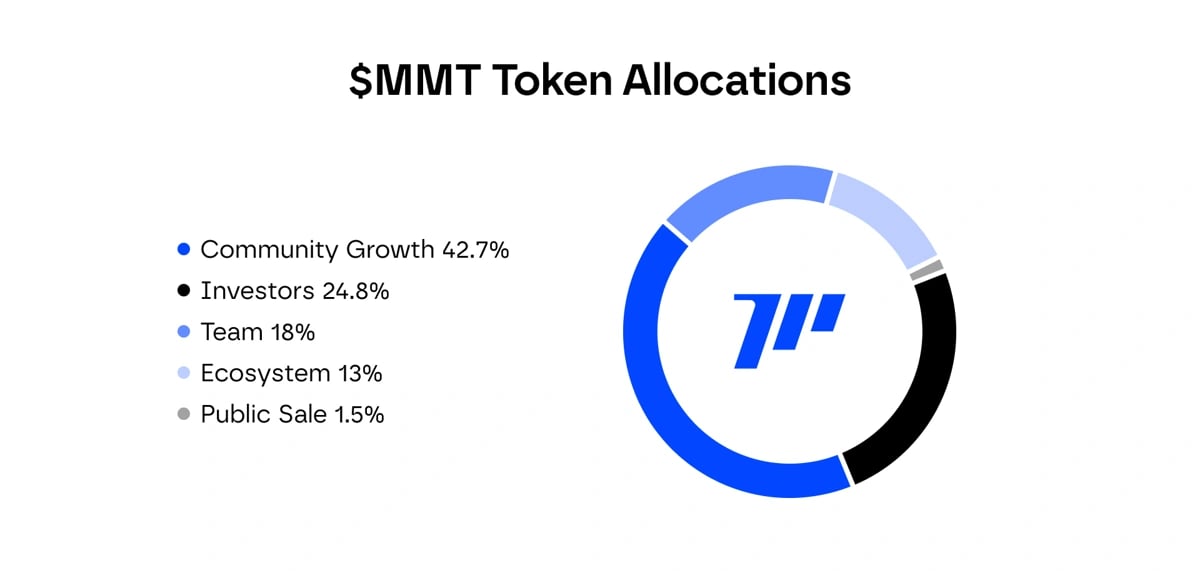
MMT has a total supply of 1B tokens and has the following allocation: [10]
- Community Growth: 42.72%
- Early Backers: 24.78%
- Team: 18%
- Ecosystem: 13%
- Public Sale: 1.5%