Agent Arena
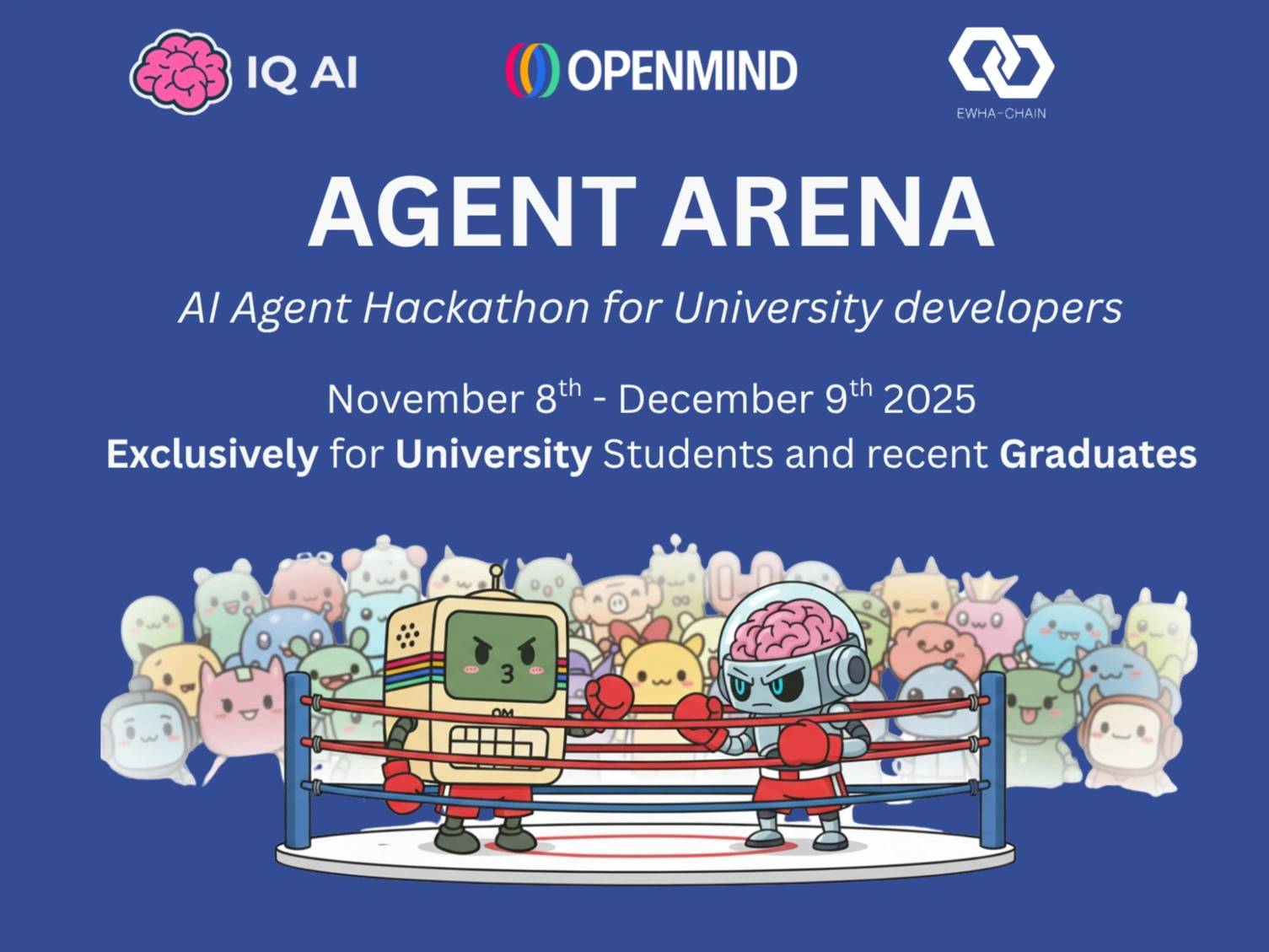
Agent Arena is a hybrid AI agent hackathon that took place from November to December 2025. The event was organized by IQ AI in collaboration with OpenMind and EwhaChain, the blockchain academic society of Ewha Womans University. [1] [2] It was aimed at university students and recent graduates, challenging them to build and deploy innovative on-chain AI agents using specific development toolkits. The hackathon featured a prize pool of over $7,000 and offered participants the opportunity for further investment from IQ AI's dedicated fund. [1] [2]
Overview
The primary objective of the Agent Arena hackathon was to foster development in the emerging field of on-chain artificial intelligence by engaging the academic community. Participants were tasked with creating functional AI agents using either IQ AI’s Agent Development Kit – TypeScript (ADK-TS) or the OM1 platform provided by OpenMind. A central requirement for prize eligibility was the mandatory deployment of all created agents onto IQ AI's Agent Tokenization Platform (ATP), a system designed for the creation and management of tokenized, autonomous AI agents on the blockchain. [1]
The event utilized a hybrid model. It was announced as IQ AI's first offline hackathon, which referred to an in-person kick-off event held in Seoul, South Korea. [3] This launch event specifically targeted students and graduates from university blockchain clubs across Korea. [2] Following the kick-off, the main hackathon was conducted as a global, virtual event, allowing eligible participants from around the world to compete remotely. The hackathon had attracted 144 registered hackers who submitted a total of 25 projects. [1]
Background and Timeline
The hackathon commenced with an in-person kick-off event on November 8, 2025, in Seoul. This launch served as a social gathering for participants to network with each other and meet the organizing teams and sponsors. The agenda for the evening included introductions from IQ AI, OpenMind, and EwhaChain, followed by dinner and a period for games and networking. [2]
The main hackathon period started around the time of the kick-off, with the official registration and development window opening on November 10, 2025. [1] Following the submission period, teams had a deadline of December 12, 2025, to launch their agents on IQ AI's Agent Tokenization Platform to remain eligible for judging and prizes.[1] [2]
Technical Requirements and Submission Guidelines
The hackathon had a defined technical scope, requiring participants to use designated platforms and provide a specific set of deliverables for their projects to be considered for prizes.
Development Tracks
Participants were required to build their AI agent projects using one of two specified technology stacks:
- IQ AI’s ADK-TS (Agent Development Kit – TypeScript)
- OpenMind’s OM1 platform and GitHub resources
Projects had to clearly demonstrate how one of these toolkits was utilized in their final submission. [1]
Mandatory Deployment
A critical rule for prize eligibility was the mandatory deployment of the developed AI agent on IQ AI’s Agent Tokenization Platform (ATP). All valid submissions were required to be successfully launched on the platform by the December 12, 2025 deadline. To facilitate this, IQ AI provided an airdrop of its native token to each eligible team to cover the necessary hosting and launch costs for one agent. [1]
Submission Deliverables
Each project submission was required to consist of several components to allow for comprehensive judging:
- A public code repository on GitHub, GitLab, or Bitbucket containing the full source code.
- A demonstration video, with a maximum length of five minutes, showcasing the agent's functionality and use case.
- A live demo link that judges could use to test and interact with the agent directly.
- A clear written explanation of how the team utilized either the ADK-TS or the OM1 platform in their project.
- Optional supplementary materials, such as links to further documentation, mockups, or presentations. [1]
Prizes and Incentives
The Agent Arena offered a combination of direct monetary prizes and additional opportunities for top-performing teams, with a total prize pool valued at over $7,000.
Prize Pool
The prize money was set to be distributed in stablecoins (USDC/USDT) and was structured into two categories:
- 1st Place: $3,000
- 2nd Place: $2,000
- 3rd Place: $1,000
- OpenMind MVP: $500
- IQ AI MVP: $500
This structure allowed for the recognition of the top three projects overall, as well as special acknowledgment for projects that best exemplified the potential of the hosts' respective platforms. [1] [2]
Additional Opportunities
Beyond the cash prizes, participants had access to other valuable incentives. Top-performing agents developed during the hackathon were to be considered for investment from IQ AI's $10 Million Investment Fund, providing a potential pathway for further development and scaling. Additionally, as a direct incentive for participation, IQ AI sponsored the launch fees on its ATP for one agent per team, removing a potential financial barrier to entry and ensuring all teams could meet the mandatory deployment requirement. [1] [2]
Winners and Projects
The winners of the Agent Arena hackathon were announced on December 22, 2025. Winning projects were selected based on their innovation, technical execution, and real-world impact. A key judging criterion was the successful implementation of IQ AI’s ADK-TS framework and the deployment of the project as a live agent on the Agent Tokenization Platform (ATP). [4]
Main Track Winners
First Place: Rogue
Rogue, the first-place winner, received a RGE, was launched on the ATP and is integrated into a tiered-access system for prioritizing trading signals. [4]
Second Place: Athenea
The second-place prize of $2,000 was awarded to Athenea, an AI-powered financial agent designed to help women in dangerous situations achieve financial independence. The application operates on the Fraxtal L2 network and is built to be used with zero prior crypto knowledge. Its features include a stealth mode disguised as a calculator, an "Evidence Locker" that stores user-uploaded files on IPFS with blockchain timestamps, and an emergency SOS protocol to transfer funds and wipe local data. All agent actions are pseudonymously logged to the ATP dashboard for transparent, on-chain verification. [4]
Third Place: CryptoInsight AI
CryptoInsight AI won the third-place prize of $1,000. It is a cryptocurrency analysis platform that combines AI with real-time blockchain data through a system of five distinct agents: Market, Portfolio, Transaction, Vision (for chart analysis), and Chat. The platform fetches live data from sources like CoinGecko and Binance to provide market sentiment, tokenomics, and technical analysis. Its architecture, built with ADK-TS, utilizes intelligent caching to reduce API costs by over 60% and supports multi-user session management. [4]
MVP Awards
IQ AI MVP: ResearchOS
The $500 IQ AI MVP award was given to ResearchOS, an autonomous research copilot that automates literature reviews. The project was highlighted for demonstrating the versatility of agent-based systems beyond the Web3 and DeFi sectors. It uses specialized agents for planning, searching academic papers from sources like arXiv and PubMed, and synthesizing information into reports. The system features a RAG-powered conversational interface using a vector database for semantic search. [4]
OpenMind MVP
The OpenMind MVP prize was not awarded, as there was a limited number of project submissions built on the OpenMind OM1 track. [4]
Organizers and Sponsors
The Agent Arena hackathon was a collaborative effort between several organizations in the blockchain and artificial intelligence sectors.
Hosts
- IQ AI: The primary organizer, IQ AI, is focusing on the integration of artificial intelligence with decentralized finance (DeFAI). Its main products featured in the hackathon were the Agent Tokenization Platform (ATP), which facilitates the creation, deployment, and management of on-chain AI agents, and the Agent Development Kit – TypeScript (ADK-TS). [1] [2]
- OpenMind: A co-host of the event, OpenMind is focused on building a "universal operating system for intelligent machines." The company's key technologies include the OM1 platform, designed to allow robots and other intelligent systems to perceive and interact with human environments, and FABRIC, a decentralized coordination layer for secure machine identity and collaboration. [1] [2]
- EwhaChain: A co-hosting partner, EwhaChain is the official blockchain academic society at Ewha Womans University in South Korea. The group is dedicated to collaborative study and project development to advance and contribute to the Korean blockchain ecosystem. [1] [2]
Sponsors
- Frax Finance: A sponsor of the hackathon, Frax Finance is a decentralized protocol known for its stablecoin technology. The protocol issues fully collateralized assets such as frxUSD, FPI, and frxETH, and operates several DeFi subprotocols including Fraxlend, Fraxswap, and Fraxtal. [2]
- KRWQ: Another sponsor, KRWQ is recognized as the first Korean Won (₩) stablecoin launched on the Base network. It was developed as a joint project between IQ AI and Frax Finance, built using LayerZero's Omnichain Fungible Token (OFT) standard to enable multichain liquidity. [1] [2]