Stable
Stable is a high-throughput Layer 1 blockchain, referred to as a "stablechain," designed to serve as a dedicated issuance and settlement layer for the USDT stablecoin. Described as a "stablecoin-centric chain" and an orchestration layer for the USDT ecosystem, the network aims to provide faster, cheaper, and more efficient stablecoin transactions by optimizing its entire architecture for this purpose. It features USDT as its native unit of account and gas token, with a stated goal of making USDT instant and programmable for global commerce and payments. [7] [4] [11]
Compare Cryptoassets
Select an asset to compare its price and other stats against Stable.
 ?
?Ecosystem map
Explore the wikis Stable is connected to and their relationships on the map.
History
Stable was introduced on July 21, 2025, with the mission to create a purpose-built blockchain to address the inefficiencies of existing infrastructure for stablecoin transactions, such as unpredictable fees, slow settlement times, and complex user experiences. The project positioned itself as the first "stablechain" optimized for payments using USDT. [7]
On July 31, 2025, the project announced it had raised a $28 million seed round. The announcement highlighted that the funding and development coincided with the passage of the GENIUS Act in the U.S., which provided increased regulatory clarity for stablecoins and was seen as a catalyst for institutional adoption. Paolo Ardoino, CEO of Tether, commented on the timing, stating, "Now, major financial institutions and banks will be able to fully unleash the power behind assets like USDT, something the Stable team fundamentally understands and is exceptionally poised to capitalize on. They are very advanced in terms of their infrastructure and roadmap, making them well positioned to bring USDT into the mainstream." [8]
On November 4, 2025, the Stable Public Testnet went live, opening the EVM-compatible execution layer to developers. The launch was supported by infrastructure partners, including USDT0 and LayerZero, to enable USDT as the native gas token and provide interoperability. [12]
Later in November, Stable announced partnerships with global payments application Oobit and payment orchestration platform Orbital to integrate StableChain for fast, low-fee USDT settlement. [13] The project also ran a multi-phase pre-deposit campaign that concluded on November 15, 2025, attracting over $1.1 billion in deposits from more than 10,000 wallets. The campaign's first phase drew criticism over allegations of insider front-running, which prompted the team to implement per-wallet deposit limits for the second phase to encourage broader participation. [14]
On December 2, 2025, Stable unveiled the tokenomics for its native governance token, STABLE, and announced that its mainnet would launch on December 8, 2025. [14] [15]
Overview
Stable is a high-throughput Layer 1 stablechain developed to support USDT as its primary asset, addressing the growing demand for faster, cheaper, and more efficient stablecoin transactions. It is designed to act as the dedicated issuance and settlement layer for USDT, offering gas-free transfers, sub-second finality, and optimized infrastructure for moving stablecoins at scale. The platform aims to unlock the potential of stablecoins by creating a developer-friendly environment with full EVM compatibility, specialized SDKs, and robust APIs. As of late November 2025, the project's public testnet had processed transactions for over 497,000 accounts and achieved an average block time of 0.73 seconds. [7] [13]
For everyday use, Stable provides a simplified wallet called StablePay that enables quick sending and receiving of funds, integration with debit and credit cards, and low-cost transactions that finalize in under a second. For enterprises, the platform includes advanced features such as guaranteed blockspace allocation, transfer aggregation for large transaction volumes, and enhanced security measures. It also supports confidential transfers that preserve privacy while meeting regulatory compliance requirements. [5] [11]
Features
Stable is a delegated Proof-of-Stake blockchain designed specifically to support large-scale USDT activity, combining sub-second block times with single-slot finality for efficient and reliable settlement. The network is fully EVM compatible, allowing developers to deploy Ethereum smart contracts and use familiar tooling while benefiting from Stable’s optimized infrastructure. A central feature is the integration of USDT as the native unit of account. Users can perform gas-free USDT transfers through account abstraction and the EIP-7702 standard. In contrast, non-USDT transfers use gas fees in USDT that are automatically converted into gasUSDT by a bundler and paymaster system. This approach simplifies the user experience, requiring only USDT0 holdings for seamless participation.
Additional functionality includes a cross-chain bridge, built with support from LayerZero, for transferring USDT0 between Ethereum, Arbitrum, HyperEVM, Tron, and other supported ecosystems, as well as a dedicated Stable Wallet that offers a Web2.5-style interface to simplify sending, receiving, and managing assets. Looking ahead, Stable plans to introduce a USDT Transfer Aggregator to combine multiple transfers into a single bundle, improving throughput, and Guaranteed Blockspace to give enterprises predictable access to resources for high-volume USDT usage. Together, these features position Stable as a purpose-built blockchain environment for stablecoin transactions across retail and institutional contexts. [1] [12]
Technology
StableBFT
The network's consensus is managed by StableBFT, a customized delegated Proof-of-Stake (dPoS) protocol based on CometBFT (a fork of Tendermint Core). It is engineered for low latency and high throughput, achieving sub-second block times and single-slot finality. The protocol's design includes optimizations such as separating the process of data dissemination from the consensus mechanism itself and enabling direct transaction broadcasting to block proposers, which helps reduce bottlenecks and improve overall network speed.
A significant future upgrade planned for the consensus layer is the transition to a Directed Acyclic Graph (DAG)-based model named "Autobahn." This model is intended to eliminate the single-leader bottleneck found in many traditional blockchain architectures by allowing for the parallel processing of transaction proposals. By separating data propagation from the final ordering of transactions, the Autobahn model aims to achieve faster finality and provide enhanced Byzantine Fault Tolerance (BFT), making the network more resilient to certain types of attacks. [2]
Stable EVM
Stable features the Stable EVM, an execution environment that is fully compatible with the Ethereum Virtual Machine. This compatibility allows developers to migrate and deploy existing Ethereum-based smart contracts and decentralized applications (dApps) onto the Stable network without significant modifications. It also ensures that developers can use familiar tools, programming languages (like Solidity), and wallets from the Ethereum ecosystem. The Stable EVM includes a set of precompiles that enable smart contracts to interact securely and atomically with the chain's core logic through the StableSDK.
To further enhance performance, the project plans to upgrade the execution layer to "StableVM++." This future iteration will integrate an alternative, high-performance EVM implementation, such as EVMONE, and incorporate an optimistic parallel execution engine based on the Block-STM model. Parallel execution enables the network to process multiple transactions simultaneously, provided they do not conflict with each other, which can significantly increase the chain's transactional throughput and efficiency. [2]
StableDB
To address storage-related performance issues that can affect blockchain scalability, Stable incorporates a custom data management system called StableDB. This system is designed to accelerate block processing by decoupling the state commitment process from physical disk storage operations. This separation allows blocks to be processed without having to wait for slow disk I/O writes to complete.
StableDB utilizes a combination of MemDB and VersionDB, which is powered by mmap, a system call that maps files or devices into memory. This approach allows recent and frequently accessed data to be managed directly in memory for faster access, while older, less-used data is stored more efficiently on disk. This tiered data management strategy helps mitigate storage bottlenecks and contributes to the network's overall performance and high throughput capabilities. [2]
USDT Integration
The Stable blockchain is fundamentally structured around USDT, which serves as the network's primary asset and native unit of account. This integration is designed to create a seamless economic environment centered on stablecoin utility.
USDT as Native Gas
On the Stable network, USDT is the exclusive token for paying transaction fees. For any on-chain operation that requires gas, such as smart contract interactions or transfers of non-USDT0 assets, fees are denominated and paid in USDT0. To facilitate this, the network employs a bundler and paymaster system that automatically converts the required fee amount into a dedicated internal gas token, gasUSDT. This design abstracts away the complexity of gas management for the user, who only needs to hold USDT0 to interact with the network. [6]
Gas-Free Transfers
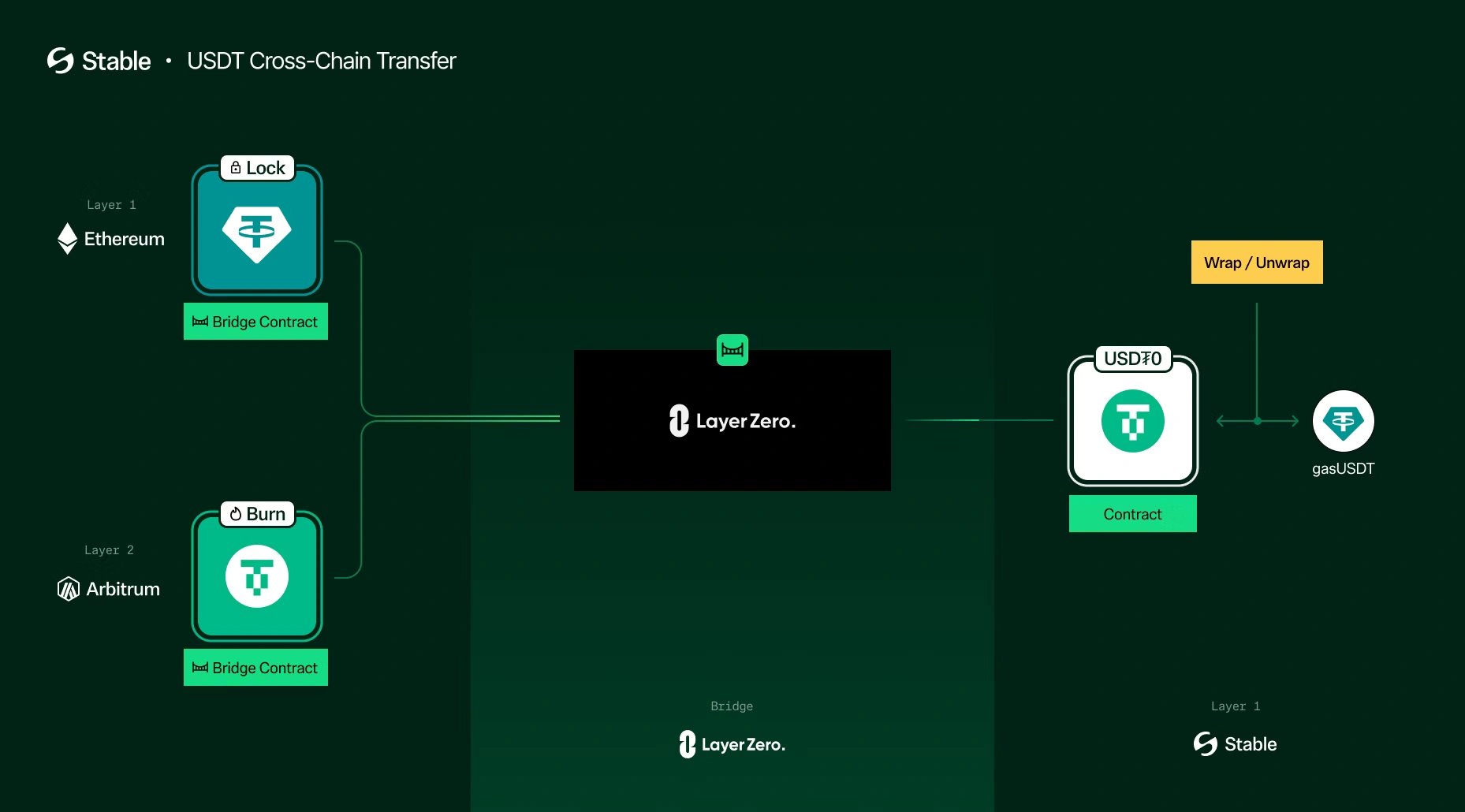
A key feature of the Stable network is the implementation of gas-free transfers for its native USDT0 token. Standard peer-to-peer transfers of USDT0 do not require the sender to pay a gas fee at the protocol level. This is enabled through the implementation of account abstraction, specifically leveraging standards like EIP-7702. Account abstraction allows for more flexible transaction validation rules, enabling the protocol to sponsor the gas costs for specific types of transactions, thereby improving the user experience for simple payments and remittances. [6]
This gas-free model is designed to eliminate the "two-token friction point," a significant barrier to mainstream adoption where users must hold both a stablecoin and a separate, volatile native token for gas fees. For retail users, this dual-token requirement adds cognitive overhead and complexity. For enterprises, it complicates auditing, reconciliation, and compliance reporting, as traditional frameworks are built for single-currency flows. By using USDT as the native gas token and making peer-to-peer transfers free, Stable aims to create a user experience that mirrors traditional finance, positioning digital assets as a viable alternative to conventional payment rails. [9]
Enterprise-Focused Features
To support institutional and high-volume use cases, Stable is developing a suite of enterprise-grade features:
- Guaranteed Blockspace: This feature will allow businesses and other high-volume users to reserve a fixed portion of the network's block capacity. By purchasing this reserved space, enterprises can ensure predictable transaction costs and consistent latency, even during periods of high network-wide demand.
- USDT Transfer Aggregator: An upcoming mechanism designed to increase network throughput by bundling multiple USDT0 transfers into a single, consolidated on-chain transaction. This is particularly useful for exchanges, payment processors, and other entities that need to process a large number of payouts efficiently.
- Confidential Transfers: This feature will utilize zero-knowledge cryptography to provide privacy for transactions. It is designed to conceal the amount of a transaction while keeping the sender and recipient addresses visible on-chain. This hybrid approach aims to offer commercial privacy while maintaining a degree of transparency necessary for regulatory compliance and auditing. [1]
USDT0
The central asset of the Stable ecosystem is USDT0, an omnichain version of USDT designed to unify liquidity and streamline cross-chain transfers. USDT0 is built on LayerZero’s Omnichain Fungible Token (OFT) standard and maintains a strict 1:1 peg with traditional USDT. Its primary function is to eliminate the complexities and risks associated with traditional cross-chain bridges, such as fragmented liquidity, wrapped assets, and potential security vulnerabilities.
Instead of creating separate, wrapped versions of USDT on different blockchains, the OFT standard allows USDT0 to exist as a single, interoperable asset across multiple networks. When a user wishes to move USDT0 from one supported chain to another (e.g., from Stable to Ethereum), the tokens are burned or locked on the source chain, and an equivalent amount is minted on the destination chain. This burn-and-mint mechanism is facilitated by LayerZero's secure cross-chain messaging protocol, ensuring that the total supply of USDT0 remains consistent and the peg to USDT is maintained. This process results in faster transfers, minimal slippage, and lower fees compared to conventional bridging methods. The Stable network features a native cross-chain bridge, enabling seamless transfers between ecosystems such as Ethereum, Arbitrum, HyperEVM, and Tron. [3] [12]
STABLE Token and Tokenomics
While USDT is used for all transactions and gas fees, the Stable network is secured and governed by a separate native utility token, STABLE. Announced on December 2, 2025, the STABLE token is designed as the coordination instrument for the ecosystem, created to align network participants without exposing end-users to a volatile asset for payments. [15] [14]
Token Utility
The STABLE token has three primary functions:
- Staking: The token is used for staking in the network's Delegated Proof-of-Stake (DPoS) consensus mechanism, StableBFT. Validators must stake STABLE to participate in block production, and token holders can delegate their STABLE to validators to help secure the network.
- Governance: STABLE holders can participate in on-chain governance to vote on protocol upgrades, network parameter changes, and the allocation of ecosystem funds.
- Incentives: Stakers and delegators earn a share of the network's transaction fees, which are collected in USDT and distributed as real-yield rewards. The demand for STABLE is driven by the desire to earn these rewards and participate in the network's security and governance. [15]
Token Distribution
The STABLE token has a fixed total supply of 100 billion, with no planned inflationary emissions. The allocation is as follows:
- Ecosystem and Community: 40% (40,000,000,000 STABLE)
- Team: 25% (25,000,000,000 STABLE)
- Investors & Advisors: 25% (25,000,000,000 STABLE)
- Genesis Distribution: 10% (10,000,000,000 STABLE)
The Team and Investor & Advisor allocations are subject to a one-year cliff followed by a 48-month linear vesting schedule to ensure long-term alignment. [14] [15]
Roadmap and Milestones
Stable has outlined a multi-phase roadmap and has achieved several key milestones in its development.
Development Phases
- Phase 1: Foundational Layer for USDT: This initial phase focuses on establishing the core infrastructure, including using USDT as the native gas token, implementing the StableBFT consensus mechanism for sub-second block time and finality, and launching the Stable Wallet to improve user experience.
- Phase 2: Experience Layer for USDT: The second phase aims to enhance network performance and enterprise functionality by adopting optimistic parallel execution to increase transaction throughput. It will also introduce USDT transfer aggregators and dedicated blockspace for enterprises to ensure efficient processing and consistent performance.
- Phase 3: Full Stack Optimized Layer for USDT: The final phase involves upgrading to a DAG-based consensus model for improved speed and resilience. This phase will also focus on expanding developer tools and resources to facilitate the development of decentralized applications on the network. [7]
Key Milestones
- July 31, 2025: Announced a 28m-seed-round-announced-link)
- November 4, 2025: The Stable Public Testnet was launched, opening to developers. [12]
- November 15, 2025: Concluded a pre-deposit campaign that attracted over $1.1 billion. [14]
- December 2, 2025: Revealed the tokenomics for the STABLE token. [14]
- December 8, 2025: Mainnet launch scheduled. [14]
Leadership
Stable is led by a team with experience in financial infrastructure, blockchain protocols, venture capital, and regulatory navigation. [10]
- Brian Mehler (Chief Executive Officer): As of November 2025, Mehler serves as CEO of Stable, leading the company's overall strategy and execution. He previously held the role of CFO, where he oversaw financial operations and strategic planning. His prior experience includes serving as CFO and Managing Director at Gateway Capital, managing over 1 billion blockchain-focused fund. [10] [13]
- Sam Kazemian (Chief Technology Officer): Kazemian serves as CTO of Stable while continuing his role as the founder of Frax Finance. At Frax, he developed a stablecoin that combines collateral backing with algorithmic stabilization, reaching a market value of over $1.4 billion. He also co-founded IQ.wiki. [10]
- Thibault Reichelt (Chief Operating Officer): Reichelt manages operations and strategy at Stable. He began his career at Kirkland & Ellis and later worked at the Abu Dhabi Investment Council before moving into venture investing. His investment portfolio has included companies such as Compound, dYdX, StarkWare, Circle, Wintermute, and Kraken. [10]
Funding
On July 31, 2025, Stable announced it had closed a $28 million seed funding round to develop its blockchain focused on overhauling traditional payments infrastructure with USDT. The round was led by Bitfinex and Hack VC and included a mix of institutional firms and prominent angel investors. [8] [16]
Institutional Investors
- Bitfinex (Lead)
- Hack VC (Lead)
- Franklin Templeton
- Castle Island Ventures
- KuCoin Ventures
- eGirl Capital
- Mirana
- Susquehanna International Group (SIG)
- Nascent
- Blue Pool Capital
Angel Investors and Advisors
- Paolo Ardoino (CEO of Tether)
- Bryan Johnson (Founder, Braintree)
- Divesh Makan (Founder, Iconiq Capital)
Additionally, Paolo Ardoino, in his capacities as CEO of Tether and CTO of Bitfinex, has been a close advisor to the project since its beginning. [8]